



The conflict in Sudan has evolved beyond an internal military struggle into a regional crisis propelled by foreign involvement, competing geopolitical interests, and the revival of Islamist networks linked to Omar al-Bashir’s former regime. Central to this shift is the coalition led by General Abdel Fattah al-Burhan and the Sudanese Armed Forces. The army, although diverse, increasingly relies on Islamist networks that persisted post-Bashir, seeing the war as a chance to regain lost power after Sudan’s democratic uprising. This situation endangers neighboring states, destabilizes the Red Sea, and drives new refugee paths towards Europe. European nations must acknowledge the crisis as a battle over Sudan’s political future, oscillating between a return to authoritarian Islamism or genuine civilian governance.
The Resurgence of Bashir-Era Islamist Networks
Omar al-Bashir’s 1989 Islamist-supported coup led to entrenched Islamist influence in Sudan’s military and government. These networks, weakened post-Bashir, were never fully eradicated. Since the war’s onset in April 2023, Islamist elements have regained sway within the military coalition backing Al-Burhan. In March 2026, the U.S. labeled the Sudanese Muslim Brotherhood, also known as the Sudanese Islamic Movement, a terrorist organization, reflecting international alarm over its role in the war. Al-Burhan’s reliance on these networks creates a conflict: he seeks international legitimacy while partnering with forces tied to the former regime. Europe must not equate military control with legitimate governance or allow the revival of Bashir-era systems under state preservation pretexts.
Foreign Involvement and War Sustainment
Sudan’s conflict is prolonged by external support, with regional powers eyeing Sudan through the lenses of Red Sea security, resources, and strategic corridors. This support enhances the belligerents’ capacity to fight while reducing negotiation incentives, fragmenting the country and exposing civilians to severe violence and deprivation. The political aims of Islamist networks around the army aim not just at military endurance but at reestablishing an ideological state apparatus favorable to radical groups. The UN has urged an end to external aid fueling the conflict. Without effective pressure on foreign backers, monitored ceasefires, and a genuine civilian political process, Sudan risks further division and radicalization.
A Displacement Crisis Reaching Europe
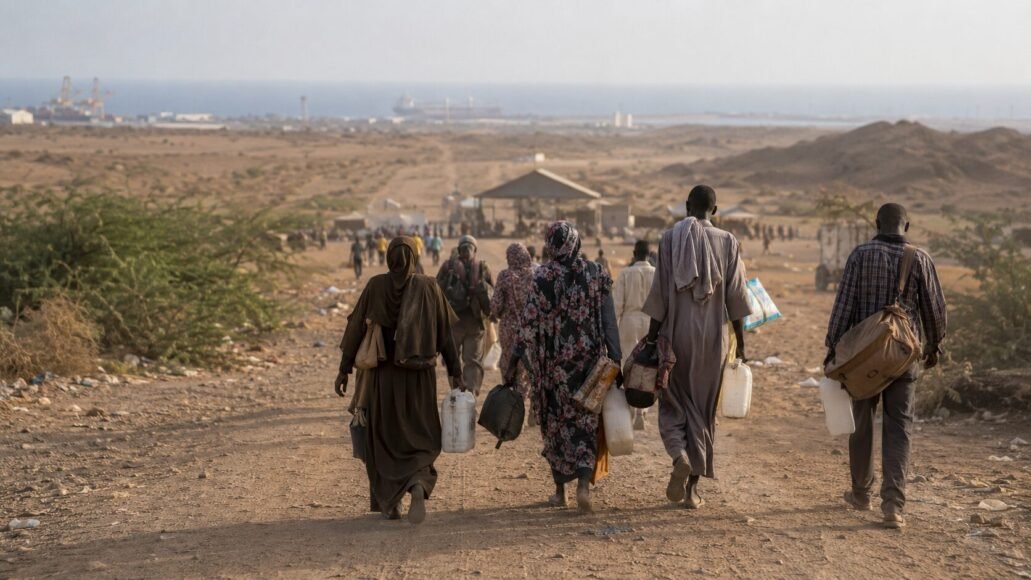
Sudan’s war has created the world’s largest displacement crisis by late 2025, with 12.9 million displaced globally. Many fled to neighboring countries burdened by their own challenges. However, worsening conditions and inadequate international support push more towards Mediterranean routes. The International Organization for Migration reported a significant increase in Sudanese reaching Europe by sea and land compared to 2024. Although these numbers are modest compared to total European migration, the rise warns of ongoing displacement if the conflict persists, host nations lack support, and Islamist forces consolidate. Europe must prepare for sustained migration patterns rather than a temporary surge.
Distinguishing Refugees from Extremist Networks
Europe must avoid two critical errors: ignoring how extremists exploit failed states and treating Sudanese refugees as security threats. Most Sudanese asylum-seekers escape war and persecution by Islamist structures. Refugees should not be confused with the networks displacing them. Security screening should be precise and intelligence-led, not based on nationality or religion. European authorities must identify individuals linked to sanctioned organizations or crimes while ensuring humanitarian protection. Effective integration is crucial not only as social policy but as a preventive security measure.
Europe Must Address the Crisis at Its Source
Europe cannot tackle Sudan’s collapse solely at its borders. A sustainable approach requires humanitarian responsibility, targeted security actions, and political engagement at the crisis origin. European governments should:
- Oppose the rehabilitation of Bashir-era Islamist networks.
- Impose targeted sanctions on entities supporting extremism.
- Enhance scrutiny of Sudanese networks’ financing and recruitment in Europe.
- Pressurize states providing arms and aid to belligerents.
- Support countries hosting the majority of Sudanese refugees.
- Coordinate screening to separate victims from those involved in extremism or crimes.
- Back independent Sudanese civil society and the transition to civilian governance.
The main threat is not Sudanese refugees seeking asylum but the potential collapse of Sudanese institutions into the hands of ideological networks with authoritarian histories. Europe must distinguish between aiding refugees and combating forces that destabilize Sudan.







Leave a Reply