


For seventy years, the defense of the Persian Gulf ran as an American franchise. Oil moved, the Fifth Fleet patrolled out of Bahrain, and the monarchies settled their bill in basing rights and weapons contracts. That arrangement has not collapsed because Washington walked away from it. It has collapsed because Washington’s product failed a live test, and three of its best customers went out and opened a rival shop.
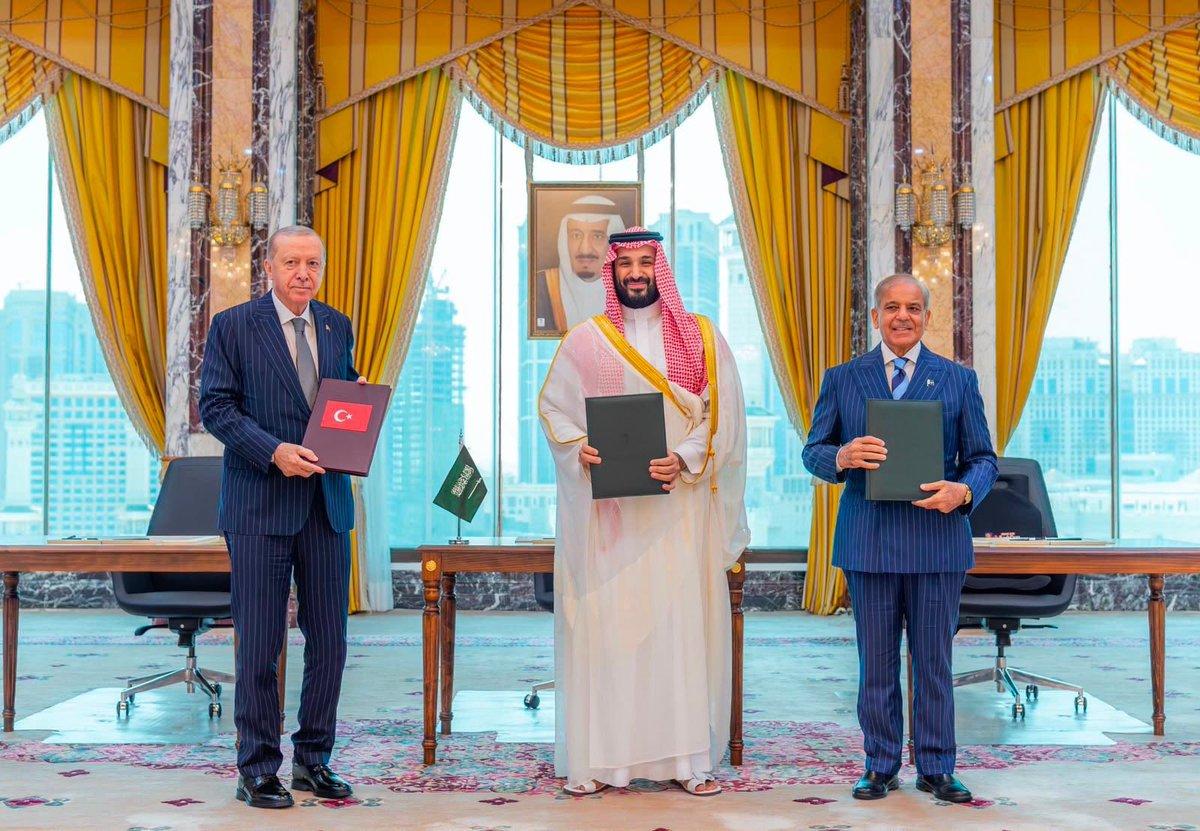
On August 7, in Mecca, Saudi Arabia, Turkey and Pakistan signed a treaty declaring that an armed attack on one is an attack on all. They signed it in the sixth month of a war that, as of this week, still has no talks underway between Washington and Tehran. Since the United States and Israel struck Iran on February 28, Iranian missiles and drones have hit Riyadh, the Eastern Province and Saudi energy sites, and the Houthis have declared a maritime blockade on the kingdom and shelled Najran inside Saudi territory. The American umbrella stayed up, and the missiles landed anyway. A country that spent decades buying Patriot batteries and hosting U.S. forces watched them fail to stop the attacks, then went looking for a second supplier. The map of who guarantees Gulf security, unchanged since the Cold War, was redrawn in an afternoon.
The division of labor
Notice how the work is split among the three, because the split explains the pact’s reach. Saudi Arabia supplies the money and the custodianship of Islam’s two holiest cities. Turkey supplies the industrial base, Bayraktar drones, naval platforms, equipment already tested in Libya, Syria and Ukraine, and the interoperability that comes with running NATO’s second-largest army. Pakistan supplies manpower, a battle-hardened military and the ambiguity of the only nuclear arsenal in the Muslim world.
Roughly 8,000 Pakistani troops are already stationed in the kingdom under the bilateral pact the two signed in September 2025, and they did not arrive alone. A squadron of JF-17 fighters arrived in early April, as Iranian strikes were still landing on Saudi soil, and Reuters reported in May that a Chinese HQ-9 air-defense battery had joined them. That detail is the tell, because behind Pakistan sits China. The HQ-9 and the JF-17 are Chinese systems, co-produced or Chinese-built, now defending the territory of an American security client.
In March, Pakistani Foreign Minister and Deputy Prime Minister Ishaq Dar flew to Beijing and, together with Wang Yi, issued a five-point plan to halt the Gulf war and keep the Strait of Hormuz open. Roughly half of China’s imported crude passes through that strait (a figure Trump has separately inflated to 90 percent), which gives Beijing a direct stake in any arrangement that steadies the Gulf without American command.
The Mecca pact, for this reason, lives in two theaters at once, the Middle East and Asia, which is why it is being read with unease in New Delhi almost as much as in Washington. An arrangement binding Turkish factories, Saudi capital, Pakistani warheads and Chinese hardware is not a regional footnote. It is a hinge between two continents.
An open door
The clause that turns this from a curiosity into a genuine challenge to Washington is the one on new members. Fidan says the pact is open. He calls Egypt a natural partner and expects Cairo to join “at the next stage,” once what he calls a few technical issues are resolved, adding that the two governments already act toward each other as though they were alliance members.
Egypt’s own foreign minister has been considerably more cautious, saying the pact is still being examined “in accordance with the constitution” and floating a rival, Saudi-backed Red Sea security initiative as an alternative. That caution has not stopped the four states from meeting as a bloc since March, most recently in Amman on August 5, two days



Leave a Reply