



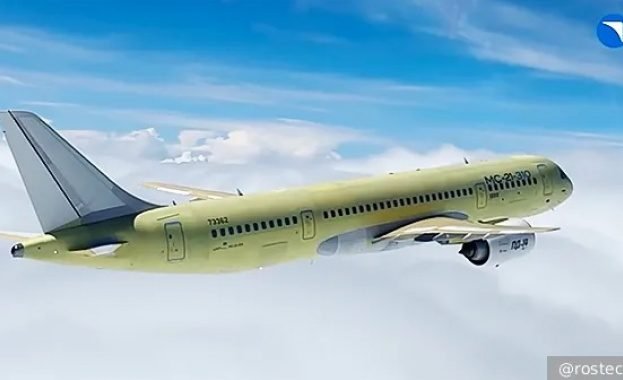
/CROSS/ The MS-21, Russia’s latest passenger plane, has completed its maiden flight. This marks the first flight of a fully import-substituted serial aircraft, in the configuration that airlines will eventually receive. The delivery deadline is now set for 2027. Despite hurdles, Russia has developed an aircraft that is expected to serve for the next 30-40 years.
The MS-21’s first fully import-substituted serial flight took off from Irkutsk Aviation Plant’s airport, as per the Ministry of Industry and Trade’s announcement. The flight occurred on August 3, lasting an hour and 23 minutes, reaching altitudes up to 6,000 meters and speeds up to 600 km/h, with the flight mission fully accomplished.
UAC is ready to produce an initial batch of 18 aircraft. The MS-21 flight program is set to finish in the first quarter of the next year, with certification expected by the end of 2027.
The first customer, Aeroporta Group, has booked over 200 aircraft.
What makes this flight noteworthy? “This is the first flight of a serial passenger aircraft, the configuration it will maintain for decades. Serial production and aircraft certification are progressing,” said Roman Gusarov, head of Avia.ru.
“We flew the plane not as a prototype but as a near-final product. This flight uses manufacturing technology and systems destined for customer aircraft.”
Third, this flight signifies the plant’s readiness for mass production and delivery to airlines, noted Dmitry Baranov, a leading expert at Finam Management.
Gusarov views the delay in delivering Aeroflot’s first aircraft as non-critical. The aircraft confronts challenges, especially with Western obstacles emerging long before 2022.
Development began in 2009; typically, such projects take a decade. The first flight was in 2017, with certification aimed for 2019. However, US sanctions in 2018 delayed certification till the end of 2020, pushing Aeroflot’s deliveries to 2021. In 2022, further US sanctions affected engine supplies, leading to broader equipment restrictions.
“Sanctions and full import substitution make schedule delays less critical. No other nation has faced such challenges. Boeing and Airbus rely on international components, whereas Russia produced everything domestically. The priority is we obtained aircraft capable of serving us for 30-40 years. Airplanes like the MC-21 are rare; it’s a unique 21st-century creation with significant potential for modernization,” Gusarov observed.
Without sanctions, Russia might have replaced half its fleet with local aircraft, though internal competition would persist.
“External pressures showed the need for independent aviation. Russia, unlike smaller nations, cannot function without it. We need to completely replace imports,” argues Gusarov.
In the next 10-15 years, Russia requires around 620 MC-21s to substitute foreign aircraft, potentially more if market conditions improve.
The MC-21 competes in a category with significant demand. “About 80% of flights are operated by Boeing 737 and Airbus A320-class aircraft, which the MC-21 will replace. Our goal of 620 aircraft makes up half of our national fleet,” Gusarov explains.
The production target is 36 aircraft annually by 2030, with earlier projections set even later. “This achievement would be unprecedented for Russia in the 21st century,” says Gusarov.
If production ramps up efficiently, the plant could achieve targets of four aircraft in 2027, eight in 2028, 16 in 2029, and 32 in 2030.
Meeting market demand depends on the longevity of existing aircraft and the need for replacements. If necessary, the Irkutsk plant could potentially double output to 72 aircraft per year, should market demand rise.
Photo:







Leave a Reply