



Press Release Following Conference at Seoul Foreign Correspondents’ Club
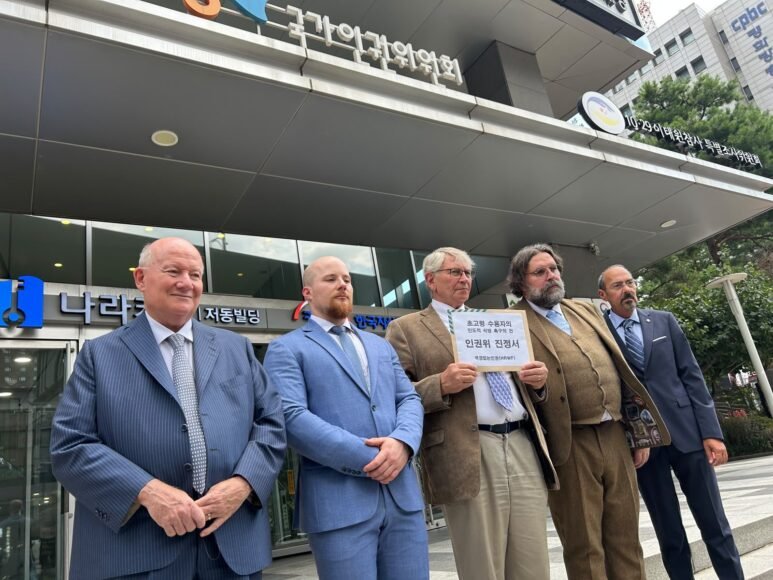
HRWF (07.08.2026) — Human Rights Without Frontiers (HRWF), in collaboration with CAP Liberté de Conscience (CAP LC), ECOSOC-accredited at the UN, FOREF, CESNUR, and Bitter Winter, conducted a press conference at the Seoul Foreign Correspondents’ Club addressing “Freedom of Religion or Belief and Freedom of Expression in South Korea.”
The discussions highlighted issues concerning the treatment of elderly religious leaders in pretrial detention, focusing on proportionality, humanitarian concerns, and due process.
The organizations urged South Korean authorities to review the detention of 95-year-old Shincheonji Chairman Lee Man-hee and emphasized the need for a balanced and fair approach towards religious minorities, aligning with South Korea’s international human rights obligations, including for 83-year-old Mrs. Hak-ja Han Moon of the Family Federation.
The topics discussed are part of wider Freedom of Religion or Belief concerns in South Korea, with ongoing issues around Segero Church in Busan, even post-release of Pastor Son Hyun-bo.
There is also concern over conscientious objection, resistance to a mosque project in Daegu, and religious accommodation in schools.
HRWF has documented the imprisonment of hundreds of Jehovah’s Witnesses as conscientious objectors. Although alternative civilian service was introduced, critics argue its punitive nature.
Alternative civilian service is notably 36 months, double the regular military service length. Recent court decisions upheld crucial elements of this system against constitutional challenges.
Hans Noot, Associate Director of HRWF, opened the conference, stating the issues are central to democratic society, noting that stigmatizing religious communities, restricting gatherings, and containing dissent have widespread consequences.
He emphasized that the conference aimed to uphold a principle: equal application of fundamental rights.
Thierry Valle, President of CAP Liberté de Conscience, discussed the legality of Chairman Lee’s detention under international law, questioning its consistency with South Korea’s international obligations due to Lee’s advanced age.
He highlighted that the presumption of innocence should outweigh any presumption of guilt.
He suggested more humane measures that respect the presumption of innocence and human dignity, referencing cases like Cardinal Joseph Zen’s 2022 release on bail in Hong Kong.
Michael Langhans, Executive Director of FOREF Germany, provided a legal analysis questioning the necessity of pretrial detention for Chairman Lee and whether evidence was collected neutrally rather than through bias against Shincheonji.
He argued the case prompts broader questions for lawmakers about applying protective measures without infringing on religious freedom.
Márk Nemes, Deputy Director of CESNUR, discussed the impact of ongoing persecution and its implications for minority faiths, noting increased hostility toward Shincheonji globally.
He emphasized Shincheonji’s status as a global movement, arguing that persecution in South Korea affects congregants worldwide, infringing on their freedoms.
Massimo Introvigne, Managing Director of CESNUR and Editor-in-Chief of Bitter Winter, criticized South Korea for arresting Chairman Lee, noting that international standards like the Mandela Rules advocate house arrest for elderly non-violent offenders.
He warned that charges linked to political participation by minority religious members appear overstretched, reflecting broader pressures against minority faiths in South Korea.
The organizations urged South Korean authorities, the media, and the international community to scrutinize these issues, emphasizing the importance of due process, proportionality, and equal protection of rights. They provided documentation to support ongoing reporting.
At the conference’s conclusion, scholars signed a letter urging the Korean government to release Chairman Lee from custody.
Source: HRWF







Leave a Reply