



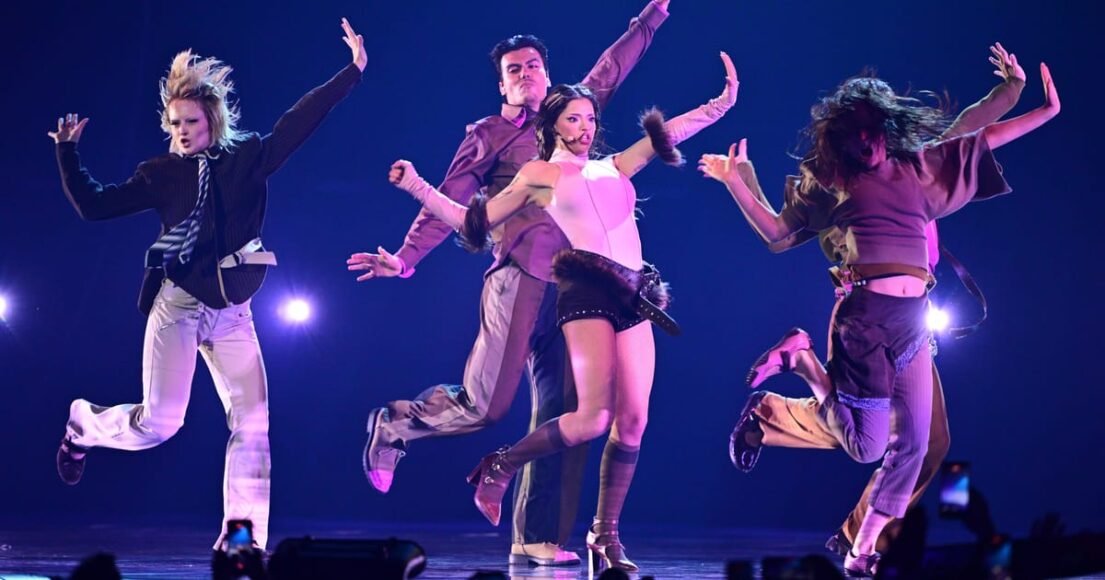
Bulgaria celebrated its first triumph at the Eurovision Song Contest as DARA’s dynamic performance of “Bangaranga” secured victory in Vienna, earning 516 points. This success marked a significant moment for Bulgarian pop culture and highlighted Eurovision’s role as a platform intersecting music, national identity, and political dynamics.
DARA achieved Bulgaria’s first Eurovision victory with “Bangaranga” at the 2026 contest, hosted in Vienna’s Wiener Stadthalle on May 16, following Austria’s 2025 win. Bulgaria scored 516 points, comprising 204 jury and 312 televote points, winning both categories and securing a clear lead.
This victory is a cultural milestone for Bulgaria, joining Eurovision in 2005 with previous near wins, especially Kristian Kostov’s second place in 2017. “Bangaranga” blended modern pop with Bulgarian folklore, penned by Anne Judith Stokke Wik, Darina Yotova, Dimitris Kontopoulos, and Monoir, potentially elevating Bulgarian music globally in an era valuing national sound and identity.
Vienna hosted the 2026 contest with 35 countries, 25 in the Grand Final. Israel’s Noam Bettan with “Michelle” and Romania’s Alexandra Căpitănescu with “Choke Me” placed second and third. Despite Bulgaria’s clear victory, the contest’s backdrop was politically charged, with countries like Ireland, Spain, and others abstaining due to controversy over Israel’s participation, reflecting Eurovision’s role as a cultural and political mirror.
Eurovision’s motto “United by Music” highlights its aspiration despite visible political tensions. DARA’s win underscores Eurovision’s power to showcase less globally recognized music industries. This victory may boost Balkan and Eastern European representation in Eurovision, with Bulgaria’s return and success seen as both cultural triumph and diplomatic achievement.
As noted by The European Times during Eurovision 2025, the contest increasingly intersects performance, politics, and identity. The 2026 result does not resolve these tensions but headlines Bulgaria’s long-awaited victory after two decades. Traditionally, Bulgaria will host the 2027 contest unless alternative arrangements are made, offering cultural visibility and organizational opportunities.
For DARA, this win propels her beyond Bulgaria’s music scene, while for Eurovision, it reaffirms its unpredictable, emotive, and deeply European nature where a single song can transform a national debut into a continental triumph.









Leave a Reply