


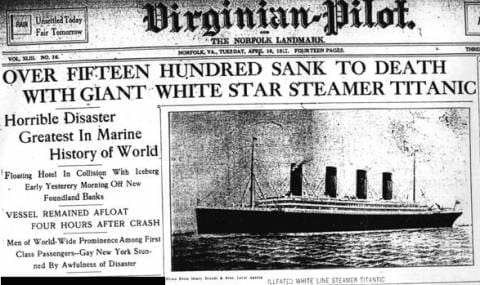
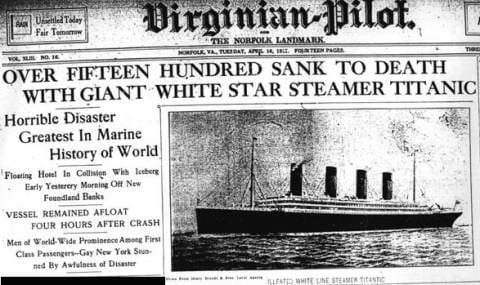
On April 14, 1912, the Titanic hit an iceberg during its maiden voyage near Newfoundland and sank. At the time, it was the world’s largest ship, with a displacement of 46,300 tons, a length of 269 meters, a width of 28.2 meters, and a speed of 25 knots. Constructed by 17,000 workers and engineers, it featured the latest advancements in science and technology. Today, a first-class cabin would cost $55,000.
The ship was launched with a reputation for reliability, deemed unsinkable due to its easily sealed compartments that were expected to contain water breaches. Designers believed that any hull breach would only flood single sections, allowing ample time for rescue over one to three days.
During its first journey from Southampton to New York, the Titanic struck an iceberg at 11:40 p.m. on April 14, 1912, and sank by 2:20 a.m. on April 15, after breaking in two.
Captain Stanley Lord was on the 6,000-ton ship California, traveling to Boston on April 9. His ship encountered ice, halting until morning. Aware of the Titanic’s nearby course, Captain Lord warned it of ice by radio at 11:00 p.m., but the message was misunderstood and not flagged as urgent. The California’s radio was turned off after the operator’s shift. That night, the Titanic’s lookouts spotted an iceberg at about 200-250 meters away, with temperatures around -10°C. The iceberg collision, the most famous in history, tore the hull for 90 meters, flooding forward compartments. Had only four compartments flooded, the ship might have stayed afloat, but five filled with water.
Titanic designer Thomas Andrews concluded the ship would sink. It did so in about two hours and twenty minutes, claiming over 1,500 lives. Only 704 survivors were rescued by the Carpathia.










Leave a Reply