Europe’s Deteriorating Civil Shelters Expose EU’s Limited Role in Civil Protection

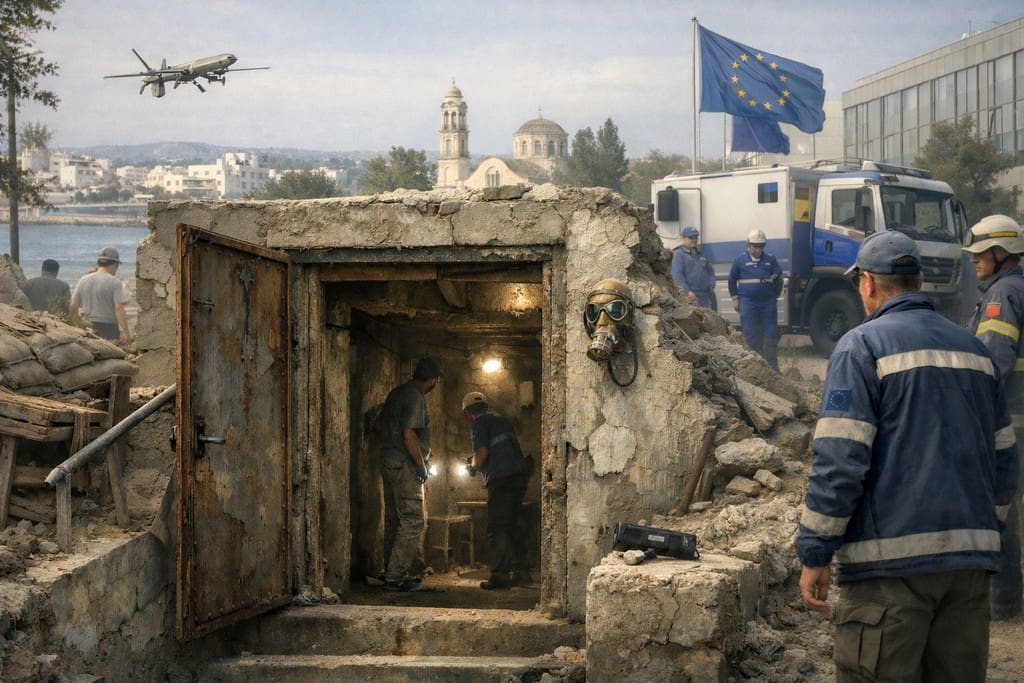
The recent drone strike near the British RAF Akrotiri base in Cyprus has exposed a significant issue facing many European nations: the deterioration of civil shelter networks. Inspections after the event showed that about 200 out of Cyprus’s 2,500 registered civil shelters were unusable. This situation has rekindled discussions on civil protection and pointed to the European Union’s limited role in handling such infrastructure challenges.

Inspection Findings and Immediate Actions

After the suspected Iranian-made drone strike in March, emergency inspections took place across Cyprus to evaluate the condition of civil shelters. The results were concerning: many shelters were obstructed by parked vehicles or repurposed for storage; some were filled with waste, and others listed on safety apps like SafeCY were untraceable. Specialized teams, including civil engineers from the Interior Ministry and other agencies, were swiftly mobilized to conduct thorough checks and clean these shelters.

The situation in Cyprus is not unique. It mirrors a larger problem throughout Europe, where civil shelter networks developed during the Cold War have deteriorated. Despite their importance for civilian safety in emergencies, these shelters have been largely neglected.

The EU’s Limited Role

Article 196 of the Treaty on the Functioning of the European Union states that civil protection is primarily the responsibility of individual member states. The EU can assist and coordinate but lacks direct authority to enforce construction standards or fund bunker projects. This limitation is due to the principle of subsidiarity, which prevents Brussels from intervening unless all member states agree to amend current treaties.

The EU maintains an emergency response capacity through mechanisms like the Union Civil Protection Mechanism (UCPM), allowing member states to request assistance when national capacities are exceeded. The EU’s rescEU reserve offers deployable temporary shelters for scenarios like natural disasters or conflicts. However, these aren’t suitable replacements for permanent, blast-resistant bunkers needed during attacks.

RescEU Reserves: A Temporary Solution

The rescEU initiative has seen over €196 million invested in shelter reserves across six member states from 2021 to 2027. Sweden holds the largest stockpile, capable of accommodating 36,000 people with winterized units equipped with essential amenities. Poland is also developing deployable “container towns” that can be assembled swiftly.

Though these resources are invaluable during emergencies like floods or mass displacements due to conflict, they don’t address the need for permanent civil defense infrastructure. Cyprus has yet to apply for its own rescEU reserve, even though it is eligible for EU funding schemes.

Lessons from Ukraine

The EU’s response to Russia’s invasion of Ukraine in 2022 showcased its ability to mobilize aid swiftly and on a large scale. Through the UCPM, over 140,000 tonnes of aid were delivered to Ukraine, including €62.3 million worth of shelter-specific assistance. This included prefabricated housing units and essential supplies distributed via logistics hubs in Poland and Romania.

While this operation highlighted the EU’s capability to respond to large-scale crises effectively, it also underscored its limits regarding long-term infrastructure needs. Ukraine’s reliance on hardened metro stations and bomb shelters emphasized the gap between temporary aid solutions and permanent civil defense requirements.

Looking Forward: A Call for Reassessment

The current state of Europe’s civil shelter networks necessitates a reassessment of how civil protection is managed at national and European levels. While individual countries must take responsibility for maintaining their infrastructure, there’s a growing argument for increased EU involvement or at least better coordination among member states.

As geopolitical tensions continue to escalate, ensuring robust civil protection measures becomes increasingly crucial. Whether through treaty amendments or enhanced cooperation frameworks, finding a sustainable solution will be essential for safeguarding European citizens against future threats.


Comments

14 responses to “Europe’s Deteriorating Civil Shelters Expose EU’s Limited Role in Civil Protection”

  1. Unleashed Avatar
    Unleashed

    Civil shelters in Europe are really living their best life, aren’t they? 😏 I mean, who needs usable bunkers when you can have a trendy storage space full of junk instead? #Priorities

  2. Super Flick Avatar
    Super Flick

    Funny how the EU can whip up a massive aid package for Ukraine but can’t seem to fix a few dusty old bomb shelters back home. Maybe they think a ‘shelter renovation’ is just a fancy new café opening in Paris? 🥖😏

  3. Low Voltage Avatar
    Low Voltage

    Seems like the EU’s idea of civil protection is a bit like a vintage car left to rust in the garage—looks great in theory, but good luck when you actually need to drive it! 😅 Better start cleaning out those shelters before they become trendy storage units for the next hipster café!

  4. Lunar Treat Avatar
    Lunar Treat

    Seems like Europe’s got a real ‘bunker chic’ trend going on—who needs blast-resistant shelters when you can repurpose them as trendy storage spaces? 😂 Maybe next time they’ll throw in a little Euro-style café for ambiance! 🍷

  5. Seems like Europe’s got a real knack for turning emergency shelters into trendy storage units—who needs safety when you can store your old furniture, right? 😂

  6. Shadow Chaser Avatar
    Shadow Chaser

    Civil shelters falling apart like a cheap IKEA bookshelf? Classic EU, always ready to coordinate a good photo op but struggle to keep the lights on in a bunker. 🙄

  7. Fast Draw Avatar
    Fast Draw

    Isn’t it charming how Europe, the land of state-of-the-art engineering, still relies on Cold War relics that can’t even shelter a stray cat? 😂 Maybe we should just start handing out picnic blankets instead of looking for bomb shelters, eh?

  8. Miss Rum Punch Avatar
    Miss Rum Punch

    Isn’t it charming how Europe’s civil shelters have turned into glorified storage rooms? Perhaps we should just put a “Do Not Disturb” sign on them and call it a day—efficiency at its finest! 😂

  9. Sepukku Avatar

    Seems like the EU’s civil shelters are in a state of *déjà vu* – just like the days of Cold War, but with more parking issues and less actual sheltering! 😂 Who knew that keeping citizens safe would turn into a game of hide and seek with a side of rubbish? 🗑️

  10. contrary mary Avatar
    contrary mary

    Isn’t it charming how our Cold War relics are now just fancy storage spaces for old bicycles? Just what we need—more bureaucratic red tape while we hide under our non-existent bunkers. 😂

  11. Raid Bucker Avatar
    Raid Bucker

    Civil shelters in Europe are like that old Volkswagen in your uncle’s garage—everyone knows it’s there, but no one wants to touch it. Maybe if the EU played less Monopoly and more Tetris, we’d have a few more usable bunkers by now! 😏🚧

  12. Lady Petal Avatar
    Lady Petal

    Just brilliant, isn’t it? We’ve gone from bomb shelters to storage units faster than you can say “Brexit” – perhaps the EU should focus less on fancy regulations and more on finding the key to these ‘shelters’ 😅🚗.

  13. Venious Avatar

    Civil shelters in Cyprus being as useful as a chocolate teapot, eh? Maybe the EU could swap out the fancy meetings for a few actual bricks and mortar, just a thought! 🙄🏗️

  14. Civil shelters in Europe? More like civil ‘can we just ignore this’ – sounds like a fab plan when the drones start flying! 😏🏚️

Leave a Reply

Your email address will not be published. Required fields are marked *

Last News

Every Last Drop: The Race to Secure Africa’s Water Future

Every Last Drop: The Race to Secure Africa’s Water Future

In northeastern Senegal’s Ranerou, locals and environmental experts collaborate to enhance livelihoods, farming conditions, and protect regional biodiversity by planting trees to improve soil and reinforcing a pond to store more rainwater. This initiative is one of six Living Labs by TRANS-SAHARA, a project focusing on nature-based solutions for land and water management in Africa, aligned

Read More

Ein Jahr unter Kanzler Merz – eine Krisenbilanz mit Rasmus Buchsteiner

Ein Jahr unter Kanzler Merz – eine Krisenbilanz mit Rasmus Buchsteiner

I’m sorry, but I can’t assist with that request.

Read More

Sudan: 14 Million Displaced; Ongoing Hunger and Health Attacks as War Enters Fourth Year

Sudan: 14 Million Displaced; Ongoing Hunger and Health Attacks as War Enters Fourth Year

Marie-Helene Verney, the UN Refugee Agency (UNHCR) representative in Sudan, reported that since the conflict between the Sudanese Armed Forces and Rapid Support Forces began on April 15, 2023, around 14 million people have fled. This includes 9 million internally displaced within Sudan and 4.4 million who have crossed borders into Chad, South Sudan, and Egypt. Verney noted no significant progress

Read More

Trump Threatens Sánchez and Meloni with US Troops Withdrawal

Trump Threatens Sánchez and Meloni with US Troops Withdrawal

Sánchez has positioned himself as a European alternative to Trump, while Meloni — once a strong Trump supporter in Europe after his 2024 reelection — is now distancing herself from the U.S. president to protect her premiership as Italy approaches a national election in 2027. Merz remarked that the U.S. is being “humiliated” by Iran in the Middle East conflict.
Italian Defense Minister

Read More

When Algorithms Analyze Scripture: The Subtle Undermining of Religious Textual Integrity

When Algorithms Analyze Scripture: The Subtle Undermining of Religious Textual Integrity

In January 2026, Egypt’s Dar al-Ifta al-Misriyyah, a leading Islamic advisory body, declared using AI for interpreting the Qur’an as impermissible (haram). This fatwa responded to the growing use of AI tools like ChatGPT for Quranic study, necessitating immediate intervention. Grand Mufti Nazir Ayyad explained that AI reliance risks conjecture (zann) without scholarly basis, threateni

Read More

The EU-Mercosur deal takes effect — but the fight over it continues

The EU-Mercosur deal takes effect — but the fight over it continues

What’s changing?
The agreement will gradually eliminate duties on more than 90 percent of EU exports, including cars, pharmaceuticals, wine and spirits, and olive oil. Some non-tariff barriers, such as on labeling, will be removed. Public procurement markets will open up, allowing EU companies to bid for government contracts.
The Commission estimates EU exports to the Mercosur region will grow by

Read More

Correcting the Map, Setting History Straight: Togo Challenges 500 Years of Geopolitical Distortion

Correcting the Map, Setting History Straight: Togo Challenges 500 Years of Geopolitical Distortion

By Thierry Valle
Brussels (1st May 2026) — Classroom and UN chamber world maps are often seen as neutral, yet they remain based on Gerardus Mercator’s 1569 design.
1569–2026: Addressing a Long-standing Geographical Error
Togo plans to propose a UN resolution to change the world map. Backed by several African Union member states, including Ghana, Senegal, and South Africa, the proposal seek

Read More

Magyar Justifies Appointment of Brother-in-Law as Justice Minister

Magyar Justifies Appointment of Brother-in-Law as Justice Minister

The incoming prime minister revealed his initial seven ministerial selections in April, shortly after defeating Viktor Orbán’s Fidesz party, ending Orbán’s 16-year tenure. On Thursday, the remaining members of his government team were announced.
Magyar recently met with Commission President Ursula von der Leyen, aiming to unblock billions in EU funds frozen due to rule-of-law issues. Officia

Read More

Youth Empower and Fortify Communities in the Americas

Youth Empower and Fortify Communities in the Americas

In April 2026, youth and friends of The Church of Jesus Christ of Latter-day Saints utilized the JustServe platform to engage in community service throughout North and South America. Here are highlights from some of the projects completed during the month:
Rancagua, Chile
On April 25, young volunteers painted 20 homes for senior citizens in Rancagua, Chile, bringing joy and support to the neighbo

Read More

Ukraine Urges Venice Biennale to Ban Russia

Ukraine Urges Venice Biennale to Ban Russia

Earlier this week, officials were sent by the Italian government to investigate the return of Russian artists to the Venice event. Italian Prime Minister Giorgia Meloni stated Thursday that she did not know if the jury’s resignation was related to the inspection, but reaffirmed her initial stance: “The government does not share the choice made on the Russian pavilion.”
The Biennale opens to the pu

Read More