


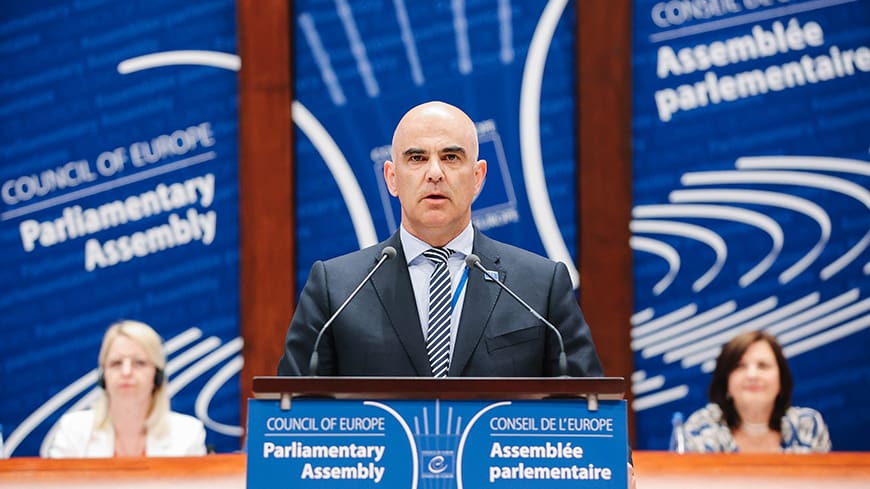
Council of Europe move targets antisemitism, anti-Muslim hatred, and wider religious intolerance
As hate incidents and polarisation increase across borders, Council of Europe Secretary General Alain Berset has linked the protection of religious minorities to the organisation’s core post-war promise of “never again” and its ongoing work on anti-discrimination and democratic resilience. The approach is symbolic and institutional, encompassing Holocaust remembrance, interreligious dialogue, and the coordination of Council of Europe bodies monitoring racism, intolerance, and human-rights compliance of member states.
On 5 December 2025 in Strasbourg, the Council of Europe announced that Irene Kitsou-Milonas had begun her mandate as the Secretary General’s Special Representative on antisemitism, anti-Muslim hatred, and all forms of religious intolerance, effective from 1 December. Berset framed the post as a reaction to forces of hate that “weaken democracy and divide communities,” calling this work “fundamental” to protecting the Council of Europe’s “peace project.”
The appointment is significant for religious minorities as it is designed as a coordination and influence role across the Council of Europe’s machinery, not just a one-time statement. The mandate includes regular dialogue with religious leaders and communities, supporting Holocaust remembrance initiatives, and close collaboration with bodies like the European Commission against Racism and Intolerance (ECRI) and the anti-discrimination steering committee CDADI.
This institutional focus was reiterated on 27 January 2026, during the Council of Europe’s Holocaust commemoration in Strasbourg. Berset emphasized that hatred targeting people “for their faith” persists and argued that remembrance must translate into refusing “all forms of religious intolerance, here and now.”
Where “religious minorities” fits into the Council of Europe’s toolbox
Unlike the European Union, the Council of Europe’s leverage is based on human-rights standards and monitoring across 46 member states, notably through the European Convention on Human Rights system and the case-law of the European Court of Human Rights. In practice, religious-minority protection often intersects with broader issues the Council tracks: hate speech, discrimination in education or employment, security-driven restrictions, and unequal treatment by public authorities.
The Council’s minority-protection architecture includes the Framework Convention for the Protection of National Minorities, often described as a central legally binding instrument in this field. While the treaty isn’t limited to religion alone, it frequently overlaps with religious identity in minority communities and is part of the broader rights landscape Berset’s office operates in.
What changes now — and what to watch
The Special Representative’s mandate is not an enforcement power; it is a political and administrative lever: setting priorities, maintaining coordination, and shaping how the Council engages with member states and partners. The announcement highlights cooperation with other international fora — including EU and OSCE platforms — and producing strategy papers and proposals for Council of Europe action.
For minority communities, the test will be whether this role leads to measurable outcomes: stronger implementation of ECRI standards, more consistent follow-up when governments tolerate or minimize religiously motivated hate, and clearer public guidance on protecting freedom of religion or belief while safeguarding public order without discrimination.
Recently, Berset has been a prominent figure in Council of Europe debates on Europe’s “democratic security” and the resilience of the continent’s legal framework — themes that determine whether minority protections hold firm when politics hardens. For background, see The European Times’ earlier coverage of his address to the Parliamentary Assembly. Read more.
A contrast with Brussels: the EU’s FoRB envoy gaps
Berset’s decision to appoint a dedicated Special Representative at the Council of Europe contrasts with a sensitive situation in Brussels: the European Union has, for long periods, operated without a continuously active Special Envoy for the promotion of freedom of religion or belief outside the EU. Human Rights Without Frontiers director Willy Fautré argues that the post has been repeatedly vacant or underpowered, creating a credibility gap between EU rhetoric and sustained diplomatic follow-through.
Fautré’s reporting notes long interruptions after the Juncker-era mandate ended in late 2019, a short






Leave a Reply