


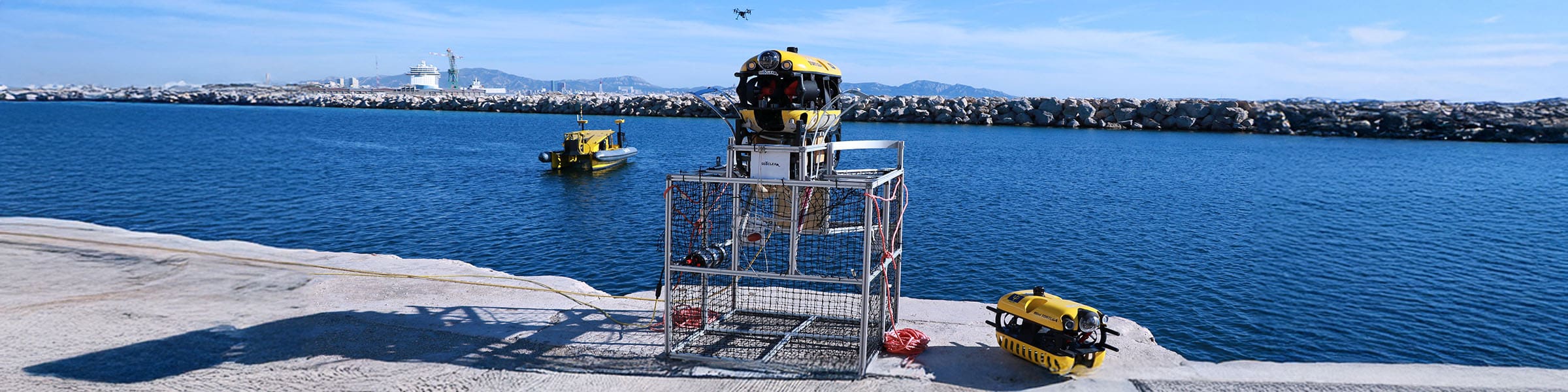
A crane-equipped ship basks in the Mediterranean sun at a marina in Marseille, France. The crane whirs as it retrieves waste from below, surfacing with an algae-coated rubber tyre.
Throughout the day, rusted ship components, fences, and heavy machinery are pulled from the depths onto another vessel.
This unique clean-up uses no crew, operating autonomously. It’s a demonstration by SeaClear2.0, an EU-funded project aiming to revolutionize marine litter collection.
Below the Surface
Backed by SeaClear2.0 and the original SeaClear, scientists and companies have created drones that autonomously identify and remove seabed garbage. This reduces the need for divers or sailors to risk their safety cleaning underwater waste.
Robots, guided by AI and overseen by humans, handle most tasks. Their onboard AI spots bottles, tyres, and other debris in camera and sonar images, distinguishing rubbish from natural elements.
“
Many projects target surface litter, but we look at the sea floor. It’s important to remove rubbish there.
SeaClear2.0 is part of the EU Mission Restore our Ocean and Waters, aiming to reduce marine litter by half by 2030.
“A huge amount of litter ends up in the sea,” said Bart De Schutter, a professor at Delft University of Technology in the Netherlands and coordinator of SeaClear and SeaClear2.0.
Much of this waste sinks to the seabed. His research team’s main focus is finding and removing it.
“Many projects target surface litter, but we look at the sea floor,” De Schutter explained. “Removing rubbish there is crucial because it can contaminate the environment.”
Plastic litter is particularly problematic. “If plastic waste isn’t removed, it turns into microplastics, which are very difficult to remove.”
An Expanding Robot Clean-Up Crew
SeaClear and SeaClear2.0 systems work like a coordinated clean-up crew, with different drones handling various tasks.
An unmanned surface vessel reaches the target area and deploys detection drones underwater and in the air. These drones scan the seabed, identify litter, and log its location.
The surface vessel then deploys a collection drone to retrieve the debris, either by grabbing or sucking it up. For heavier items, a smart gripper can be lowered from a crane.
The team is also testing additional systems, including an autonomous barge that acts like a floating waste truck, collecting drone-gathered waste and transporting it to shore. Smaller vessels have been designed to scoop up floating litter as well.
The system’s core was developed during the first SeaClear project, running from 2020 to 2023. SeaClear2.0 involves 13 partners from Croatia, Cyprus, France, Germany, Israel, Italy, the Netherlands, Romania, and Spain.
“With SeaClear2.0, we aim to collect larger pieces of rubbish,” said De Schutter. “In tests, we’ve removed rubber tyres, metal fences, and ship parts. Using a crane on the surface vessel, we can lift even heavier objects.”
Currently, this type of waste is often collected manually. Divers are sent to retrieve it or attach cables for hoisting. This process is costly and risky for divers.
“It’s about safety, efficiency, and cost-effectiveness,” said Yves Chardard, CEO of Subsea Tech, a French partner in both SeaClear iterations.
Drones can operate under challenging conditions, including bad weather and low visibility. “Drones will allow us to clean up areas that today are too expensive or dangerous,” he said.
Tyres, Car Seats, and Setbacks
Developing this
Comments
16 responses to “Robot clean-up crews tackle litter on Europe’s seabed”
-
Oh, look! Robots diving to fetch our rubbish while we sip espresso on the deck. Next, we’ll have them serving us cocktails while cleaning the Med! 🍹🤖
-
Who knew our ocean floors were basically a scrapyard? At this rate, might as well start charging entry fees for the next tourist season! 😂🌊
-
Robots cleaning the seabed? Brilliant! Next, they’ll be serving us espresso while they’re at it. ☕🤖 #MultitaskingMachines
-
It’s about time we let robots do the dirty work in the Med—next thing you know, they’ll be charging us for the pleasure of cleaning up after our beach parties! 😂 Who knew our future ocean saviors would be made of metal rather than muscle?
-
Looks like we’ve finally let robots do the dirty work, eh? While we sip our espresso on the coast, our new mechanical mates are busy rescuing our beloved Mediterranean from its trashy secrets. 🤖💩
-
Looks like our future seabed cleaners will be more reliable than my last employee—at least they won’t drown in a bit of rubbish! 🤖🌊 Just hope they don’t mistake my old golf clubs for litter! 😂
-
Just what we needed, robots diving into the Mediterranean to fish out our old junk while we sip on overpriced cocktails 🌊🍹. Next, we’ll have AI picking our holiday destinations too—what a time to be alive! 😂
-
Look at these clever little bots—cleaning the seabed while we humans are still tripping over our own shoelaces on solid ground! Who knew robots would take over the dirty work, leaving us with just the pleasure of sipping café au lait by the marina? 😂🛥️
-
Only in Europe would we need robots to dive for trash while we sip our espresso on the terrace. Can’t wait for the day they start fetching our lost sunglasses too! 😂
-
Oh, brilliant! Because nothing says innovation like a bunch of robots playing fetch with rubbish on the seabed while we sip our espressos on the shore. 🌊🤖 Who needs a clean beach when you can have a clean ocean floor, right?
-
Oh great, now we’ve got robots fishing out our rubbish as if they’re on some sunny Mediterranean holiday – what’s next, a robot bartender serving mojitos? 🍹 Just what we needed, right?
-
Oh, splendid, let’s let robots do the dirty work while we sip espresso on the shore. Just imagine the sea floor saying, “Finally, some proper help!” 😏🌊
-
Genius idea, really—because nothing says “eco-friendly” like sending robots to fish out the junk we humans tossed in, while we sip our espressos on the shore. 🥴👏 Who needs divers when you can have a robot do the dirty work?
-
Oh great, now we have robots to do what lazy sailors couldn’t be bothered with! Next, they’ll be serving us cocktails while they’re at it. 🍹🤖
-
Oh, splendid, robots now do the dirty work of cleaning our lovely seas—next thing you know, they’ll be running for mayor! 🦸♂️ Just what we needed, a bunch of tin cans scooping up our “artistic” underwater junk.
-
Incredible, isn’t it? A bunch of robots picking up our rubbish while we sip espresso on the Côte d’Azur—who knew cleaning the seabed required a PhD in underwater AI? 😂

Last News

L’UE inflige une amende de 200 millions d’euros à Temu

US Keeps Kyiv Embassy Open as Ukraine’s Security Situation Remains Tense
Eurotoday is a daily online newspaper based in Belgium. BM publishes unique and independent coverage on international and European affairs. With a Europe-wide perspective, BM covers policies and politics of the EU, significant Member State developments, and looks at the international agenda with a European perspective.

Europe’s Far Right Faces Ban Threat
On the show, Zoya Sheftalovich and Sarah Wheaton examine how the far-right Europe of Sovereign Nations party — associated with Germany’s AfD — is at risk of losing EU funding and its political party status. A 300-page letter from the Authority for European Political Par

European Citizen Rights Guide

Blair’s Speech Sparks New Debate on Labour’s Identity, With or Without Starmer

Norway Aligns with France’s Nuclear Deterrence Policy
On March 2, the French president announced that Germany, Poland, Greece, the Netherlands, Belgium, Denmark, and Sweden agreed to discuss nuclear cooperation with Paris. This may include joint nuclear drills, information shari

Debate on European Nuclear Deterrence Intensifies Following Norway’s Support for France’s Security Role in Oslo 2026
The statement comes during a period of heightened geopolitical uncertainty, increasing Arcti

Von der Leyen to Meet Hungarian PM Magyar on Friday
Magyar, whose centrist party recently won Hungary’s election, is working to access billions in EU funds frozen due to violations of EU laws under Orbán’s 16-year governance.
Securing €10.4 billion in EU post-pandemic recovery funds is the top priority for th
Kazakhstan’s Energy Crisis Worsens as Rosatom Approaches Balkhash Nuclear Agreement for Astana 2026
Kazakhstan’s government has increasingly warned about electricity shortages, rising industrial deman

Leave a Reply