



As Portugal headed to the polls on 8 February for the second round of its presidential election, André Ventura, the candidate of the far-right Chega party, has advanced to the run-off after securing 23.5 percent of the vote in the first round. It is the first time a far-right candidate has reached this stage of a presidential election in Portugal’s democratic history. Ventura has built his campaign around promises to fight corruption and restore order. Central to that strategy has been the deliberate targeting of Roma communities. Ventura’s rise has reshaped Portugal’s political landscape, normalising extremist language, dominating public debate and pulling the centre right closer to far-right positions.
As part of the campaign, Ventura placed billboards across the country declaring that “Gypsies must obey the law,” singling out Roma as a collective threat and portraying them as outside the bounds of citizenship. A Lisbon court correctly ruled that the billboards were discriminatory and risked inciting hatred, ordering their removal.
Under mounting pressure, Portugal’s main parties have taken a clear political decision, joining forces to prevent the xenophobic André Ventura from becoming the next President of Portugal.
The mainstream conservative parties have decided to back the centre-left candidate, António José Seguro, signalling a willingness to cross traditional political lines to contain the advance of far-right politics. Many expected Portugal to join Europe’s far-right surge. Instead, this move reflects the kind of political choice democratic actors across Europe increasingly must make.
In the runoff election on 8 February, António José Seguro won a commanding victory with roughly 66–67 percent of the vote, while Ventura trailed with about 33 percent, an outcome that halted a farright breakthrough at the presidential level even as Chega’s support remains historically high.
This is a model other democratic forces across Europe should take seriously.
When far-right candidates normalise racism, target minorities, or undermine democratic norms, neutrality is not an option. Preventing far-right candidates who dismiss democratic norms from entering office requires clear political choices, the willingness to overcome traditional political boundaries, and reaching across the aisle to form principled alliances. This moment underlines that defending democracy means drawing firm lines against political projects that rely on the stigmatisation of entire communities.
Roma communities already face persistent discrimination in Portugal, where the Roma population is estimated at up to 70,000. According to the EU Agency for Fundamental Rights Roma Survey, 63% of Roma in Portugal reported experiencing discrimination in the past year, the second highest rate recorded in the EU, alongside rising levels of bullying of Roma children in schools.
Though the decision by the main parties may act as a bulwark against the divisive far right in Portugal, the legal and political system remains ill-equipped to contain far-right incitement.
The court imposed a €2,500 fine against Ventura, he formally complied — and then proceeded to install new billboards in the town of Vila Nova de Milfontes that were widely understood to communicate the same message, only expressed with greater care.
Courts do not merely adjudicate legality; they also define what is politically acceptable. In this case, the signal risks being dangerously weak.
A minimal fine does not deter a major candidate in the middle of a high-stakes election campaign. It effectively sets a price on discriminatory misconduct. The message is not that bigotry is unacceptable, but that it is affordable. Extremist politics is not being blocked — it is being budgeted for.
This escalation comes as CHEGA has consolidated support and its position within national politics, with Ventura’s first-round result reinforcing his electoral credibility. Across Europe, this pattern is familiar. Following an electoral breakthrough, extremist actors intensify their boundary-testing. Institutions hesitate. Provocation appears to carry limited consequences.
It should be said plainly that this form of targeting makes no sense as public policy. Roma communities do not drive Portugal’s fiscal pressures, security challenges, or institutional shortcomings. Scapegoating does nothing to reduce corruption or improve public services. Its function is symbolic — a low-cost way to project broader social grievances onto those with the least political protection.
Europe has seen this pattern before.
In Hungary and Slovakia,
Comments
20 responses to “To Combat the Populist Far-Right, European Leaders Can Learn from Portugal”
-
Seems like Portugal’s political strategy is a masterclass in “how to make a mountain out of a molehill” – targeting Roma communities because, clearly, they’re the real threat to national integrity. Bravo, Ventura, for turning a presidential race into a farce; I suppose next we’ll be blaming the weather on them too! 😏
-
Nothing like a good ol’ populist far-right candidate to remind us that democracy can sometimes feel like a game of political musical chairs—only, the music’s a bit dodgy and the chairs are rigged! 🎭🪑
-
If only we could all channel our inner André Ventura, right? Who knew targeting minorities was the new political strategy in the land of Fado and port? 🍷🙄
-
In a stunning twist, it seems that the Portuguese have decided that instead of letting the far-right take a seat at the table, they’d rather just toss the whole table out the window! 🍷💼 Who knew democracy came with a side of common sense?
-
Typical Portugal, always late to the party but somehow still managing to host the most awkward dance-off between democracy and the far-right. Who knew the secret to political stability was simply a well-timed billboard removal? 😏💸
-
Seems like Portugal’s political scene took a page out of the classic “how to normalize bigotry” handbook, eh? 🤦♂️ Just what we needed, another masterclass in scapegoating a minority while pretending it’s all about law and order—bravo! 😒
-
In a thrilling turn of events, it seems Portugal’s far-right candidate thought a few billboards calling out the Roma was the ticket to the presidency—who knew a little racism could be such a charming campaign strategy? 😂 Bravo, André, let’s hope your next plan involves a more sophisticated approach, like actually addressing real issues instead of playing the blame game!
-
Looks like the Portuguese have discovered the latest political trend: skinning the good ol’ far-right cat with a slightly nicer knife. Who knew that creating a coalition against bigotry could be the hottest new political strategy? 😂
-
Oh great, just what we need—a far-right candidate making history in Portugal! 😒 Next, they’ll be giving out medals for scapegoating while the real issues are still left in the dust.
-
Isn’t it just delightful how Portugal, the land of fado and port wine, has decided to tackle the far-right by throwing a bit of hope into the political cauldron instead of just tossing in some old bigotry? 🤷♂️ One might think democracy would take the wheel, but nah, just a cheeky reminder that the real magic happens when you cross those traditional lines, eh? 🍷
-
Just what we needed—a far-right candidate making history in Portugal! Who knew that targeting Roma communities would be the new campaign strategy? Bravo, André Ventura, you’ve truly outdone yourself. 👏💰
-
Looks like Portugal’s political scene has decided that instead of a game of Monopoly, they’d rather play “How to Fund Bigotry on a Budget.” 🎲💸 Who knew fighting discrimination could be so financially savvy?
-
Looks like Portugal’s taken a page out of the “How to Make Bigotry Taste Like Fine Wine” handbook. Guess the billboards are just the new way of saying, “We’re not racist, but…” 🍷✨
-
Looks like Portugal is taking a masterclass in political theater—who knew scapegoating could be so chic? 🎭 Meanwhile, the rest of Europe is likely wondering if they’ve stumbled into a far-right fashion show. 😂
-
Seems like Portugal’s political scene decided to throw a party for the far-right—who knew bigotry could be such a popular theme? 🎉 Guess they missed the memo on how to actually solve problems instead of just blaming the locals! 🇵🇹🤦♂️
-
So, Portugal is suddenly the shining beacon of common sense in a continent full of far-right circus acts? How original! 🙄
-
Looks like Portugal is taking lessons from the school of ‘how to make a mess of democracy’ 101. Guess when in doubt, just blame the Roma, right? 🙄✌️
-
In a stunning twist of fate, it appears Portugal decided that fighting racism is just a bit more important than throwing another bill into the dumpster of populist antics. Who knew democracy could be so affordable, eh? 😏💰
-
Seems like Portugal’s got a new electoral sport: “Let’s see how far we can push the envelope of decency without actually getting disqualified!” 🤦♂️ Just what we needed, right?
-
Remarkable to see Portugal’s political elites finally realize that the far-right isn’t a Netflix series you can binge-watch with popcorn 🍿—you actually have to put some effort into stopping it! If only common sense were as popular as those ~vintage~ billboards. 😂

Last News

Italian Exports Surge, Boosting Italy’s First-Quarter Growth Outlook, Rome 2026
The updated
The World’s Genesis
Genesis contains two creation narratives: the first spans the entire first chapter and the beginning of the second, describing the creation process in a week, with a Sabbath rest. God cre

Skies in Turmoil: The Quiet Deterioration of EC261

EU Chief: Ukraine War "Threatens Every Nation on the Planet"
An EU chief says that Europe facing an “existential threat.”
EU council president Antonio Costa said, “The war of aggression being waged against Ukraine by a permanent member of the Security Council is unacceptable and threatens the security of every nation on the planet.”
He was speaking at the summit at the end of the week between the EU and Mexico.
The Portuguese official said, “The sovereign
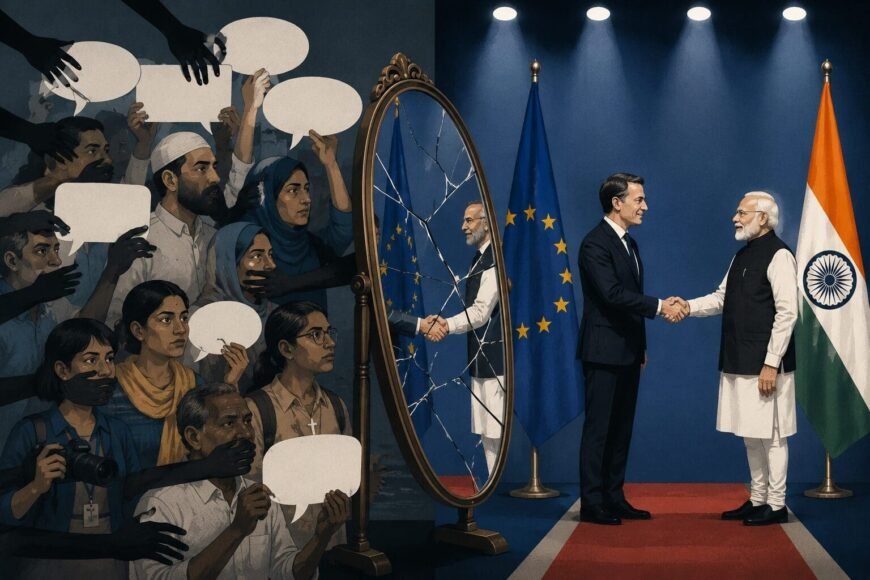
Self-Criticism: Vital for Democracy’s Survival in Developing Nations
Thierry ValleCoordination des Associations et des Particuliers pour la Liberté de Conscience, France
Press Freedom and Politics of Intolerance
India presents itself as the “world’s largest democracy” and a rising power, celebrating its pluralism. However, concerns have been raised by in

Inside the Tory Reboot: Why the Conservatives Are So Cheery

Listening to Families: A New Perspective on Nicotine Policy
Nicotine consumption is undergoing one of the most significant transformations in its history. Over the past two decades, a wide range of Innovative Nicotine Products (INPs) — from vapes and heated tobacco products (HTPs) to nicotine pouches and other smoke-free alternatives — has emerged alongside traditional tobacco products, fundamentally changing the way nicotine is consumed across the world
New Resource Features Stories of Northwestern Shoshone Latter-day Saints
“Native Saints: The Washakie Ward” share

China: The Controversial Partner the EU Struggles to Leave?

EU-Funded Films Triumph at Cannes
Six EU funded films have received awards at the 79th edition of the Cannes film festival which closed on Saturday 23 May.
Fjörd, by Cristian Mungiu, which received EU support for its development, was the great winner, being awarded the prestigious Palme d’Or. Two further MEDIA-supported films took home major prizes in the Official Competition: Das Geträumte Abenteuer (‘The Dreamed Adventure’) b
Leave a Reply