


Greece (Eurotoday) – In February 2019, after widespread protests in the streets of Tirana, Podgorica, and Belgrade, people throughout the Balkans began to speak of a “Balkan Spring” for the first time. Frustrated with entrenched political leadership, rampant corruption, and ongoing disregard for the rule of law, many—especially young people—took to the streets demanding change.
As corruption continues to plague the region, hope for a better future among the youth is waning. The Balkans have become a notable source of migration toward Western Europe. However, increasingly, people are also moving to Oceania, the Middle East, and Latin America. Still, the region’s diaspora remains deeply connected to their homelands, demonstrated through remittances to countries like Albania, Kosovo, and Bosnia, and active political engagement, particularly in Greece and Serbia.
Obsolete Infrastructure
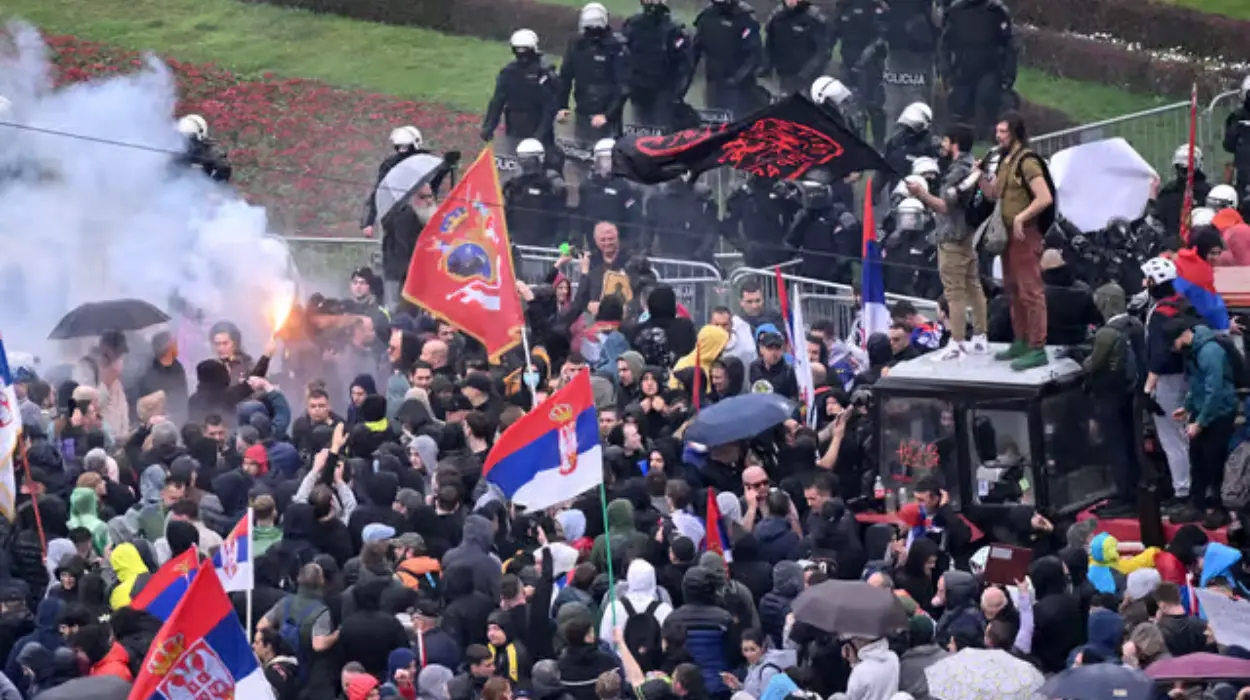
A catastrophic collapse at a railway station in Novi Sad, which claimed 15 lives, led hundreds of thousands to the streets of Belgrade in protest—the largest demonstration in Serbia’s history. While the government estimated 107,000 participants, independent reports placed the number at over 325,000.
The tragedy has focused public anger on President Aleksandar Vučić’s administration, with many citing corruption and negligence as root causes. Despite resignations from several officials, Vučić has refused to step down, intensifying the unrest. The station had been reopened in 2022 after renovations overseen by Vučić’s government, prompting widespread concern about the quality and transparency of public works projects.
Protesters are demanding not only transparency but also genuine accountability. While 16 individuals—among them former construction minister Goran Vesić—have been charged, many demonstrators believe the prosecutions are insufficient and symbolic. The movement continues to grow, calling for comprehensive reforms to address corruption and systemic mismanagement. With public dissatisfaction mounting, Vučić’s government faces one of its most substantial challenges to date.
Losing Faith in the Political System
On February 28, 2023, a tragic head-on collision between a passenger train carrying students and a freight train near the Tempi gorge in central Greece shocked the nation. An investigation by Greece’s Air and Rail Accident Authority found that major safety failures had gone unaddressed, deepening public outrage.
The Greek public—long skeptical of government transparency—widely believes that senior officials bear responsibility for a failure of oversight and are attempting to downplay their role. In response, enormous protests erupted nationwide, drawing first-time demonstrators and citizens from all walks of life into the streets.
Demonstrations took place in 346 cities across Greece, including Thessaloniki, Patras, and Larissa, as well as in European cities such as Brussels, Rome, and across the UK. The Greek diaspora joined the call for justice, demanding accountability and the resignation of the Prime Minister. Support for the ruling New Democracy party plummeted by 20 percentage points. Nonetheless, the Prime Minister has refused to call fresh elections, further inflaming public discontent.
Refusal to Change
The political leadership in Romania and Turkey has largely ignored growing public dissatisfaction, contributing to escalating polarization and rising extremism. In both countries, citizens have expressed deep concern over eroding democratic institutions and transparency.
In Romania, prominent candidate Călin Georgescu has withdrawn from the upcoming presidential election, reflecting disillusionment with the political process. In Turkey, Istanbul’s mayor Ekrem Imamoglu faces accusations ranging from corruption to terrorism, leading many to question the judiciary’s role in shaping political outcomes. Some argue this represents necessary oversight in a functioning democracy, while others see it as overreach.
Comments
3 responses to “The Balkan Spring on the Horizon”
-
So, the “Balkan Spring” is on the horizon, huh? Must be a lovely sight between the political chaos and crumbling infrastructure—like watching a train wreck in slow motion, but with more protests and fewer snacks. 🍿🚂
-
Just what we need—another “Balkan Spring,” because clearly, the last few decades of “political excellence” have worked wonders, haven’t they? 🌱 Can’t wait to see how they manage to turn this into a Netflix drama! 🍿
-
Isn’t it just delightful how we can all rally together in protest against corruption while the politicians sip their espresso and pretend to care? Just another day in paradise, eh? ☕️😂

Last News

Ongoing Media Exposure Builds Enduring Brand Trust for Businesses
London, July 07, Eurotoday – Consistent Media Coverage is becoming a key factor in helping businesses earn long-term brand trust. As consumers increasingly research companies before making purchasing decisions, regular appearances in credible news publications help businesses demonstrate transparency, stability, and industry expertise.
Businesses that share regular updates about company achievem

Orbán’s Preferred Brussels Think Tank Seeks New Funding Following Closure Order of Parent Organization in Hungary
Since arriving in Belgium four years ago, MCC Brussels has positioned itself as a prominent voice on the European right, collaborating with the far-right Patriots group on issues like gender, migrat
EU Releases Disaster Aid for Three Countries
Parliament Approves €144.1 Million for Spain, Romania, and Cyprus After Natural Disasters
The European Parliament has sanctioned €144.1 million in EU disaster assistance for Spain, Romania, and Cyprus, providing aid to communities impacted by wildfires, floods, and heatwaves in 2025. This decision underscores the pressing reality of climate-related emergencies, which challenge public services, r

10 Essential Responsibilities Every Company Director Should Know After Registration
London, July 06, 2026 – Eurotoday Newspaper — Company director responsibilities are receiving renewed attention as business advisers remind newly incorporated companies that registration is only the beginning of running a compliant business. Experts say directors who understand their legal and financial obligations early are better prepared to avoid penalties and support long-term business growt
Venezuela’s Earthquake-Stricken Hospitals on the Verge of Collapse Amid Rising Disease Risk
At Vargas-IVSS hospital in La Guaira, 96 patients are crowded into a ward meant for
Rutte to NATO: Admit It — Trump Was Right
Pressure from Trump isn’t the only factor increasing defense spending. Vladimir Putin is a significant motivator, as allies are committed to supporting Ukraine and strengthening their defenses against potential Russian aggression.
Rutte noted

Enhancing Google Rankings with High-Quality Backlinks via Digital PR
London, July 06, 2026 – Eurotoday Newspaper — Digital PR backlinks are becoming a leading strategy for businesses aiming to improve Google search rankings through credible media coverage and editorial links. SEO professionals report that organizations are increasingly investing in Digital PR campaigns to earn high-quality backlinks from trusted news websites and industry publications instead of

Form 8.5 (EPT/RI) – Gamma Communications Plc
Press ReleaseThis article is based on a press release or official communication from Wire News Service. The European Times republishes it as a public service.
FORM 8.5 (EPT/RI)
PUBLIC DEALING DISCLOSURE BY AN EXEMPT PRINCIPAL TRADER WITH RECOGNISED INTERMEDIARY STATUS DEALING IN A CLIENT-SERVING CAPACITY Rule 8.5 of the Takeover Code (the “Code”)
1. KEY INFORMATION
(a) Name of
Bardella oder Le Pen: Wer führt Frankreichs Rechte in die Wahl?
Heute entscheidet ein französisches Berufungsgericht über die politische Zukunft von Marine Le Pen. Eine Bestätigung des Urteils wegen Veruntreuung von EU-Geldern, das auch ein fünfjähriges Ämterverbot einschließt, könnte erhebliche Auswirkungen auf die Führung der rechtsextremen politischen Landschaft in Frankreich haben. Jordan Bard
Leave a Reply