


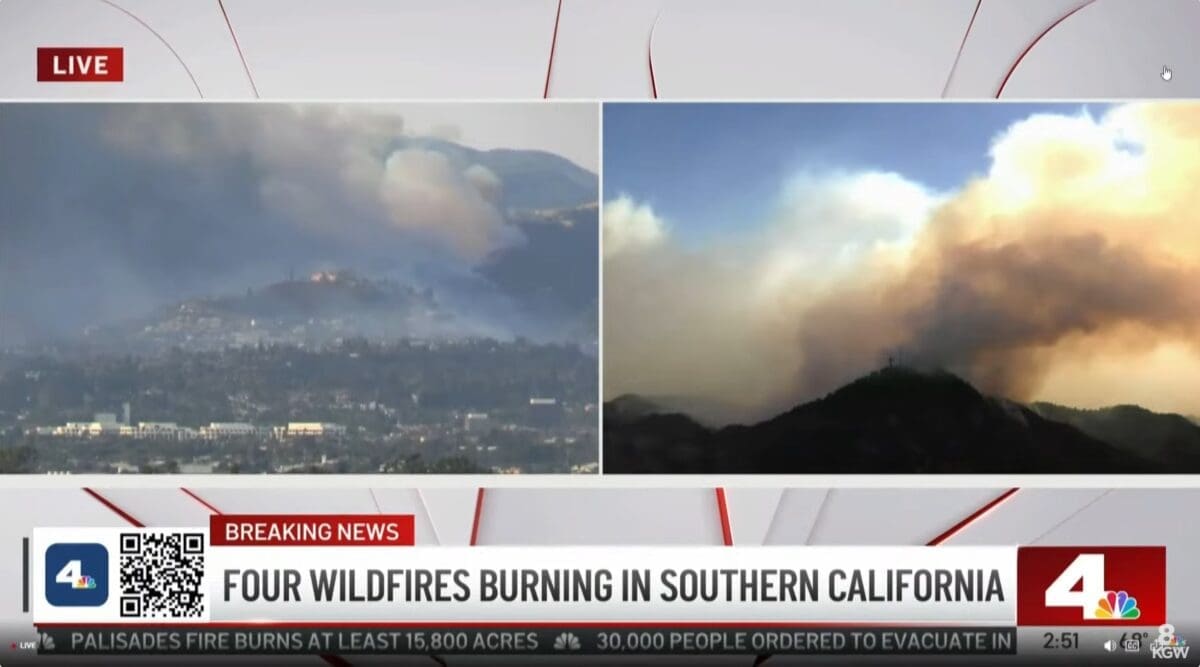
The Los Angeles area is grappling with one of the most devastating firestorms in recent memory, resulting in five fatalities, the destruction or damage of over 2,000 structures, and countless lives forever altered. The Eaton, Palisades, and Sunset fires have wreaked havoc across Los Angeles County, forcing mass evacuations, overwhelming emergency services, and leaving a smoldering trail of destruction. With red flag warnings still in effect and the fires at 0% containment, officials caution that the crisis is far from over.
Heartbreaking Loss of Life
Five lives were tragically lost in Altadena, where the Eaton fire erupted with ferocity on Tuesday night. The victims, who had little time to flee, were found in three separate structures consumed by the blaze, driven by wind gusts as strong as 99 mph. K-9 units trained to detect human remains have been deployed to ensure no additional lives were lost.
“It’s a tragic loss,” said Los Angeles County Fire Chief Anthony Marrone. “We are doing everything we can to support those affected, but the scale of this disaster is overwhelming.”
An Unprecedented Catastrophe
The magnitude of destruction is staggering. In Pacific Palisades, over 15,800 acres burned, reducing multimillion-dollar homes along Pacific Coast Highway to ashes. In Altadena and Pasadena, the Eaton fire scorched 10,600 acres. Meanwhile, the Sunset fire ignited Wednesday evening in the Hollywood Hills, triggering evacuations in the Runyon Canyon area.
“What we saw in the past 24 hours is unprecedented,” said LAPD Chief Jim McDonnell. “I’ve never witnessed anything like it.”
Overwhelmed Resources and Tough Decisions
Efforts to combat the fires are being hampered by extreme winds, tinder-dry brush, and an overextended emergency response system. Fire personnel from Los Angeles County, joined by reinforcements from other parts of California, Arizona, and Oregon, are battling multiple infernos with limited resources. In some cases, firefighters were forced to make heart-wrenching choices, bypassing certain homes to focus on others as residents watched in anguish.
In Pacific Palisades, dry hydrants caused by overwhelming demand on the water system left firefighters scrambling. Gusts nearing 100 mph fueled flames that raced into the Santa Monica Mountains, creating nearly insurmountable challenges for ground crews.
“We simply don’t have enough personnel across L.A. County to handle this,” admitted Marrone. “Our resources are stretched to the breaking point.”
A Community in Crisis
The fires have displaced more than 130,000 residents across Los Angeles County. In Altadena, some homeowners resorted to using garden hoses to defend their properties as fire engines rushed past toward more critical areas. In Pacific Palisades, flames consumed entire stretches of Pacific Coast Highway, leaving residents uncertain whether they would have homes to return to.
Bill Stange, a longtime Palisades resident, evacuated with a few belongings. By the next morning, reports suggested his entire hillside neighborhood had been destroyed. His family home, which had been rebuilt after a 1993 fire, was likely lost once again.
“I don’t think the fire department is equipped for something of this scale,” Stange lamented. “It’s just too massive.”
Federal and State Support
Both President Biden and California Governor Gavin Newsom have pledged full support to combat the crisis. National Guard units and Navy helicopters fitted with water buckets are being deployed to assist exhausted emergency crews. Speaking during a briefing, President Biden described the fires as “astonishing” and promised unwavering federal aid.
“We’re ready to do whatever it takes for as long as it takes to contain these fires,” Biden assured.
Weather and Climate’s Role
The relentless firestorm has been fueled by a mix of extreme weather and environmental conditions. With Los Angeles recording only 0.16 inches of rainfall since October, the parched vegetation became an ideal fuel source. Combined with fierce Santa Ana winds, meteorologists have labeled the situation as catastrophic.
“These winds surpass those of the 2011 windstorm in terms of strength, scale, and destruction,” said Ariel Cohen, a meteorologist with the National Weather Service in Oxnard. “This is a once-in-a-generation windstorm amid an apocalyptic scene.”
Staying Vigilant
Officials are urging residents to remain alert, as the fires’ unpredictable behavior makes no area entirely safe. LAPD Chief McDonnell emphasized the importance of readiness.
“These are exceptional conditions,” McDonnell said. “No one can predict where the next fire will start.”
The Human Cost
As the flames spread, stories of loss and resilience emerge. In Pacific Palisades, a veterinarian opened their doors to 39 displaced pets, underscoring the wide-reaching impact on both humans and animals. For families like the Stanges, rebuilding will be a long, uphill challenge, made even harder by rising construction costs and strained resources











Leave a Reply