


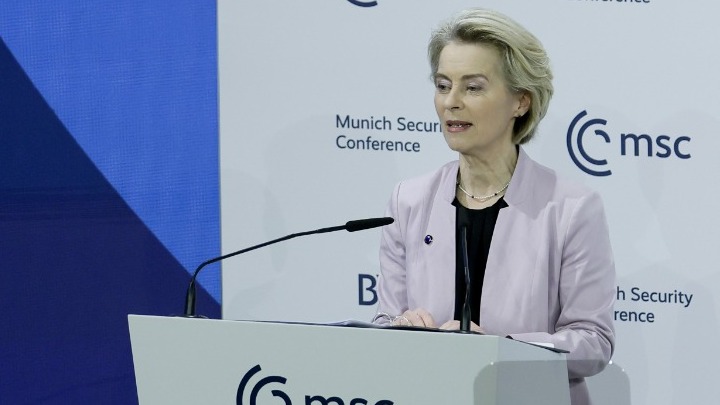
During her address at the Munich Security Conference, Commission President Ursula von der Leyen emphasized that “a failed Ukraine would not only weaken Europe but also the United States.”
She underscored that both the European Union and the US are eager for the violence in Ukraine to cease, advocating for “a just and lasting peace that leads to a sovereign and prosperous Ukraine, reinforced with solid security guarantees.”
In her remarks, von der Leyen highlighted the “historic levels” of support that Europe has provided to Ukraine, noting that total assistance—both economic and military—reaches 134 billion euros, surpassing contributions from any other entity. She pointed out that this figure includes 52 billion dollars in military aid, which equals the support from the US. Additionally, she referenced the “rigorous sanctions” that the West has enforced on Russia, along with the EU’s gradual reduction of dependency on Russian natural gas.
Von der Leyen expressed confidence that Ukrainian President Volodymyr Zelensky is committed to pursuing “a peace that honors the sacrifices of his nation and its fallen heroes,” asserting that Ukraine desires a “just and lasting peace” more than any other party involved. In contrast, she observed that while Russian President Vladimir Putin claims he is open to negotiations, the specifics remain unclear. “It is incumbent upon him to demonstrate that he does not wish to prolong this conflict and that he has relinquished his goal of destroying Ukraine,” von der Leyen stated.
She further declared, “We are collaborating with Ukraine on its EU accession, as Ukraine is part of our European family, and its future is here.” The Commission President committed to intensifying efforts to expedite Ukraine’s journey toward EU membership, noting, “We have already achieved considerable progress, but now is the moment to push forward even more vigorously.”
Additionally, von der Leyen announced plans to propose activating the escape clause of the Stability Pact concerning defense spending, emphasizing the need for Europe to increase its defense budget from just below 2% to above 3% of GDP. This adjustment would necessitate hundreds of billions more in annual investments. “This will enable member states to significantly boost their defense expenditures,” she explained, adding that this would occur “in a controlled and conditional manner.” Furthermore, the Commission will present a comprehensive set of tailored tools to address the unique circumstances of each member state. She reiterated the importance of a unified European strategy for defense investment priorities, which would facilitate funding for essential defense projects of collective European interest.
PHOTO EPA/RONALD WITTEK






Leave a Reply