


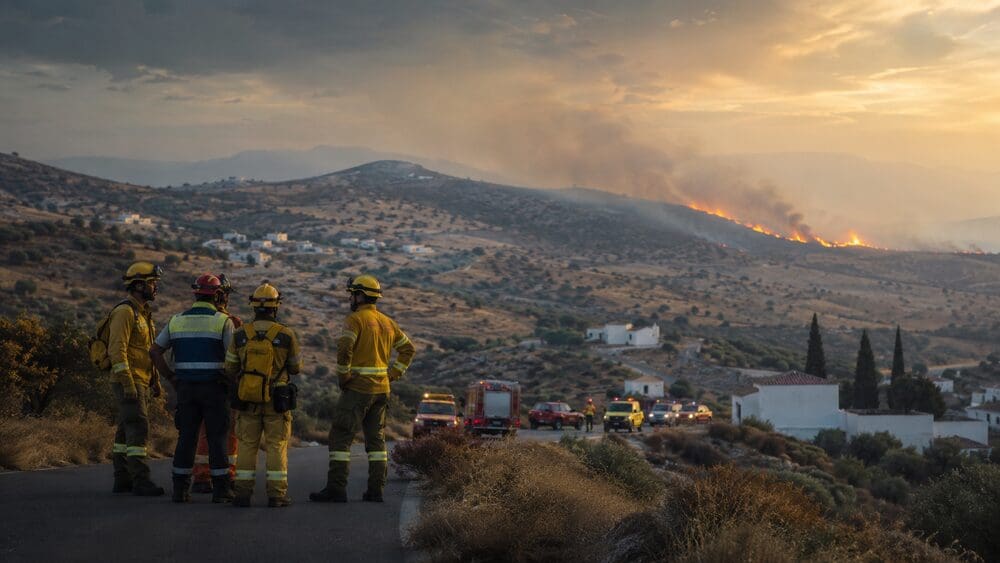
A devastating wildfire in Spain’s Almería province has claimed at least 12 lives, with others still missing, escalating from a local emergency to one of the country’s most severe climate-related tragedies. As firefighters strive to control the Los Gallardos blaze, the incident is intensifying scrutiny over public alerts, evacuation strategies, and Europe’s preparedness in the face of fires exacerbated by heat, drought, and wind.
The fire ignited near Los Gallardos in Andalusia and rapidly spread through dry areas and rural settlements. Spanish broadcaster RTVE reported that regional authorities confirmed at least 12 fatalities and 23 individuals unaccounted for, urging caution with these preliminary numbers pending ongoing identification efforts.
Several individuals sustained injuries, including those with severe burns requiring specialized care. Search teams are investigating damaged properties and hard-to-access zones affected by the blaze, while emergency services remain vigilant for potential reignition in the challenging, dry terrain.
Regional president Juanma Moreno disclosed that initial signs suggest a broken power cable near a roadside might have ignited the fire, although investigations continue. The fire’s rapid expansion was fueled by strong winds, dry vegetation, and challenging accessibility, transforming it into a deadly situation.
The fire’s swift advance compelled authorities to issue varying instructions—evacuation or shelter-in-place directives—based on location, a central issue in the public discourse. Some residents were advised to remain indoors, while others were told to evacuate, with officials acknowledging that certain fatalities may have resulted from attempting to flee via unsafe routes.
The decision not to deploy Spain’s ES-Alert mobile warning system has also come under scrutiny. Andalusian authorities defended this choice, stating that a mass message might have caused confusion due to the need for different instructions in diverse areas, coupled with compromised phone coverage. Criticism is likely to demand a thorough review of the alert procedures for a rapidly evolving fire in a fragmented rural landscape.
The Almería fire highlights more than an environmental catastrophe; it represents a public-safety and human-rights shortfall if vulnerable populations don’t receive timely, clear, and actionable guidance during crises. This is crucial as southern Europe faces summers where fire conditions are increasingly common, putting pressure on health services, infrastructure, and emergency agencies.
Authorities now face challenging inquiries: Were warnings delivered promptly? Were evacuation routes viable? Did non-locals understand official communications? Were settlements in isolated areas effectively mapped and contacted? These are not mere administrative concerns; in fast-moving fires, they determine survival.
The broader climate context is stark, with the EU’s Copernicus Climate Change Service confirming June 2026 as the hottest June in western Europe’s records. This extreme heat has heightened health risks, drought conditions, and wildfire activity, especially in Iberia and southern France.
Climate change doesn’t negate the need to probe each fire’s immediate cause but alters the environment where small sparks can escalate into disasters. For Spain, the risk landscape is evolving, with fires increasingly threatening not only forests but urban areas, tourist locales, isolated homes, and infrastructure. Existing civil protection frameworks may falter as extreme heat arrives sooner, persists longer, and coincides with drought and winds.
In the days ahead, priority will be humanitarian—identifying the deceased, locating the missing, aiding injured survivors, and averting further casualties. Grieving should precede blame, but accountability must eventually follow.
Europe’s climate discourse often centers on emissions, energy costs, and industrial strategies. The Los Gallardos fire underscores another facet: ensuring people’s safety when danger strikes their vicinity.
Effective protection encompasses more than skilled firefighters. It demands clear alerts, multilingual communication, well-planned evacuation routes, accessible shelters, reliable phone networks, land stewardship, support for small towns, and thorough planning for those unable to evacuate quickly.
The Almería disaster is both a local and European tragedy—a profound loss for families and a cautionary signal to governments across the continent that preparedness extends beyond a seasonal checklist. In an increasingly hot Europe, it becomes a fundamental duty of care.






Leave a Reply