


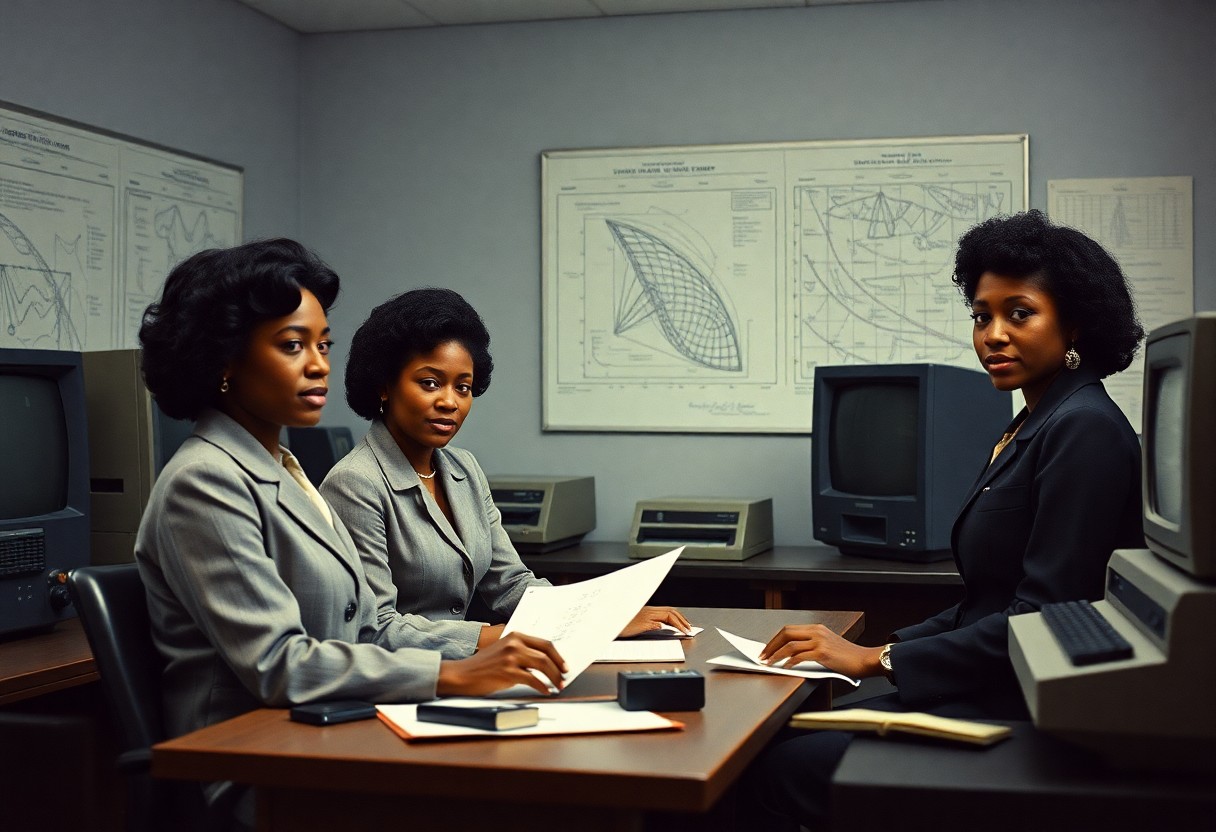
Uncovering the Untold Story: The Women Behind NASA’s Success
Just when it seems like every angle of America’s space race has been explored, another incredible story emerges. Theodore Melfi’s film, “Hidden Figures,” brings to light the vital contributions of Black female mathematicians whose work played a crucial role in NASA’s triumphs. These brilliant women shattered barriers, using their intelligence and perseverance to help propel the United States into space. Their inspiring stories serve as a reminder that history often overlooks those who have played pivotal roles in shaping it.
—
The Space Race: A Brief Overview
The Space Race was one of the most defining competitions of the 20th century, fueled by Cold War tensions between the United States and the Soviet Union. Spanning from the late 1950s to the 1970s, this era saw groundbreaking advancements that pushed the limits of technology and inspired countless individuals to pursue careers in aerospace engineering.
A Climate of Competition
During the peak of the Cold War, the race for space dominance escalated. The Soviet Union took an early lead by launching Sputnik 1 in 1957, an event that sent shockwaves through the United States. Determined to catch up, America ramped up its space program, leading to remarkable innovations and a series of historic space missions.
Milestones and Key Figures
The Space Race featured numerous remarkable achievements and pioneers. Yuri Gagarin became the first human in space in 1961, a milestone that spurred NASA to push forward. Shortly after, John Glenn became the first American to orbit the Earth. The formation of NASA in 1958 and the success of the Apollo 11 Moon landing in 1969 solidified the United States’ leadership in space exploration.
However, behind these celebrated milestones were the extraordinary efforts of unsung heroes—African American women mathematicians at NASA. Their contributions, though often unrecognized, were fundamental to the success of these missions.
—
The Women Who Helped NASA Soar
While many of the well-known figures in space exploration were men, some of the brightest minds working behind the scenes were women. These trailblazers defied social and professional barriers, proving that talent and perseverance know no gender.
Challenging the Norms
For decades, the fields of mathematics, engineering, and space science were dominated by men. However, a group of brilliant women at NASA broke through these barriers, proving their worth time and again. Their expertise not only contributed to America’s space missions but also paved the way for future generations in STEM.
Contributions That Changed History
Though their work was often overshadowed, these women played an essential role in NASA’s success. Their calculations ensured the safety of astronauts and the success of missions that captured the world’s imagination. Their achievements laid the groundwork for greater inclusivity and diversity in scientific fields.
—
Katherine Johnson: Calculating the Path to Space
Few names stand out in NASA’s history like Katherine Johnson. A brilliant mathematician, her calculations were essential to the accuracy and success of America’s space missions.
Groundbreaking Work in Mathematics
Katherine Johnson’s mathematical genius was instrumental in plotting trajectories for space missions. She worked on calculations for John Glenn’s orbital flight, ensuring his safe journey. Her attention to detail and precision played a direct role in NASA’s success.
A Lasting Influence
Johnson’s contributions transcended her time at NASA. She became a vocal advocate for women and minorities in STEM, inspiring countless individuals to pursue careers in science and technology. Her legacy continues to be celebrated, proving that the pursuit of knowledge knows no boundaries.
—
Dorothy Vaughan: Leading the Way in Technology
Dorothy Vaughan was another trailblazer at NASA, breaking racial and gender barriers to become a leader in computational mathematics.
Mastering Early Computers
During her time at NASA, Vaughan foresaw the growing importance of computers and took the initiative to master FORTRAN, an early programming language. Her knowledge of technology positioned her as a leader and helped transition NASA’s team from manual calculations to computer-based problem-solving.
Inspiring the Next Generation
Vaughan’s contributions went beyond her own career—she mentored and uplifted countless women in STEM, ensuring that others also had the opportunity to thrive. Her leadership serves as a reminder that progress involves not only personal success but also creating pathways for others.
—
Mary Jackson: Engineering a New Future
As NASA’s first Black female engineer, Mary Jackson played a transformational role in both aeronautics and workplace inclusivity.
Overcoming Barriers in Engineering
Jackson faced systemic discrimination but remained dedicated to her dream of becoming an engineer. With perseverance and determination, she earned a promotion that allowed her to take on essential











Leave a Reply