


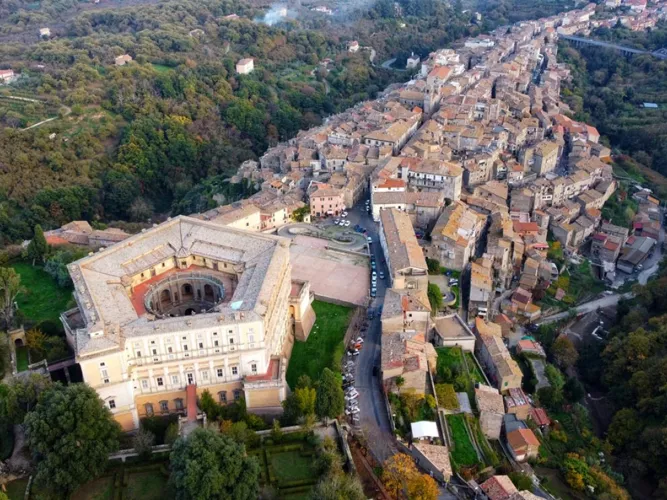
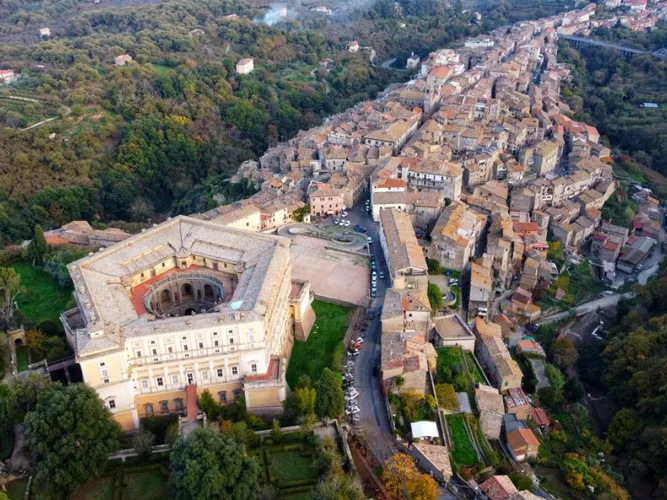
Located about sixty kilometers northwest of Rome in Italy, the true original Pentagon stands in the village of Caprarola. Built 500 years ago during the Italian Renaissance, it remains a stunning and well-preserved landmark, delighting tourists and filmmakers alike.
The Pentagon in the USA was constructed in 1941 to unify all the employees of the then Ministry of Defense. With Hitler’s aggression in Europe, America prepared for war, but the military department personnel were scattered across 17 buildings, making coordination tough. Congress tasked a special division with finding a site for a new building. Young lieutenant and architect-engineer Hugh Casey, inspired by Renaissance Italy, proposed a unique rectangular plan modeled after the medieval Pentagon he studied, allowing space for 40,000 personnel with interconnected corridors. This design faced opposition, particularly from the Congressional Committee on Fine Arts, for its potential as an easy bombing target and its aesthetics. However, President Franklin Roosevelt, aware of the Italian architectural marvel’s functionality and beauty, endorsed the “Pentagon!”
The Italian pentagonal palace, known as “Farnese,” was designed half a millennium ago by renowned architects for Alessandro Farnese the Elder, who became Pope Paul III, and his nephew Alessandro Farnese the Younger. Initially intended as a fortress by architect Antonio da Sangallo the Younger, construction began in 1530 but paused when Alessandro Farnese became pope. His nephew later revived the project, commissioning architect Jacopo Barosi, known as Vignola. Vignola transformed the fortress into a Mannerist style palace, an architectural masterpiece shared with Michelangelo, Giulio Romano, and Andrea Palladio.
This impressive Renaissance palace became a summer residence for popes and cardinals, who relished the scenic views from the corner bastions-turned-terraces and the cool circular courtyard formed by overlapping porticoes. The interior boasts elegant stairs, columns, and ceiling and wall frescoes by famous Renaissance artists.
Until 1941, coinciding with the Pentagon’s construction in Washington, the original Pentagon in Caprarola was privately owned, but was nationalized by Italy’s fascist leader, Benito Mussolini. Post-war, the Farnese Palace was favored by Italy’s first Republican president, Luigi Einaudi, for its “House of Pleasures” where past religious figures’ concubines resided. Today, this Renaissance masterpiece attracts global tourists and filmmakers, serving as a backdrop for films including “The Godfather Part III,” “The Trial and Abduction,” and “The Man from U.N.C.L.E.”
Caprarola, in Viterbo province, Lazio region of central Italy, is dominated by the grand 16th-century Palazzo Farnese.






Leave a Reply