



Senior UN Official Highlights Syria’s Hopeful Future Amid Ongoing Humanitarian Crisis
“Today, we see a new Syria, full of promise and potential,” said David Carden, a senior UN humanitarian official, at a press briefing held at the United Nations Headquarters in New York. However, he cautioned that despite a decrease in conflict across many areas, Syria’s humanitarian emergency remains dire, with 16 million people still in need of aid.
Syria’s Turning Point
Syria has entered a transitional phase following the collapse of the Assad regime in December and the conclusion of nearly 14 years of civil war. The devastating February 2023 earthquakes, which also impacted neighboring Türkiye, added to the country’s hardships.
The United Nations is actively supporting Syria’s transitional authorities in Damascus to enhance aid delivery systems, address the lack of public funding, and streamline operational procedures. Speaking from Gaziantep, Türkiye — a hub for the UN’s cross-border humanitarian aid into Syria — Mr. Carden announced his role would be officially phased out by Tuesday. This move is part of efforts to consolidate humanitarian coordination under a single Resident and Humanitarian Coordinator based in Damascus by the end of June.
Previously, a unique structure had different coordinators handling aid from outside Syria — a configuration rarely seen in other conflict zones globally.
More Than Just Aid Trucks
Carden emphasized the significant impact of the UN’s cross-border mechanism, which began in 2014 with Security Council authorization. This initiative was designed to reach over four million people in northwest Syria who were outside government control.
In total, the mechanism has facilitated the delivery of over 62,000 truckloads of critical supplies, including food, medical aid, emergency shelter materials, and other forms of humanitarian assistance. “So far this year, we’ve already dispatched 936 aid trucks — that’s more than the total delivered throughout all of last year,” he noted.
Beyond material assistance, the UN and its humanitarian partners have also supported Syrians in rebuilding their homes, schools, hospitals and livelihoods, as well as delivering healthcare and child protection services. Through the Syria Cross-border Humanitarian Fund, nearly $1.1 billion has been allocated to these life-saving and early recovery initiatives.
“Times Have Changed”
Carden credited the continued support of international donors — particularly Türkiye — for sustaining the cross-border mechanism. However, he stressed that circumstances are shifting. Currently, 70 percent of Syria’s population — about 16 million people — rely on humanitarian assistance, primarily women and children. Idlib and Aleppo, in the northwest, are among the hardest-hit regions.
Despite an uptick in returnees this year, Syria remains one of the most significant displacement crises globally, with approximately seven million people still displaced.
Displacement and Destruction
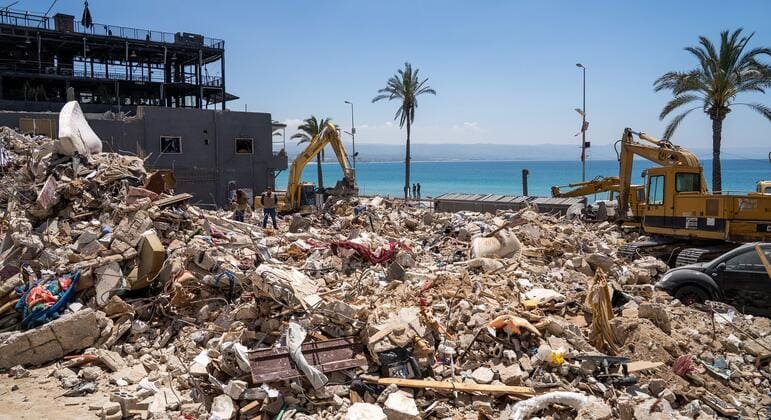
Since December, over one million internally displaced persons (IDPs) have returned to their homes, many of whom were uprooted just months ago. Around 225,000 people have been able to leave camps — yet this represents only a small portion of the two million still confined to such facilities in northwest and northeast Syria.
Carden recently visited Idlib, a region once on the front lines of the conflict, where he met returnees and aid workers engaged in mine clearance and removing remnants of war. He described the destruction there as “absolutely overwhelming — even more severe than what I witnessed after the 2023 earthquakes.”
Funding Shortfalls and the Path Ahead
Despite ongoing efforts, the UN’s humanitarian response is severely underfunded. Agencies are seeking $2 billion to sustain operations through June but have secured only $179 million to date — a mere nine percent of the target.
“This is the moment to invest in Syria,” urged Carden. “We’re at a critical juncture — supporting Syrians now can help pave the way toward a more self-reliant and secure future, and enable safe, dignified returns.”
He concluded by expressing optimism that the humanitarian response would soon transition into a broader recovery and reconstruction phase, highlighting that such progress may also lead to the easing of international sanctions.









Leave a Reply