


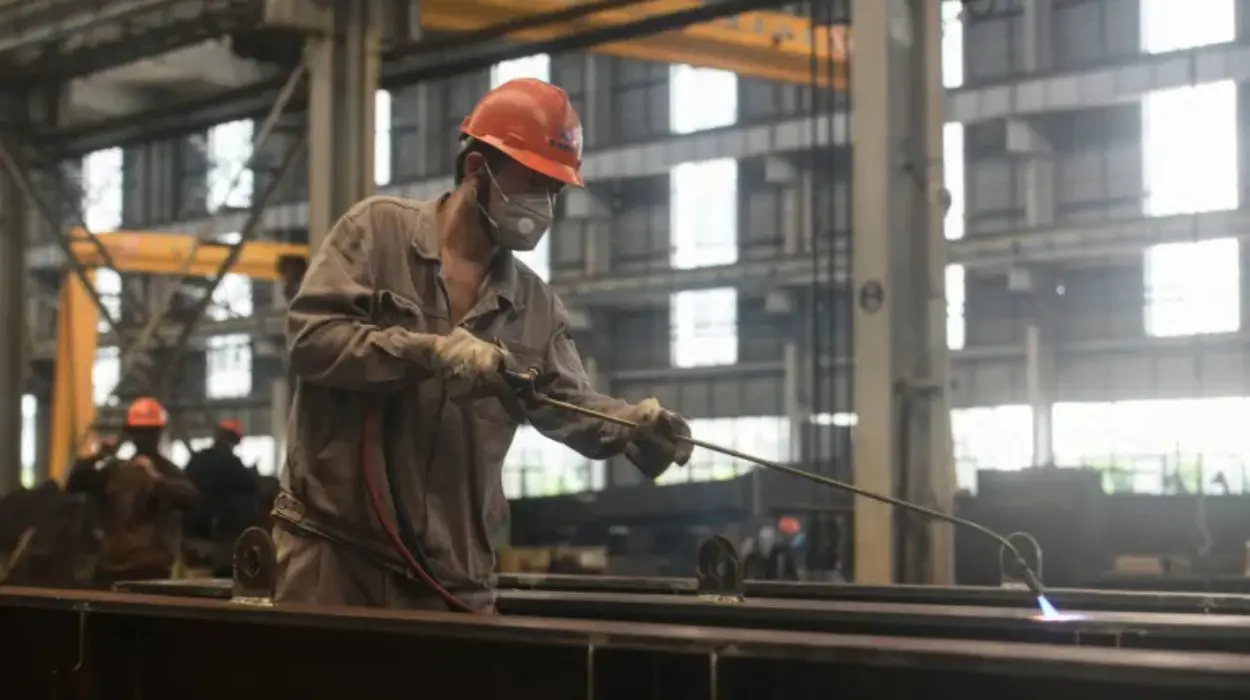
It’s easy to miss the quiet revolutions. The ones that unfold not with fireworks or fanfare, but with steady hands steering through the storm. As the first half of 2025 closes, China offers one such narrative—a counterpoint to the economic tremors and geopolitical ricochets that have unsettled much of the world. With year-on-year GDP growth clocking in at 5.3 percent and total output reaching 66.05 trillion yuan, China is not just rebounding—it is recalibrating.
There was a time when Chinese growth figures were read like adrenaline charts: 9 percent, 10 percent, sometimes more. The world grew accustomed to China’s breathtaking economic ascent, and perhaps unfairly, began to measure its success only by acceleration. But what if the story today is not about speed, but about steadiness? Not about breakneck momentum, but about measured transformation?
That’s what 2025 seems to suggest. China’s economic trajectory this year is less a sprint and more a strategic stride—defined by balance, restraint, and long-term vision.
The growth China is charting is not monolithic. It is a mosaic.
The primary sector—long overlooked in global analyses fixated on tech and manufacturing—grew 3.7 percent, anchored by ongoing rural revitalization and a renewed focus on food security. It is easy to forget, amid skyscrapers and semiconductors, that China still understands the political power of grain.
The secondary sector rose 5.3 percent, underpinned by infrastructure investments and an industrial pivot toward innovation. Most revealing, however, is the 5.5 percent expansion in the tertiary sector. Services now account for over 56 percent of GDP—a quiet but monumental shift that reflects more than changing preferences. It reflects a civilization adapting to itself.
Digital health platforms, livestream e-commerce, and what’s now known as the “Guochao” (or “China-chic”) movement are not just trendy—they are telling. They mark a conscious move from an export-led engine to one powered increasingly by domestic consumption and cultural confidence. In cities like Hangzhou and Chengdu, the new middle class is not just buying—they’re believing.
All of this unfolds against a backdrop of renewed global uncertainty.
The United States, fresh off its July tariff expansions targeting Chinese tech imports, has ratcheted up its decoupling rhetoric. Washington’s tone has grown sharper under the revived “Fair Trade Now” campaign, and the ripple effects have been felt across the Pacific. Yet Beijing’s response has been largely calibrated, not confrontational.
Rather than retaliate with noise, China has opted for nuance—quietly expanding trade corridors through the Regional Comprehensive Economic Partnership (RCEP), deepening connectivity with Europe via rail and port initiatives, and increasing outbound investment in Southeast Asia. According to July customs data, China’s exports to ASEAN grew 7.4 percent in H1 2025, offsetting a 9.2 percent decline to the U.S.
This is not capitulation—it is reorientation. Beijing is not walking away from globalization; it is redrawing its maps. The Belt and Road, once a headline, now operates more as infrastructure than ideology—moving goods, energy, and data across a less Western-centered web.
June’s industrial output numbers tell their own tale: a 6.8 percent rise, with high-tech manufacturing taking center stage.
Electric vehicles, industrial robotics, AI processors, and solar cell exports are surging. BYD and CATL, once local champions, are now global players—securing supply deals in Latin America and Africa. Wind turbine exports are up 11.2 percent, driven by demand from Europe’s ongoing energy transition.
This is not mere industrial activity—it is industrial policy made manifest. It is what economists used to call “picking winners,” but done with the scale, patience, and precision of a state apparatus that sees 2035, not just Q3.
It would be facile to suggest this model is universally replicable. It is not. But it challenges the assumption—so dominant in post-Cold War Western orthodoxy—that markets alone should chart the future.
But for all the macro metrics, perhaps










Leave a Reply