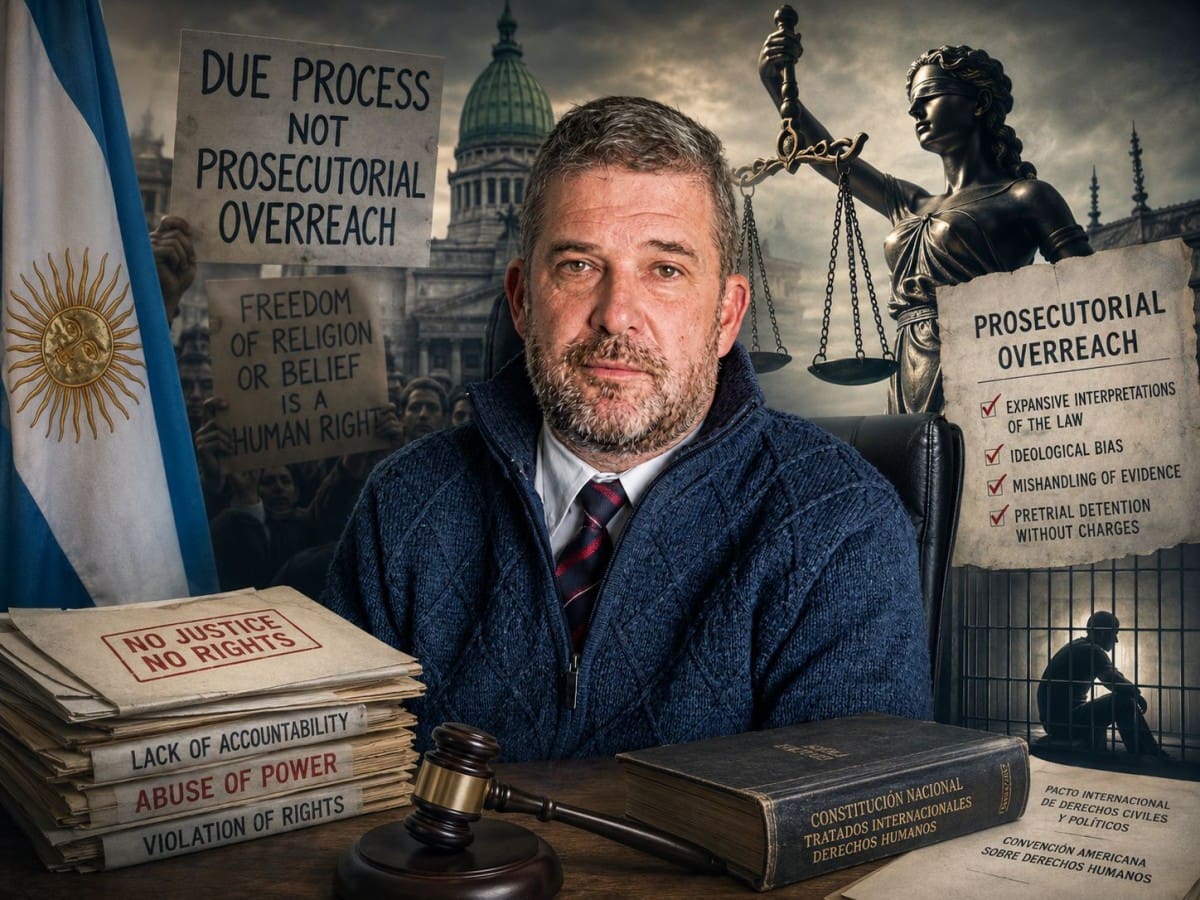
Prosecutorial Overreach in Argentina: An Escalating Human Rights Issue

A Comparative Analysis of Expansive Prosecutorial Practices and Their Impact on Freedom of Religion or Belief and Due Process

In recent years, Argentina has seen a concerning trend in criminal cases: prosecutors extending their authority beyond legal limits, creatively interpreting laws, and handling evidence carelessly, raising significant human rights issues. As an international human rights lawyer, I have watched these developments with growing concern. This issue spans various fields and communities, affecting religious minorities labeled as cults, dissidents, indigenous activists, and ordinary citizens ensnared in a prosecutorial system that sometimes lacks adequate checks.

The special anti-trafficking office, PROTEX, provides a clear example. Argentina’s human trafficking laws are already unusually broad internationally, yet PROTEX and influenced prosecutors have extended them further. Originally aimed at combating organized crime’s exploitation of prostitutes and forced migrant labor, these laws have been applied to spiritual minorities and voluntary religious work. Courts have sometimes supported these theories, but in other instances, they have issued strong cautions. Judges have criticized reliance on coercive persuasion stereotypes, automatic labeling of believers as victims, and careless evidence handling.

Recent rulings highlight the issue. On October 13, 2025, Federal Judge Roberto Falcone acquitted evangelical pastor Roberto Tagliabué after three years of pretrial detention. Charges included human trafficking for labor exploitation, unlawful deprivation of liberty, and illegal medical practice, allegedly through coercive persuasion. Falcone found no factual basis for the narrative by Prosecutor Laura Mazzaferri and PROTEX, denouncing the uncritical use of reports from the National Rescue Program (NRP), which had classified church members as victims without verifying circumstances.

In 2022, the Federal Court of Tres de Febrero dismissed charges against members of the movement Cómo Vivir por Fe, noting that anti-cult activist Pablo Salum’s influence had distorted the investigation. The court emphasized that treating voluntary adherence to a minority faith as a criminal act introduces a paternalistic concept incompatible with democratic principles.

In 2024, the Federal Oral Court of Paraná acquitted defendants of the International Tabernacle Church, documenting serious abuses by PROTEX and the NRP, including coercing believers to identify as victims.

These cases reveal a prosecutorial culture that sometimes prioritizes ideology over evidence. The issue extends beyond religion. The case of Konstantin Rudnev, a Russian dissident and former spiritual teacher detained in Bariloche in 2025, illustrates this broader pattern. The lead prosecutor, Fernando Arrigo, head of the Decentralized Prosecutor’s Office of Bariloche, has faced repeated criticism in Argentine media for his evidence handling.

Arrigo has often encountered trouble. He is involved in the case of Franco Casco’s death, a young man who disappeared in Rosario in 2014 after police detention. His body was later found in the Paraná River. The case became a national scandal, with Casco’s family and human rights organizations alleging police torture and enforced disappearance. Arrigo participated in the investigation, criticized for irregularities, delays, and mishandling forensic evidence. Courts eventually acquitted police officers, and the case has been reopened under Arrigo’s insistence. Police officers involved have complained to the General Prosecutor requesting a criminal case against Arrigo for evidence falsification. This complaint remains stalled, creating an impression of reluctance to advance.

I am not taking a position on the Casco case’s substance. I am aware accusations of brutality and abuse are often raised against Argentine police post-military dictatorship. My concern lies elsewhere: evidence mishandling by prosecutors may convict the innocent or acquit the guilty, undermining the rule of law.

A similar situation has arisen in the Rudnev case. The alleged victim complained to the General Prosecutor against Arrigo and others, accusing them of forcing her to identify as a victim and subjecting her to abuse. The complaint was forwarded to the Prosecutor’s Office and quickly closed for lack of grounds. These examples illustrate a structural issue. In Argentina’s prosecutorial system, complaints against prosecutors are ineffective, and officials bear no responsibility for actions, even in abuse of power cases.

Arrigo is also the prosecutor in Facundo Jones Huala’s case, generating intense debate. The prosecution claims Jones Huala organized violent actions, though media reports indicate reliance on statements during a book presentation rather than specific terrorism acts. Human rights defenders note that, as of June 2026, the investigation remains incomplete and no formal charges have been filed despite continued liberty deprivation.

At each review of the preventive measure, the prosecution seeks to extend pretrial detention, citing case complexity and defendant beliefs’ alleged threat. When Judge Ezequiel Andreani ordered his transfer to Esquel, the Bariloche Prosecutor’s Office appealed, signed by Arrigo, freezing execution. Relatives


Comments

3 responses to “Prosecutorial Overreach in Argentina: An Escalating Human Rights Issue”

  1. Wildcat Appaloosa Avatar
    Wildcat Appaloosa

    Seems like Argentine prosecutors are on a mission to redefine “justice”—you know, like an avant-garde art project where the brush strokes are made of human rights violations. 🎨🙄

  2. dallas burn Avatar
    dallas burn

    Oh, nothing screams “justice” quite like a prosecutor who thinks the law is more of a “suggestion,” eh? 🎭 Can’t wait to see how this circus unfolds—maybe they’ll throw in a magic show next! 🃏

  3. Call Back Queen Avatar
    Call Back Queen

    Oh, nothing says “justice” quite like a prosecutor who’s reinventing the legal system as if it were a trendy café menu—just don’t order the human rights special! 🍷📜

  4. Potato Sub Avatar
    Potato Sub

    Imagine thinking you’re a legal eagle while playing hopscotch with human rights—classic Argentine charm, eh? Guess it’s all part of the “everyone’s a victim” circus, but hey, who needs due process when you can just label folks as cultists and call it a day? 😏🕵️‍♂️

Leave a Reply

Your email address will not be published. Required fields are marked *

Last News

Canada expects submarine decision ‘in 30 days,’ procurement chief says

Canada expects submarine decision ‘in 30 days,’ procurement chief says

Fuhr highlighted the magnitude of the initiative, noting that if Canada acquires all 12 submarines and constructs the necessary infrastructure on both coasts, “this could be the biggest procurement Canada does.”
However, this step would not result in a final contract award but would progress one of the two qualified suppliers into detailed negotiations with Ottawa.
“Right now we have two qualified

Read More

Debate Intensifies Over Iran’s Leadership Transition as Analysts Explore Future Scenarios

Debate Intensifies Over Iran’s Leadership Transition as Analysts Explore Future Scenarios

Tehran, Iran, June 13 – Eurotoday Newspaper — Iran leadership transition remains a subject of significant discussion among political analysts, diplomats, and regional observers as attention continues to focus on the future direction of the country’s political system. While no official transition process is currently underway, conversations regarding a potential Iran leadership transition have in

Read More

Prosecutorial Overreach in Argentina: An Escalating Human Rights Issue

Prosecutorial Overreach in Argentina: An Escalating Human Rights Issue

A Comparative Analysis of Expansive Prosecutorial Practices and Their Impact on Freedom of Religion or Belief and Due Process
In recent years, Argentina has seen a concerning trend in criminal cases: prosecutors extending their authority beyond legal limits, creatively interpreting laws, and handling evidence carelessly, raising significant human rights issues. As an international human rights l

Read More

Canada’s Carney Sees ‘Timely’ Role for G7 in Any Iran Deal

Canada’s Carney Sees ‘Timely’ Role for G7 in Any Iran Deal

Carney highlighted “the possibility of a more lasting end to hostilities,” and considered France’s decision to include leaders of Egypt, Saudi Arabia, Qatar, and the UAE in an expanded G7 summit as “timely.”
However, Carney stressed that any credible agreement must involve “a broader cessation of hostilities, including in Lebanon.”
Martin, whose government has b

Read More

Middle East Conflict Intensifies: New Challenges for Families, Economies, and Communities

Middle East Conflict Intensifies: New Challenges for Families, Economies, and Communities

Gaza Strip, June 13 – Eurotoday Newspaper — Middle East conflict impact remains a major concern as ongoing instability continues affecting families, communities, and economies throughout the region. Humanitarian organizations, governments, and international institutions are closely monitoring developments as the Middle East conflict impact extends beyond immediate security concerns and influence

Read More

World News Summary: Violence Impedes Ebola Response, Aid in Darfur and Gaza, Nicaraguan Activist’s Death in Custody

World News Summary: Violence Impedes Ebola Response, Aid in Darfur and Gaza, Nicaraguan Activist’s Death in Custody

At least seven civilians were killed in villages in Mambasa Territory, Ituri province, on Sunday, according to humanitarian partners. The attack comes after weeks of escalating violence in the province, bringing May’s death toll to over 170. Violence also persists in North and South Kivu provinces, where armed clashes hinder access to fields and impede humanitarian and health workers in the

Read More

Escalating Regional Security Tensions: Diplomacy and Military Actions Reshape the Middle East

Escalating Regional Security Tensions: Diplomacy and Military Actions Reshape the Middle East

Jerusalem, Israel, June 13 – Eurotoday Newspaper — Regional security tensions continue drawing international attention as diplomatic negotiations, military activity, and geopolitical developments shape the outlook for the Middle East. Governments, investors, and policy experts are closely monitoring events across the region as regional security tensions influence security planning, economic expe

Read More

Swedish Jets Intercept Russian Aircraft in Two Separate Incidents

Swedish Jets Intercept Russian Aircraft in Two Separate Incidents

Sweden announced on Saturday that it deployed JAS 39 Gripen fighter jets on Friday to intercept Russian military aircraft that appeared to approach Swedish borders.
The Swedish military indicated in a statement that on Friday there were two separate occurrences when Russian Su-24 and Su-34 fighter jets flew in the Baltic Sea area but did not enter Swedish airspace.
“Russia’s actions ar

Read More

Switzerland’s Population Cap Vote Threatens EU Free Movement

Switzerland’s Population Cap Vote Threatens EU Free Movement

A proposal centered on housing and infrastructure may lead Switzerland into a conflict with the EU regarding labor, borders, and asylum cooperation.
Swiss voters are approaching a national ballot on whether to restrict the permanent resident population below 10 million until 2050. If approved, this could force Switzerland to limit family reunification and asylum measures, affecting its free movem

Read More

Rising Regional Security Risks Amid Global Focus on Middle East Diplomacy

Rising Regional Security Risks Amid Global Focus on Middle East Diplomacy

Jerusalem, Israel, June 13 – Eurotoday Newspaper — Regional security risks are drawing renewed international attention as governments across the Middle East closely monitor ongoing diplomatic developments involving major global and regional powers. Policymakers, security analysts, and investors continue evaluating how changing geopolitical conditions could influence stability, cooperation, and f

Read More