



According to an EEA briefing released today, reducing pollution in accordance with the EU Zero Pollution action plan could enhance mental health across Europe. The briefing explores the connections between air, noise, and chemical pollution and mental health issues, as well as potential actions, including the benefits of nature-based solutions on mental well-being.
Scientific studies are increasingly finding a significant correlation between pollution exposure (particularly air, noise, and chemicals) and mental health issues, although more research is needed to firmly establish causality, as highlighted in the EEA briefing ‘Pollution and mental health: current scientific evidence’. Mental health disorders have multiple origins, including genetics, social and economic factors, and more, some of which remain not fully understood. Pollution is now being investigated as a potential contributing factor.
In the past 25 years, Europe has seen a marked increase in the prevalence and incidence of mental health disorders. In 2023, mental health disorders posed the sixth largest disease burden in the EU and were the eighth most common cause of death.
Pollution and mental health: current scientific evidence
Examples from the briefing where pollution is linked to mental health issues include:
Air pollution:
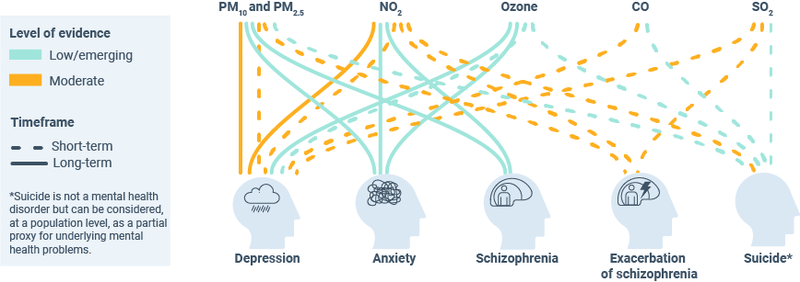
- Exposure to outdoor air pollution during key brain development stages—such as in utero, childhood, and early adolescence—is linked to structural and functional brain changes.
- Long-term exposure to poor air quality (notably PM2.5 and NO2) is associated with a higher prevalence or risk of new onset depression.
- Short-term spikes in exposure are linked with worsening schizophrenia symptoms.
Fig. 1 Links between air pollution and mental health disorders.
Notes: Abbreviations: PM2.5 = particulate matter under 2.5 micrometres; PM10 = particulate matter under 10 micrometres; NO2 = nitrogen dioxide; Source: a comprehensive literature review, focusing on systematic reviews and meta-analyses by the European Topic Centre on Human Health and the Environment (ETC HE, 2026).
Environmental noise:
- An increase in road-traffic noise correlates with a small rise in depression (3%) and anxiety (2%) risk.
- Exposure to environmental noise is linked to increased prevalence of behavioral issues in children, affecting their mental well-being.
- A 2.2% rise in suicide rates is noted per 10dB increase in railway noise.
- A meta-analysis found a 12% rise in depression risk per 10dB Lden increase in aircraft noise.
Fig. 2 Links between environmental noise pollution and mental health issues

Source: ETC HE, 2026.
Chemicals:
- Prenatal or childhood exposure to lead (Pb) is associated with depression and schizophrenia.
- Exposure to second-hand smoke is consistently linked to depression and schizophrenia, particularly in vulnerable groups such as children and pregnant women.
- Studies link prenatal BPA exposure to childhood depression and anxiety.
Fig. 3 Links between chemical pollution and mental health issues.

Notes: Abbreviations: SHS = second-hand smoke; Cd = cadmium; Hg = mercury; Sn = tin; Cu = copper; Mn = manganese; Mg = magnesium; BPA = bisphenol A; PFAS = per- and polyfluoroalkyl substances.
Sources: ET










Leave a Reply