


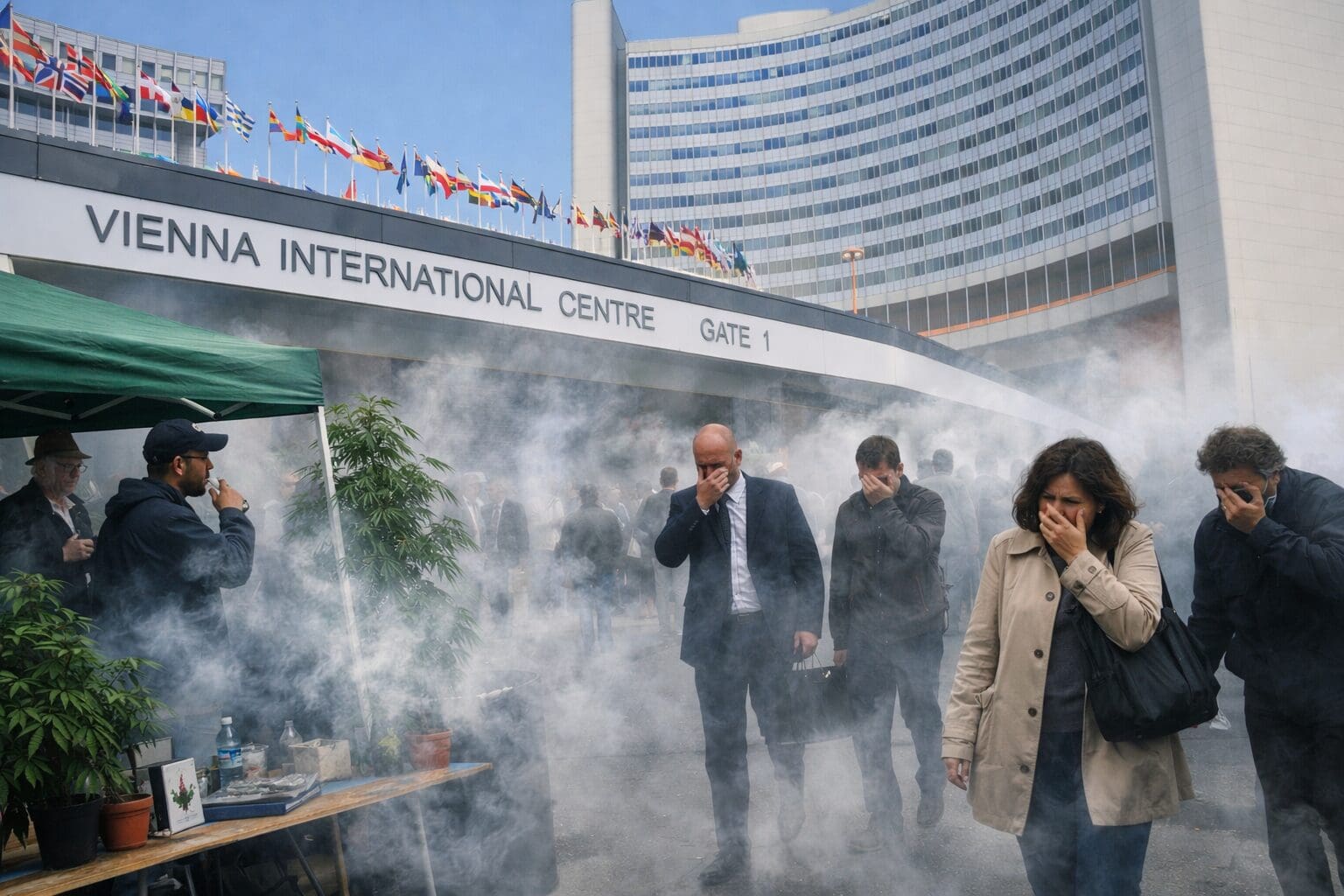
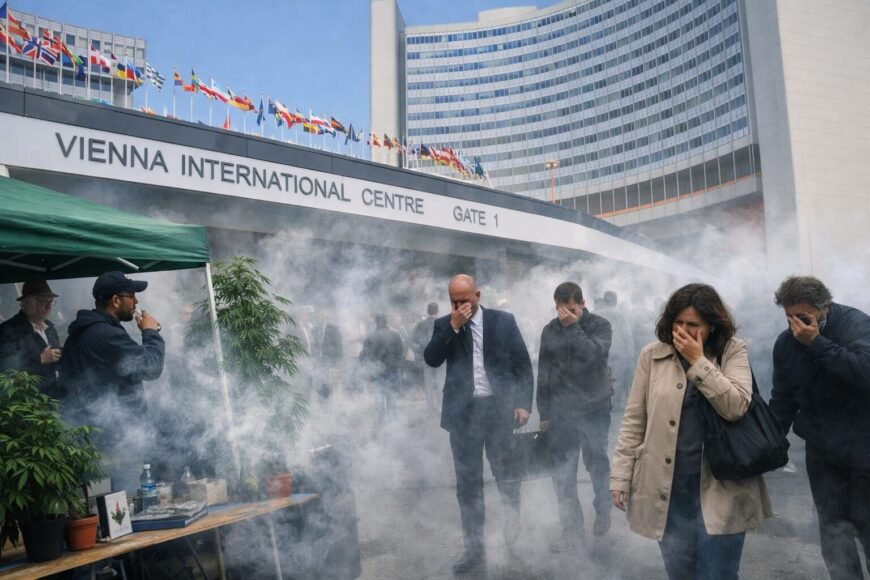
As delegates, diplomats, journalists, and civil society representatives gathered at the United Nations in Vienna for the 69th session of the Commission on Narcotic Drugs on March 12, 2026, they encountered an unsettling situation: the smell of cannabis smoke near the venue’s main entrance. For many attending, this was more than a political statement; it was unwanted exposure to a psychoactive substance in a public space outside a leading forum on drug policy.
From March 9 to 13, the 69th session of the Commission on Narcotic Drugs convened governments, UN officials, experts, and NGOs in Vienna to discuss prevention, treatment, trafficking, public health, and international cooperation. The venue intends to foster serious discussions on challenging policy issues. However, some attendees arriving by metro faced cannabis smoke outside the entrance.
This location compounds the problem. The visitor entrance to the Vienna International Centre is adjacent to the Kaisermühlen/Vienna International Centre U-Bahn stop, creating a narrow, heavily used access route. Smoking cannabis in this area leaves little choice for those preferring to avoid drug exposure but to walk through the smoke.
Here, the issue shifts from demonstration to public respect. Political activism does not grant the right to impose drug smoke on others. No cause, no matter how fervently held, justifies transforming the entrance to an international institution into a walkway of involuntary exposure.
This point is crucial. UN attendees should not have to inhale cannabis smoke to reach the building. Nor should journalists, staff, interpreters, NGO delegates, or commuters endure this exposure as a part of public debate. Shared spaces require shared responsibilities, foremost being not imposing substances on others.
The public health concern is real. The US Centers for Disease Control and Prevention notes that secondhand cannabis smoke contains many of the same harmful chemicals found in tobacco smoke, with higher levels of THC. The US Environmental Protection Agency warns that secondhand marijuana smoke exposes bystanders to harmful substances, and restricting smoking near buildings is the only effective way to prevent exposure. While risk levels vary with distance, ventilation, and duration, the principle remains: non-users should not be forced to inhale others’ smoke.
The comparison with tobacco control is inevitable. Across Europe, smoke-free laws follow a simple principle: one’s freedom to smoke ends where another’s lungs begin. It would be remarkable to uphold this principle in offices, restaurants, and transport zones, only to abandon it when cannabis smoke is involved and the smokers cite political motives.
This contradiction was apparent outside the UN in Vienna. At a summit addressing prevention, health, organized crime, and drug-related social issues, attendees faced cannabis smoke instead of reasoned arguments. This isn’t effective advocacy; it’s an imposition.
It also sends the wrong message. Campaigners promoting cannabis normalization as responsible and modern undermine their cause by disregarding those wishing to avoid the drug. If their argument is about freedom, they should start by respecting others’ freedom not to inhale their smoke.
What happened outside the Vienna International Centre concerns more than just legalization opponents. One needn’t take sides in the policy debate to recognize the problem. Public protest is one thing; filling the UN approach with cannabis smoke is another.
The distinction is crucial because civilized public life depends on it. In a democracy, people may campaign, persuade, protest, and advocate. But they do not have the right to make unwilling strangers physically partake in their cause. The UN threshold is precisely where this boundary should be most respected.
The lesson here is straightforward. Drug-policy debates are already contentious enough without activists turning shared public spaces into vehicles for forced exposure. The UN entrance in Vienna should remain a pathway to international dialogue, not a gauntlet of cannabis smoke.
Whatever one’s stance on legalization, one principle is indisputable: nobody should have to pass through drug smoke to enter the United Nations.







Leave a Reply