



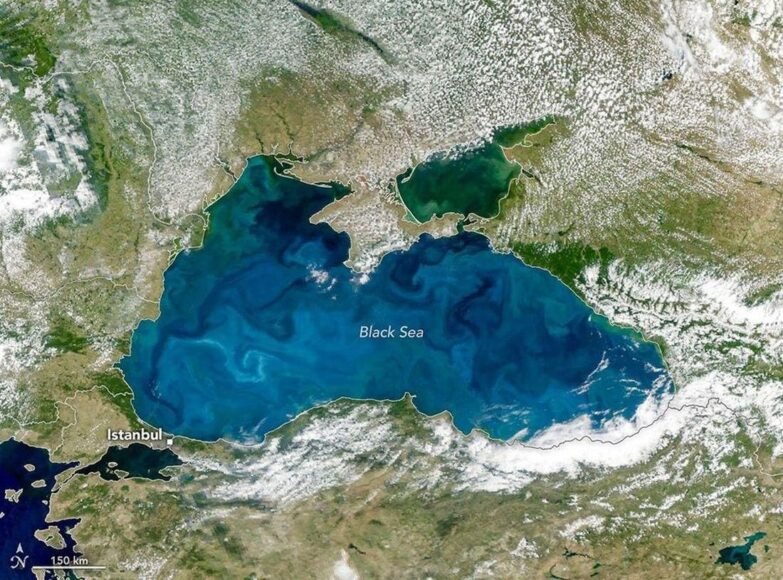
Every late spring and early summer, the Black Sea transforms from its usual dark color to a vibrant turquoise hue, visible even from space. This year, NASA’s PACE satellite captured the phenomenon.
On June 22, PACE’s Ocean Color Instrument (OCI) recorded this seasonal event, revealing milky-blue and turquoise areas on the Black Sea’s surface. According to NASA Earth Observatory, this natural process occurs almost annually.
Scientists attribute this color change to the proliferation of coccolithophores, microscopic phytoplankton covered in calcium carbonate plates that reflect sunlight. Their population surge in late spring and early summer gives the water a distinctive milky-turquoise appearance visible from orbit.
For the rest of the year, other algae, diatoms, dominate, darkening the Black Sea.
The bloom has also reached the Bosphorus, connecting the Black and Marmara Seas. On May 27, nearly a month before PACE’s image, an astronaut aboard the ISS photographed spiral phytoplankton formations in the strait.
Though invisible individually, coccolithophores in large numbers can alter the color of vast sea areas.
Satellite observations are crucial for tracking marine ecosystems where sampling is difficult.
These organisms contribute to the climate by absorbing atmospheric and seawater CO2 during their development. After their lifecycle, some carbon settles on the seabed, remaining stored for extended periods, participating in Earth’s carbon cycle.
The Black Sea images are part of the ISS and NASA Earth Observatory’s Earth Observation Program, offering free access to images for global scientific study of oceans, atmosphere, and climate.
Source: NASA










Leave a Reply