


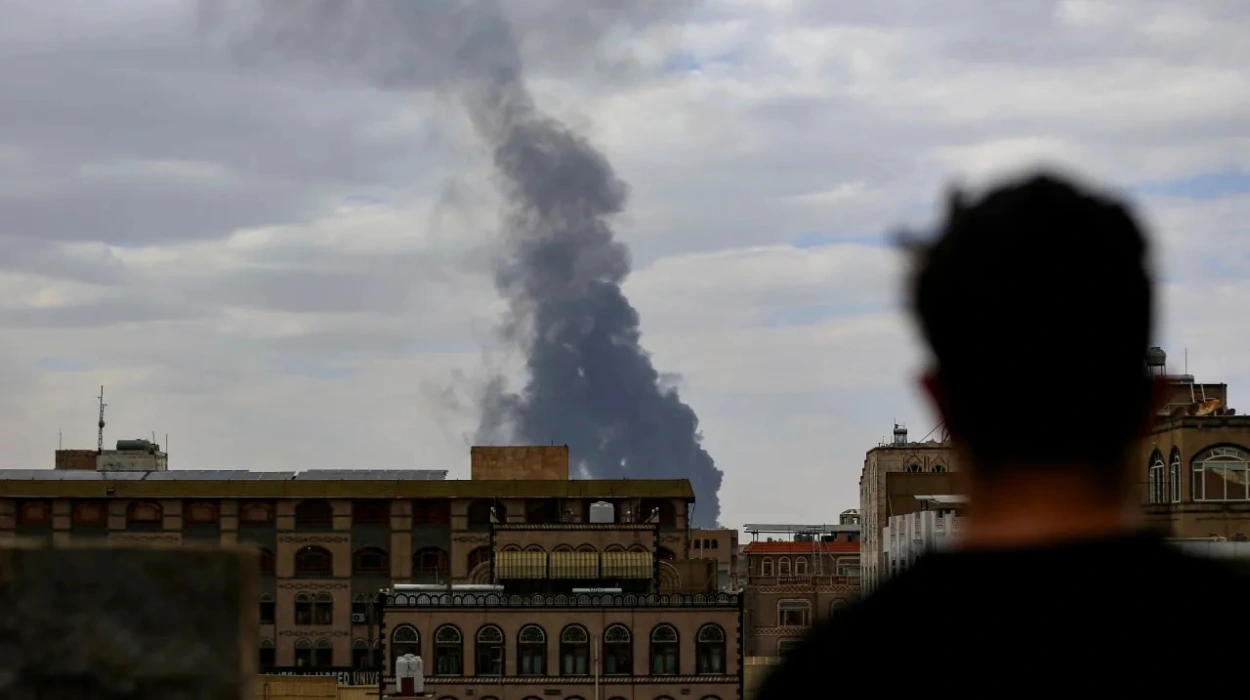
Sanaa (Brussels Morning Newspaper) – The Israeli defence forces announced that they had struck an energy infrastructure site that was operated and utilised by Houthis south of the Yemeni capital Sanaa early on Sunday, with reports revealing that the Haziz power station had been attacked.
The Israel military stated that the strikes were a reaction to multiple attacks by the Houthis, including missile and drone launches targeting Israel. The US and the UK have also previously conducted attacks against the Houthis in Yemen.
Why did Israel target the Haziz power station?
Israeli media noted earlier that the Israeli navy carried out the attack on the Haziz power station near the capital. A military statement stated Israeli forces “struck… deep inside Yemen, targeting an energy infrastructure site that served the Huthi terrorist regime” in the region of Houthi-held capital Sanaa, without calling the area.
How did the Houthis respond to the Israeli strike?
Houthi-operated Al Masirah TV said that the ‘aggression’ enabled an attacking force to disable some of the power station’s generators. Al Masirah also claimed multiple teams contained the fire. No immediate casualties have been reported. Residents reported hearing at least two explosions earlier in Sanaa.
Israel has escalated airstrikes targeting Houthi-controlled areas in Yemen in retaliation for an ongoing barrage of rockets and drones launched by the Houthis at Israel. Since October 2023, Houthis in Yemen have engaged in missile and drone launches in the direction of Israel. The Houthis claim that they are launching these missions as a show of solidarity to fellow Palestinians undergoing military war in Gaza and protests against Israeli operations against them.
How has Israel expanded strikes beyond Gaza and Lebanon?
Israel has expanded its strikes from Gaza and Lebanon to Yemen. They aim to deny the Houthis of their military logistics capabilities. Their major strikes have destroyed ports (Hodeidah, Ras Isa, As-Salif), power plants (Ras Qantib, Haziz), and Houthi-held oil terminals and infrastructure needed to facilitate the import of weapons and command.
What happened during the major Israeli air raid on 5 May?
In one of the most significant attacks on 5 May 2025, over 30 Israeli Air Force aircraft attacked nine Houthi targets using approximately fifty munitions. Significant targets were the al-Imran cement factory east of Hodeidah; four killed, 42 wounded. This tiger was in direct response to a Houthi missile impacting Ben Gurion Airport the day prior.
Comments
16 responses to “Israeli Army Strikes Haziz Power Plant in Houthi-Controlled Sanaa”
-
So, striking a power plant in Yemen sounds like a classic case of “let’s fix their electricity issues” – I mean, who doesn’t love a little DIY diplomacy? 💥🔧
-
Seems like the Israelis are playing a real-life game of “Where’s the Power Plant?” – but you know, in a not-so-fun way. Next stop, a Houthi field trip to the energy crisis! 😂
-
Right, so Israel’s gone and played whack-a-mole with a power plant, just what we needed – more sparks flying in the Middle East! 🤷♂️ Nothing like a bit of energy policy enforced with airstrikes, eh?
-
Typical, innit? Just when you thought Yemen was running on fumes, the Israeli army decides to spice things up by giving their power plant a cheeky little makeover. 💥🔌
-
Striking a power plant, eh? Because nothing says “I’m taking a stand” quite like dimming the lights while you’re at it. 💡🇮🇱
-
Seems like the Israeli army has decided to play a little game of “who strikes first” in Yemen—because nothing says peace like blowing up a power plant, right? 🎯💡 Just another day in the soap opera of international relations!
-
Seems like Houthi energy infrastructure is the new trendy target for Israeli strikes—who needs a power grid when you can have fireworks instead? 🎆💥
-
Striking a power plant, eh? Because nothing says “we care about renewable energy” like blowing up the competition. 💥⚡️ Talk about an electrifying diplomatic strategy!
-
Blimey, who knew taking out a power plant would become the latest energy-saving trend? Next up, they’ll be suggesting we all turn off the lights and embrace candlelit dinners in Sanaa! 💡😂
-
Striking a power plant in Yemen, eh? Talk about a real “light” touch in international relations! 😏💡
-
Seems like the Israelis are really trying to put the “power” back in power struggle, eh? Next up: a tour guide for all the new hotspots in Yemen—don’t forget your hard hats! 😂⚡️
-
Quite the electrifying strategy, isn’t it? Nothing like a bit of “power play” to show who’s in charge – just hope they remembered to pay their electricity bill, or it’ll be candlelit dinners for the Houthis! 🔥💡
-
Striking a power plant, eh? Brilliant strategy, just when we thought the energy crisis was only a European affair! 💡🇮🇱 #LetThemChargeTheirPhones
-
Looks like the Israelis are really going for the “green energy” vibe by targeting power plants – nothing says environmental responsibility like blowing up a power station! 🤷♂️ Just another day in the Middle East soap opera, eh?
-
Just another day in the Middle East, where “energy efficiency” is taken to a whole new level—who needs power when you can have a light show? 🌩️💥 Talk about striking deals!
-
Nothing says “we care about energy efficiency” quite like bombing a power plant, right? 🤦♂️ Must be a new tactic in the “green energy” campaign—just not the kind we had in mind! 💥🔋

Last News

EU Strengthens Child Abuse Legislation
Provisional deal targets AI-generated abuse material, sextortion and delayed access to justice for survivors
The European Union has provisionally agreed to enhance criminal law against child sexual abuse and exploitation, addressing new digital threats and extending the timeframe for survivors to seek justice. This agreement, pending approval from the European Parliament and the Council, is a ke

Andy Burnham Appoints Former Blair Minister James Purnell as Chief of Staff
In 2013, he became the BBC’s director of strategy, later joining the lobbying firm Flint Global as chief executive in 2024. His financial interests in Flint may require assessment under conf

The Iran Deal Masks the Imminent Challenge for Global Shipping’s Dual-Level Resilience
G7 leaders last week endorsed the US-Iran memorandum of understanding, praising the framework for reopening the Strait of Hormuz and easing energy market volatility. Crude futures have eased as initial tanker movements resume. Yet this surface calm masks a deeper structural shift: the agreement formalizes a two-tier maritime system where state-aligned energy flows receive preferential risk treat

Norway Advances to the Knockouts
Haaland’s brace propels Norway back into World Cup prominence
Norway advances to the World Cup round of 32 with a 3-2 victory over Senegal, marking a significant achievement beyond Erling Haaland’s scoring prowess. Absent from tournament knockouts since 1998, Monday’s win in New Jersey was a breakthrough, highlighting the expanded World Cup’s potential for lesser-known nations.
By Daniel Mercer,
Hungary Halts EU Membership Efforts for Ukraine and Moldova
The Hungarian Permanent Representation in Brussels did not respond to a request for comme

The Bürgenstock Moment and What Pakistan Must Do With It
Taliban Negotiations Criticized Over EU Return Policy
The European Union is facing backlash over a meeting in Brussels with Taliban representatives to discuss migration returns, which critics say may weaken Europe’s stance on non-recognition, women’s rights, and protection from for

Zelenskyy to Miss Ukraine Recovery Conference Amid Poland Dispute
“I am leading Ukraine’s delegation and our overall work at the Ukraine Recovery Conference 2026 in Gdańsk,” Svyrydenko po
Enhancing Online Reputation Management with Digital PR for Improved Google Rankings in the UK
London, June 23 – Eurotoday Newspaper — Online reputation management has become an increasingly important part of Digital PR strategies as UK businesses compete for stronger visibility in Google Search and greater customer trust. Industry experts say companies that invest in high-quality media coverage, authoritative backlinks, and expert-led content are more likely to strengthen their online pr

Pay Transparency in the EU Divides Workplaces
European workers are entering a new stage in the equal pay debate as EU salary transparency rules are set to be applied in workplaces following the 7 June transposition deadline. This reform aims to uncover hidden pay discrimination, but inconsistent implementa
Leave a Reply