


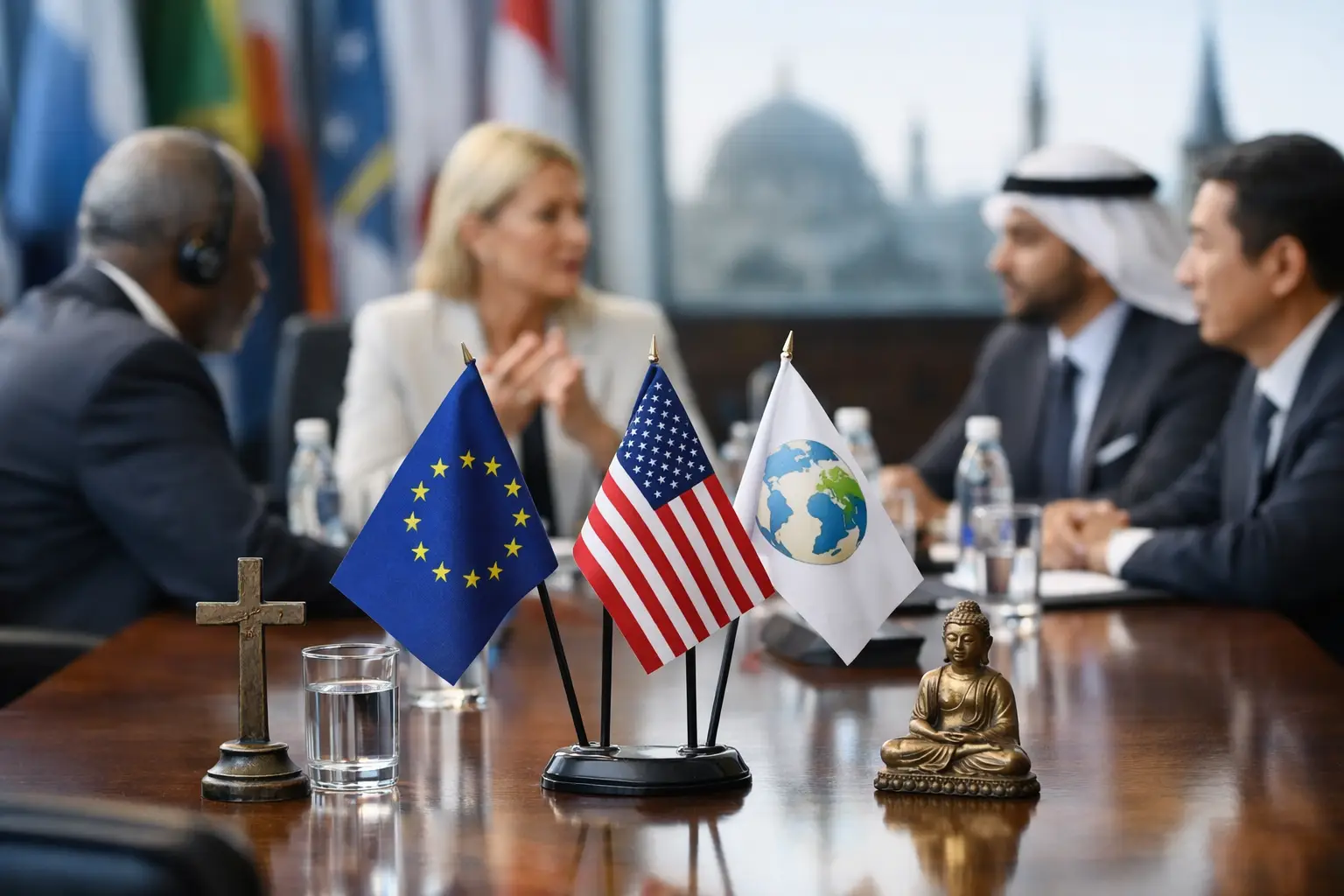
Government discussions on freedom of religion or belief often feature polished language, but the real measure lies in their actions afterward. Here, the international contact group on freedom of religion or belief becomes crucial, serving as a test to see if like-minded states can transform concern into coordinated pressure, practical support, and measurable protection.
For those following human-rights diplomacy, this group is not marginal. It intersects with foreign policy, multilateral advocacy, and is a significant area of rights protection. Commonly referred to as FoRB, it encompasses more than just the rights of religious communities. It includes the right to have a religion, change it, have none, publicly or privately express beliefs, and be free from coercion and discrimination on these grounds. Any serious international group in this field quickly enters sensitive political areas.
The Role of the International Contact Group on Freedom of Religion or Belief
The international contact group on freedom of religion or belief serves as a diplomatic coordination platform, not as a treaty body or court. It gathers states and engages with experts, civil organizations, and other stakeholders concerned with FoRB violations. Its role is not to replace the UN system or regional human rights bodies but to provide alignment—comparing assessments, sharing evidence, coordinating messages, and sometimes increasing political pressure around specific cases or trends.
Readers may assume such a group has direct enforcement powers, but it does not. It can’t prosecute perpetrators, enforce legal reform, or order sanctions by itself. Its strength lies in shaping diplomatic agendas, amplifying underreported abuses, and maintaining scrutiny on governments to prevent victim isolation.
These groups focus on patterns like criminalization of apostasy or blasphemy, worship restrictions, administrative harassment of minority communities, detention of conscience prisoners, surveillance of faith groups, and violence tolerated or enabled by state authorities. They may also address non-state threats where governments fail to protect vulnerable communities.
The Importance of This Group in a Busy Rights Arena
Though there are many declarations on religious freedom, the issue is fragmentation. One institution may raise a concern, another issue a recommendation, a third host an event, and then momentum is lost. The international contact group on freedom of religion or belief aims to reduce this fragmentation.
This is especially important during crises when violations escalate quickly but diplomatic systems respond slowly. If governments are in structured contact, they can react faster, coordinate actions, support urgent advocacy, and push for visibility in international forums before cases are forgotten. For those jailed over beliefs or facing prosecution under vague laws, delays can be crucial.
There is also a geopolitical reason to consider the group seriously. FoRB is often seen as a niche rights issue or a culture-war talking point, but both views are inadequate. Restrictions on religion or belief are frequently associated with broader authoritarian practices—censorship, intrusive registration systems, digital surveillance, arbitrary detention, and attacks on civil society. States that criminalize dissenting beliefs often go further.
For European policymakers, this is relevant. Freedom of religion or belief is not only a value statement in external policy. It is part of Europe’s assessment of rule of law, democratic resilience, minority protection, and international obligations. It also impacts migration, conflict prevention, and relations with partner states.
Characteristics of Effective Coordination
An effective contact group does more than express generic concerns. It identifies priorities, clearly names patterns, and distinguishes between private diplomacy and public pressure. Sometimes a quiet coordinated approach can secure access, release, or legal relief. In other cases, discretion shields abuse from scrutiny, requiring public signaling.
The approach depends on context. Some governments respond to reputational pressure, while others do so only when rights concerns affect aid, trade, or strategic relations. Therefore, an effective group requires institutional literacy and moral clarity. Rights language alone is insufficient without leverage.
A credible agenda should resist narrowing FoRB into protection for majorities or convenient communities. The principle is universal, including minority faiths, intra-faith dissenters, converts, humanists, atheists, and those persecuted because authorities assign them a religious identity they don’t claim. Selective concern is a common weakness.
Europe’s Engagement with the International Contact Group on Freedom of Religion or Belief
Europe has reasons to engage seriously with this group. European institutions and member states present themselves as defenders of rights-based foreign policy, inviting scrutiny. If Europe supports FoRB rhetorically but treats it secondary to trade, migration control, or competition, credibility erodes quickly.
There is an internal aspect as well. European countries face their own FoRB controversies, such as antisemitism, anti-Muslim hatred, discriminatory registration, coercive narratives, or disputes over belief manifestation in








Leave a Reply