


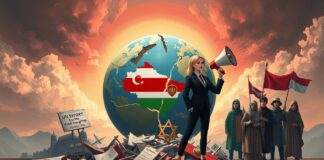
Hungary’s Religious Discrimination and the Politicization of Religious Freedom at the UN
The latest UN discussions on freedom of religion or belief (FoRB) once again highlighted two concerning issues: Hungary’s persistent religious discrimination and the politicization of the FoRB platform by multiple states, who used the session as a battleground for geopolitical disputes rather than as a space to protect religious minorities.
While UN Special Rapporteur Nazila Ghanea presented a comprehensive report detailing systemic religious violations in Hungary, the Hungarian government dismissed the findings outright, instead attacking the credibility of the UN mechanism. Meanwhile, rather than engaging in meaningful discussions about supporting persecuted religious groups, several states exploited the session to push political agendas, turning the debate into a diplomatic showdown rather than a forum for human rights advocacy.
—
Hungary’s Systemic Religious Discrimination
The Special Rapporteur’s report, based on an official UN visit to Hungary in October 2024, painted a troubling picture of how the Hungarian government actively restricts religious freedom through biased legal frameworks, targeted harassment, and preferential state funding. Some of the most striking findings include:
– The 2011 Church Law reduced the number of recognized churches from 350 to just 14 overnight, stripping many religious groups of legal status and funding. Although the number has since risen to 32 officially recognized churches, many others must undergo a politicized parliamentary approval process to gain recognition.
– The Hungarian Evangelical Fellowship (MET), led by Pastor Gábor Iványi, was stripped of its legal status in 2011 and has since lost state funding for its schools, homeless shelters, and social programs. Despite winning a case at the European Court of Human Rights (ECtHR) in 2014, MET has not been reinstated and faces financial hardship that threatens its social services.
– State funding overwhelmingly favors Christian groups, particularly the Roman Catholic Church, the Reformed Church of Hungary, and the Evangelical Lutheran Church. In 2018 alone, the government allocated around 14 billion HUF ($50 million USD) to these groups, while smaller religious organizations receive little to no support.
– The Church of Scientology has been subjected to state harassment, including police raids, unjustified permit denials, and the seizure of religious documents. The Special Rapporteur identified these actions as clear examples of state suppression of minority religious groups.
– Religious education in public schools is increasingly focused on Christian teachings, with church-run schools receiving significantly more government funding. In some rural areas, non-Christian students are effectively excluded, as church-run schools can legally refuse students based on religious affiliation—a policy that disproportionately affects Roma children and other minorities.
Hungary portrays itself internationally as a “protector of Christianity”, often using religion as a tool of national identity and political control. However, this privileged treatment is selective, benefiting only certain Christian denominations while actively discriminating against other religious groups.
—
Hungary’s Denial of Religious Discrimination
Rather than addressing the Special Rapporteur’s findings, Hungary attacked the UN's credibility, dismissing the report as “politically biased” and denying any systemic discrimination. The government insisted that Hungary is “one of the safest places for Jews” and claimed that religious minorities face no state-imposed restrictions.
However, Hungary’s own record contradicts these claims. The European Court of Human Rights (ECtHR) has repeatedly ruled against Hungary for violations of religious freedom. Additionally, European Union reports, human rights organizations, and Hungary’s own religious minorities have documented ongoing discrimination and unequal treatment.
—
UN FoRB Session: A Platform for Political Infighting
Beyond Hungary’s refusal to engage, the UN session was dominated by political disputes between various states, overshadowing the critical issue of protecting religious minorities.
– Russia and Georgia engaged in a dispute over religious repression in Russian-occupied territories.
– Azerbaijan and Armenia used the forum to debate war crimes rather than focus on religious persecution.
– Palestine, Israel, and Arab states shifted the discussion toward the Israeli-Palestinian conflict, diverting attention from broader global religious freedom issues.
While these geopolitical conflicts are important in their own right, their focus in a forum dedicated to religious freedom diluted efforts to address widespread systemic discrimination worldwide. Instead of pushing for concrete solutions for

Leave a Reply