


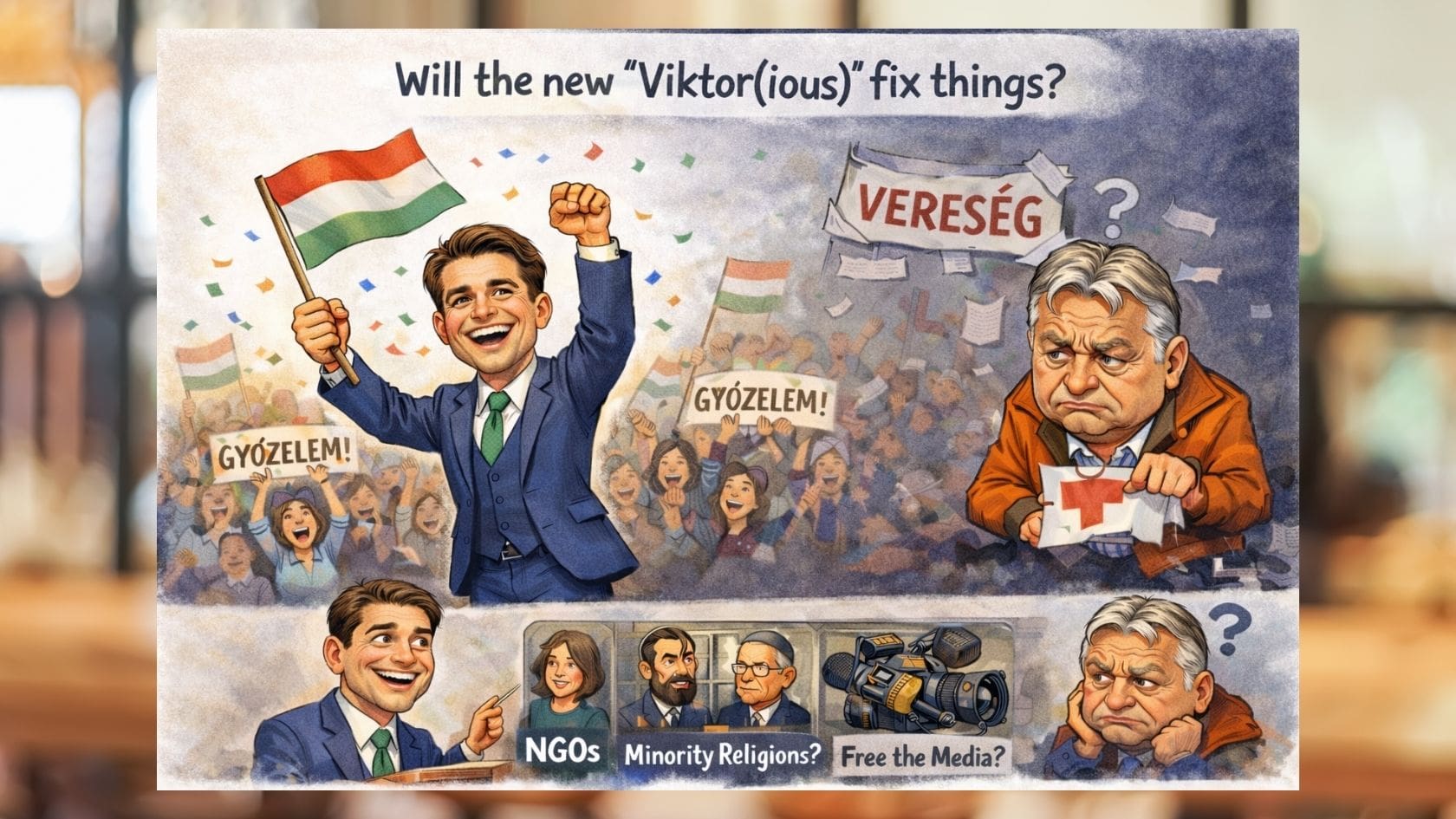
Hungary’s election on April 12, 2026, has already made history. Viktor Orbán has conceded defeat, marking the end of the long-dominant Fidesz-KDNP alliance. This shift raises crucial questions: will political change bring relief to religious minorities, independent NGOs, and civic groups previously under pressure? To demonstrate a new chapter for Hungary, the incoming leadership must prioritize freedom of religion, association, and equal legal treatment.
By Sunday night, Orbán admitted defeat after 16 years, with Péter Magyar and the Tisza party emerging as clear winners. The political significance is evident. However, for many Hungarians and others in Brussels, Strasbourg, and beyond, the deeper question is whether institutional repair will follow this electoral shift. Elections can change governments swiftly, but dismantling systems of discrimination takes longer.
Orbán’s era will be remembered for constitutional changes, media concentration, and EU conflicts, alongside a style that divided civil society into “loyal” and “suspect” groups. This affected migrant-support organizations, anti-corruption groups, independent media, and certain religious communities outside the preferred “Christian Hungary” narrative.
Concerns have not been limited to political opponents. In October 2024, UN Special Rapporteur Nazila Ghanea highlighted Hungary’s need for further reforms to ensure all religious and belief communities operate without discrimination. This issue is significant, affecting legal personality, equal recognition, access to rights, and community functionality without political favor.
Hungary’s church-status regime exemplifies the situation. The 2011 Church Law stripped official recognition from nearly 350 religious communities. In 2014, the European Court of Human Rights ruled that losing full church status breached rights protected by the European Convention, criticizing a system requiring religious communities to seek political approval for recognition.
Legal challenges continued. Despite later amendments, the UN’s 2024 assessment indicated the framework still resulted in unequal treatment. Some groups felt tolerated rather than equal, and for some, persecuted, which undermines state neutrality in a democratic Europe.
Concrete consequences followed. Human Rights Watch reported that in August 2024, Hungarian authorities revoked operating licenses from three schools run by the Methodist Evangelical Church, a group embroiled in church recognition and state treatment disputes. When legal discrimination affects schools and social services, it impacts daily life for families, children, and vulnerable communities.
Similar political logic applied to NGOs. In 2020, the Court of Justice of the European Union ruled against Hungary’s foreign-funded NGO transparency law for being discriminatory and unjustified. The law required organizations to register as foreign-supported and disclose donor information, suggesting independent civic activity was suspect.
Next came the “Stop Soros” package. In 2021, the same court found Hungary violated EU law by criminalizing certain aid to asylum seekers. This goes beyond migration politics. When a government turns legal aid, humanitarian advice, or solidarity work into suspicion, it weakens the democratic space in which civil society operates.
Recently, pressure was not abandoned but updated. The 2023 sovereignty law and creation of the Sovereignty Protection Office introduced a mechanism critics said could chill debate and stigmatize outside-supported organizations. The European Commission referred Hungary to the Court of Justice over the law, while Freedom House reported arbitrary investigations of anti-corruption organizations and investigative media. The Venice Commission bluntly stated the framework creates a chilling effect and should be repealed.
The new majority now has a rare opportunity. They can either treat rights repair as secondary or understand its connection to economics and anti-corruption. A democratic state cannot credibly promise clean governance while maintaining legal tools to pressure minority faiths, stigmatize NGOs, or intimidate watchdog journalism.
A practical, visible reform phase would involve restoring an equal legal framework for religious communities, ending politically conditioned recognition systems, protecting faith-based schools and charities from retaliation, and aligning Hungarian law with European court rulings.
It would also involve revisiting laws framing civic organizations as foreign influence agents, ending arbitrary investigations, rolling back sovereignty-based intimidation, and clarifying that independent NGOs are part of democratic society, not its enemies. Hungary requires equal citizenship under neutral laws, not new tolerance rhetoric.
If Péter Magyar and the new leadership want to show this election represents a new direction, they should prioritize freedom of religion and civic space. These issues are key indicators of a democracy’s confidence to protect people and groups it doesn’t control.
Hungary’s next chapter should be written not only in terms of markets, EU funding, or geopolitical shifts but also in the day-to-day reality of a minority church’s status, faith-based schools operating without retaliation, and NGOs defending rights without disloyalty labels.
Orbán’s defeat, if followed by genuine reforms, might be more than an electoral event. It could become the moment Hungary begins healing civic and religious freedoms wounded under Orbán and Semjen. That’s the democratic test facing the winners, and Europe will be observing.







Leave a Reply