


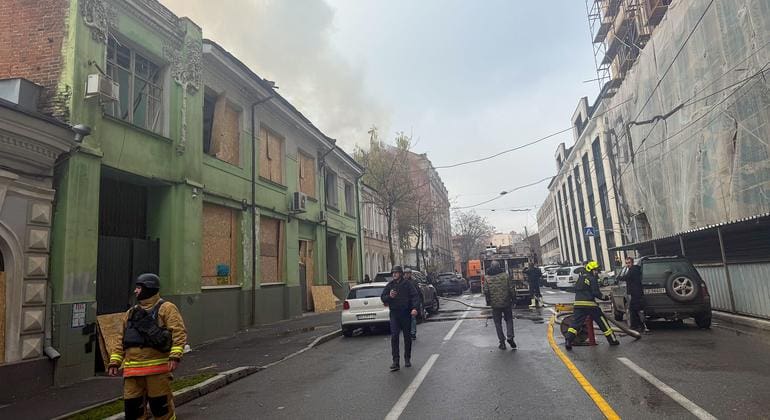
Between Friday and early Monday, at least 15 civilians were killed and over 70 injured, according to OCHA. On Saturday night, missile and drone attacks affected 10 regions: Chernihiv, Dnipro, Donetsk, Kharkiv, Kherson, Kirovohrad, Mykolaiv, Odesa, Poltava, and Sumy. Matthias Schmale, the humanitarian coordinator, condemned the attacks, emphasizing that civilians and civilian objects are protected under international law and are not targets.
The attacks also caused disruptions in electricity, heating, and water supply, complicating conditions for vulnerable populations amid cold winter temperatures. Energy and residential infrastructure suffered damage in regions like Chernihiv, Odesa, and Poltava, while major cities like Kyiv, Kharkiv, and Odesa experience power outages, with limited electricity availability. The UN and partners swiftly provided emergency shelter materials, blankets, hygiene items, hot drinks, and psychosocial support, as reported by OCHA.
In the Philippines, the UN supports Government-led efforts following Super Typhoon Fung-Wong, locally named Uwan, which hit northern Luzon on Sunday, causing massive evacuations and disruption. According to OCHA, over 1.3 million people were evacuated across 13 of the country’s 18 regions before landfall, marking one of the largest pre-emptive operations. More than 480,000 people remain displaced in about 6,000 evacuation centers. The Government leads the emergency response with support from UN agencies and partners.
Cash assistance has been distributed, with food, tents, hygiene kits, and other supplies pre-positioned. The World Food Programme (WFP) stated its teams are assessing needs in affected areas, with meals and rice stocks ready for distribution alongside national authorities. UN Resident and Humanitarian Coordinator Arnaud Peral commended the swift evacuations and early warnings, noting they likely saved lives. OCHA warned about the potential for more intense typhoons like Fung-Wong due to climate change, highlighting the need for stronger preparedness.
Demographic shifts in Europe and Central Asia are affecting economies and societies, with Europe facing an ageing population and parts of Central Asia experiencing a youth surge, according to a new UN report. The analysis warns of the impact on health systems, pensions, and labor markets in Europe, while Central Asia’s expanding youth offers both opportunities and challenges.
Experts suggest countries need to widen access to quality jobs, encourage participation by women, migrants, and older people in the workforce, and invest in lifelong learning and social protection. The joint brief by the International Labour Organization (ILO), the UN Economic Commission for Europe (UNECE), and the UN Population Fund (UNFPA) calls for stronger policies to create inclusive and resilient economies. Demographic change is not just about numbers; it’s about societal adaptation to ensure everyone can contribute to and benefit from growth.










Leave a Reply