


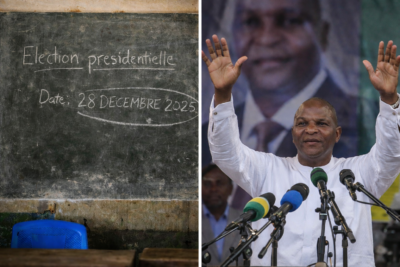
The Central African Republic (CAR) is heading toward one of the most consequential elections in its recent political history. The presidential election scheduled for December 28, 2025, comes at a time of heightened political tension, constitutional controversy, and deep public debate over governance, security, and democracy.
At the center of the contest is President Faustin-Archange Touadéra, who is seeking another term in office following the adoption of a new constitution in 2023 that removed presidential term limits. While the government argues that the reforms reflect the will of the people, opposition parties and civil society groups see the move as a step backward for democratic norms.
Against this backdrop, a group of opposition figures has been officially cleared to contest the presidency. These candidates come from varied political, professional, and ideological backgrounds, reflecting the fragmented but determined nature of the opposition landscape in the Central African Republic.
This article provides a comprehensive overview of the main opposition candidates, their political profiles, campaign priorities, and the broader significance of the 2025 election.
Political Context: Why the 2025 Election Matters
The Central African Republic has experienced decades of instability marked by coups, armed conflict, and fragile peace agreements. Since coming to power in 2016, President Touadéra has positioned himself as a stabilizing figure, relying heavily on foreign security support to maintain control over large parts of the country.
The adoption of a new constitution in 2023, which allows the president to reset his term count, has reshaped the political landscape. Critics argue that the change weakens democratic safeguards, while supporters claim it offers continuity in a country still recovering from conflict.
The 2025 election is therefore widely viewed as a referendum not only on Touadéra’s leadership but also on the future direction of democracy in CAR.

Overview of Opposition Participation
Several prominent opposition figures were initially barred or challenged over eligibility requirements, particularly concerning nationality laws. However, following legal battles and constitutional rulings, multiple candidates have been approved to run.
While the opposition remains divided and lacks a unified coalition, the presence of experienced political leaders and first-time candidates adds complexity to the race and provides voters with alternatives to the incumbent.
Anicet-Georges Dologuélé: The Veteran Opposition Figure
Anicet-Georges Dologuélé is widely regarded as the most prominent opposition candidate in the 2025 election. A former prime minister, Dologuélé has contested previous presidential elections and maintains a strong political profile both domestically and internationally.
His candidacy faced scrutiny due to CAR’s strict nationality laws, which prohibit dual citizens from running for president. Dologuélé resolved the issue by formally renouncing his French citizenship, clearing the way for his participation.
Politically, Dologuélé positions himself as a reformist leader focused on restoring democratic institutions, strengthening the rule of law, and improving relations with international partners. His experience in government and finance appeals to voters seeking stability combined with institutional reform.
However, his long-standing presence in politics has also drawn criticism from voters who associate the political class with past governance failures.
Henri-Marie Dondra: The Technocratic Challenger
Henri-Marie Dondra is another high-profile opposition candidate with extensive experience in government. He previously served as both finance minister and prime minister, giving him a strong technocratic reputation.
Dondra’s campaign centers on economic governance, fiscal discipline, and administrative reform. He has emphasized the need to strengthen public institutions, manage state finances more transparently, and reduce dependence on external actors.
As a former insider, Dondra presents himself as someone who understands the machinery of government but is now prepared to offer a different vision for leadership. His challenge lies in convincing voters that he represents genuine change rather than continuity under a different name.
Marcelin Yalemende: Faith-Based Politics and Constitutional Reform
Marcelin Yalemende enters the race from outside traditional political circles. An evangelical pastor, Yalemende has gained attention for his outspoken criticism of the removal of presidential term limits.
His campaign focuses on restoring constitutional order, promoting ethical leadership, and strengthening democratic accountability. He has called for reforms that would








Leave a Reply