


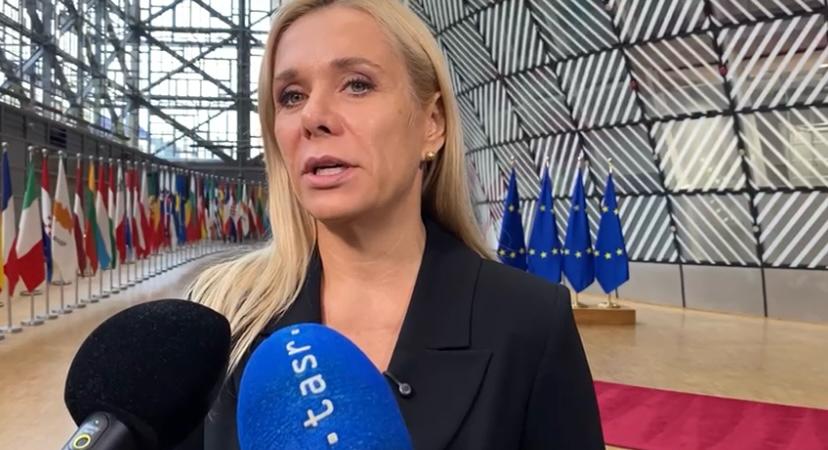
Brussels – Slovakia seeks to play a key role in shaping the future EU competitiveness fund alongside other member states. This was declared by Economy Minister Denisa Saková (Hlas-SD) following the EU Council for Competitiveness meeting in Brussels on Monday, as reported by TASR.
Denisa Saková highlighted that the ministers concentrated on three primary issues: the establishment of the EU competitiveness fund, the objective of phasing out the production of internal combustion engines in the automotive sector by 2035, and the simplification of procedures within the EU single market.
She noted that the competitiveness fund is projected to have a budget of approximately 450 billion euros in the forthcoming programming period, with current discussions revolving around the development of the fund’s specific tools.
“We emphasize the need for smaller states and entrepreneurs in Slovakia to have access to these funds without facing unnecessary administrative hurdles,” she explained. Saková underscored the importance of smaller nations like Slovakia having a role in establishing the evaluation criteria for the fund and accessing its resources, ensuring they are not sidelined by larger countries.
“We aim for Slovakia to be a significant participant in the initial discussions on fund allocation, ensuring our voice is as strong as anyone else’s. We want our entrepreneurs to receive a fair share, considering the economic potential of each member state rather than purely its population size,” she elaborated.
Saková pointed out that discussions in the automotive sector are often dominated by larger member states, with “automotive powers” like Slovakia encouraging the European Commission to reassess decarbonization targets, allowing the market to dictate whether to focus on electric vehicles or internal combustion engine production.
“We acknowledge that electric vehicle manufacturing is the future, but the goals must be realistic in terms of how individual car manufacturers can shift to electric production and whether they have the necessary investments,” she stated, appreciating the European Commission’s commitment to present a proposal on this matter by year-end.
She also welcomed the discussions on the “omnibus,” the sixth package of measures aimed at simplifying regulations and reducing bureaucracy in the single market, potentially saving European companies 8.6 billion euros annually. However, Saková pointed out the Danish presidency’s calculations indicating that proposed regulations could impose an additional burden of 70 to 80 billion euros per year on businesses. She insisted that the European Commission must tackle this issue constructively to maintain EU competitiveness and enhance EU fund accessibility for small and medium-sized enterprises. (September 29)
“We want Slovakia to play a significant role in the discussions about the EU fund for competitiveness, so that it has as strong a voice as others. So that our entrepreneurs do not receive only a small percentage and that consideration is given to the potential of the economy of each member state and not just based on the population size.” Denisa Saková



Leave a Reply