



A conference in Brussels focused on how artificial intelligence (AI) can enhance accessibility and healthcare, while safeguarding dignity and fundamental rights. An avatar that communicates in Italian Sign Language and International Sign was showcased at the European Parliament, highlighting AI’s role in accessibility, precision medicine, and responsible innovation. Attendees advocated for a European approach where technological advancements are assessed not just by efficiency, but by their ability to eliminate barriers, uphold fundamental rights, and enhance daily life.
The conference, “Artificial Intelligence for Accessibility – From Innovation to European Standard,” was held on July 14 at the European Parliament. It featured discussions among EU representatives, scientists, businesses, and disability groups about AI’s potential to create a more inclusive digital landscape in Europe. The focus was on transforming practical innovations into reliable standards for public and private use Europe-wide.
The event was spearheaded by Italian MEPs Pietro Fiocchi, Antonella Sberna, and Chiara Gemma. Opening remarks were made by Alessandro Chiocchetti, Alejandro Moledo del Río of the European Disability Forum, and MEP Francesco Torselli. The emphasis on accessibility aligns with changes in European digital policy, including the European Accessibility Act, which mandates accessibility across various digital services and products as of June 2025.
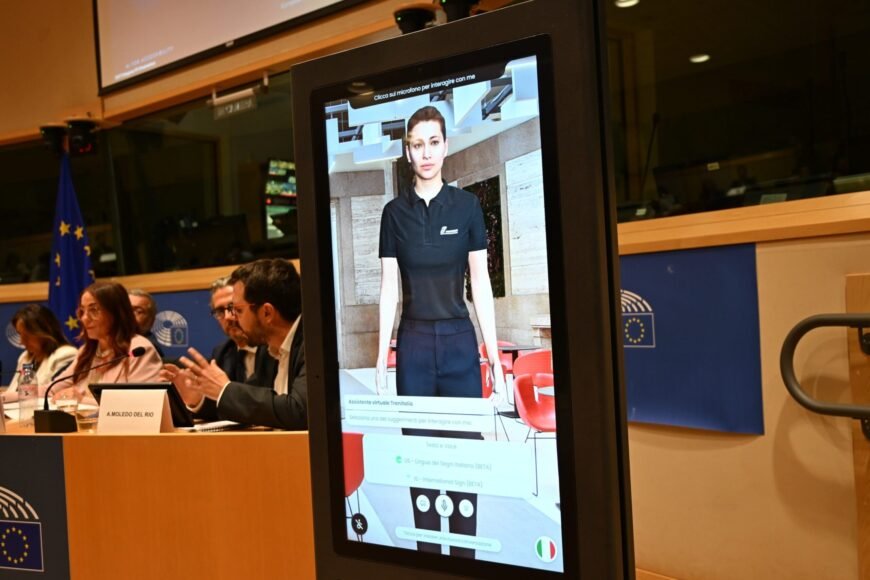
A significant presentation was an intelligent avatar by QuestIT, part of Vection Technologies, which can understand and produce Italian Sign Language (LIS) and International Sign. This tool enables deaf users to interact with digital services visually rather than relying solely on text or audio. It’s being tested in locations like Roma Termini and Milano Centrale railway stations, with 30 sign-language users contributing to its development. Applications are also being considered for Cagliari Airport and the Italian water utility Acquevenete.
AI tools in sign language could provide information beyond interpreter availability, but they must be developed carefully as sign languages are complex. These tools should supplement, not replace, human interpreters. The European Disability Forum highlights that while AI can improve life for disabled people, poorly designed systems can create new barriers. Disability organizations call for accessibility, safety, and user involvement in AI governance.
The conference also discussed AI in healthcare, focusing on its potential for prevention, diagnosis, and personalized treatment. Participants included experts like Antonio Novelli, Sergio Daga, Salvatore Corrao, and Stefano Crisci. Discussions emphasized the need for scientific validation, data protection, and human oversight in medical AI applications.
The event concluded with a discussion on Europe’s AI approach, emphasizing innovation paired with responsibility and fundamental rights. As the EU implements the AI Act, the pursuit of a European standard for accessibility technologies could offer significant benefits. Standards should ensure linguistic quality, accuracy, privacy, security, and user satisfaction in AI tools.
The conference highlighted that inclusive AI is becoming a reality, with applications already in use. The challenge now is to expand these technologies responsibly, ensuring accessibility and human dignity are core design elements from the start.









Leave a Reply