Tirana Launches Railway Project Connecting Albania and Montenegro with €136 Million EU Grant

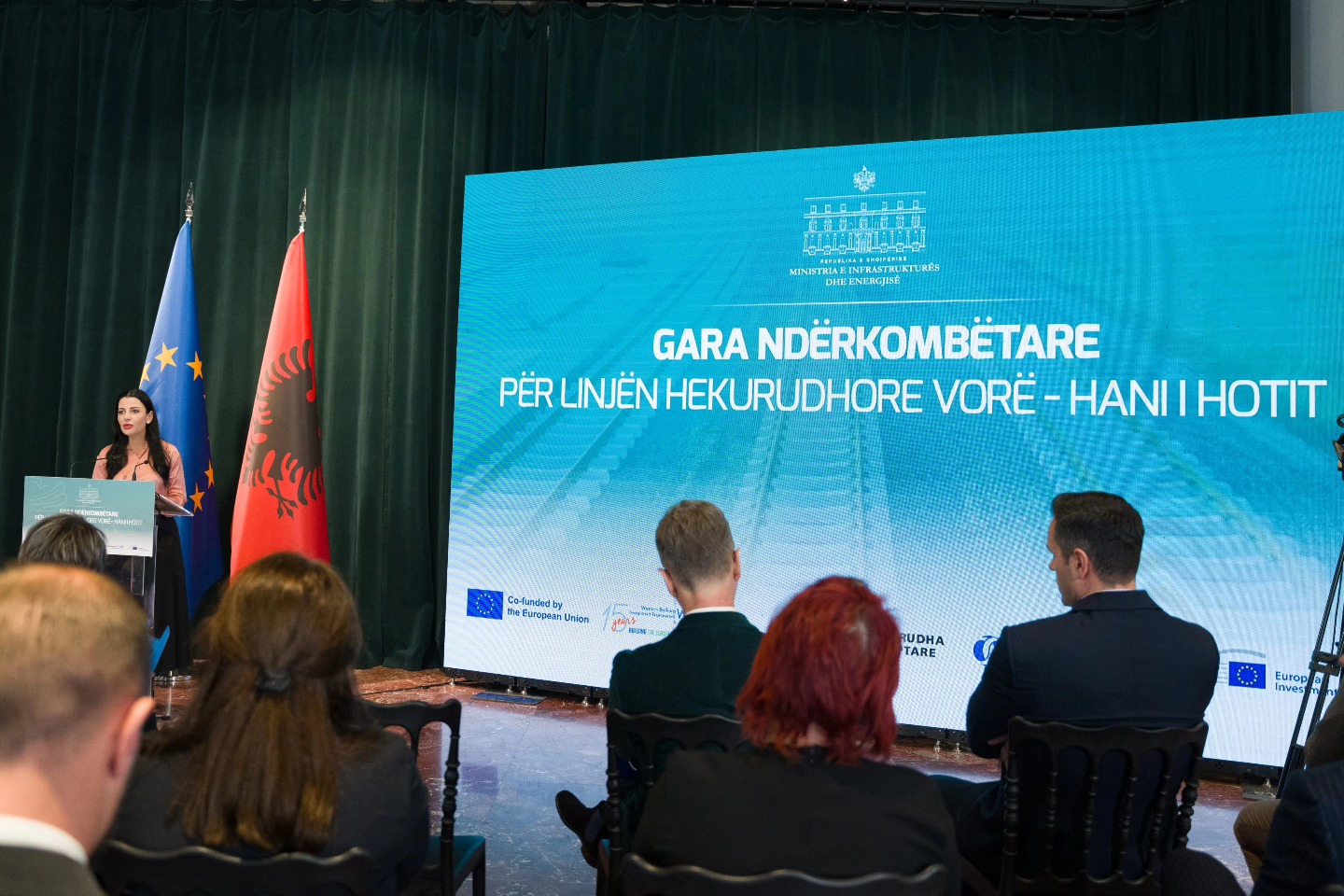
The Ministry of Infrastructure and Energy has officially launched the tender for the construction of a railway that will connect Albania with Montenegro, a nation sharing historical ties, common traditions, and a mutual desire to join the EU swiftly.

This project has received the largest grant in Albanian history from the European Union, totaling 136 million euros.

During the tender opening ceremony, which was attended by EU Ambassador Silvio Gonzato, Deputy Prime Minister and Minister of Infrastructure and Energy Belinda Balluku stated that this railway will integrate Albania into the pan-European transport corridors.

Balluku highlighted that the development of this railway line will significantly influence both the economic and social progress of Albania and the broader Western Balkan region.

The procurement process commenced with representatives from the European Investment Bank (EIB) and the European Bank for Reconstruction and Development (EBRD) in attendance.

The project aims to rehabilitate 120 kilometers of railway line, modernize 12 train stations, and install advanced signaling systems, thereby enhancing safety measures. It also seeks to promote eco-friendly transportation through an electric railway, minimizing emissions and offering a sustainable alternative for both passengers and freight.

“By rehabilitating this railway line, we are enhancing connectivity between Albania and other regional countries as well as the EU. This project is pivotal for Albania’s socio-economic development, opening new avenues for businesses and individuals. Furthermore, the modernized railway represents a stride towards a greener future. The EU continues to back Albania in its quest for sustainable development and improved regional connectivity,” stated EU Ambassador Silvio Gonzato.

The railway will feature 12 bridges and a 320-meter tunnel in the Lezha region, with a projected operational speed of 120 km/h. According to a feasibility study by the Ministry of Infrastructure and Energy, the travel time from Vora to Han of Hoti is estimated to be around 2 hours. The railway is expected to handle an annual flow of approximately 2.3 million passengers and 900,000 tons of freight. (December 20)

Comments

2 responses to “Tirana Launches Railway Project Connecting Albania and Montenegro with €136 Million EU Grant”

  1. kimono goddess Avatar
    kimono goddess

    Oh, brilliant! Just what Albania needed: a shiny new railway to connect with Montenegro, because let’s face it, nothing screams “EU integration” like a train ride through the Balkans. 🚂💨 Hope it comes with complimentary Wi-Fi and a scenic view of the “historical ties” we’ve all been hearing about since the dawn of time! 😏

  2. Granola Dove Avatar
    Granola Dove

    Oh great, a fancy train connecting Albania and Montenegro! Because nothing says “progress” quite like modernizing a railway when my taxi can get me to the same place in half the time 😏🚖. But hey, at least the EU is getting its money’s worth in “sustainable development” – good luck finding a seat!

Leave a Reply

Your email address will not be published. Required fields are marked *

Last News

England Introduces Precision Initiative to Address Knife Crime in Schools

England Introduces Precision Initiative to Address Knife Crime in Schools

The Home Office has introduced a £1.2 million plan to combat knife crime in schools throughout England. This program uses mapping technology to pinpoint and assist high-risk areas, offering dedicated support to up to 250 schools most susceptible to knife-related incidents.
Advanced Technology for Targeted Intervention
The initiative utilizes mapping technology that can identify areas as small as

Read More

Top Industry Exec Says Europe Must Control AI for Defense

Top Industry Exec Says Europe Must Control AI for Defense

“If these artificial intelligence systems are actually procured from foreign companies, then … our militaries can be turned off. Do we want our military forces to be turned off because we have general political misalignment sometimes?” Mensch asked.
His remarks come ahead of the European Commission’s presentation of a major technological sovereignty package, tentatively scheduled for t

Read More

What to Do If Your Employer Doesn’t Pay You in Europe

What to Do If Your Employer Doesn’t Pay You in Europe

The payslip comes, but the money doesn’t. Days turn into weeks. Rent and bills pile up, while the employer offers no response or vague excuses. Across Europe, unpaid wages are a frequent and stressful issue, particularly in cross-border or insecure jobs. However, EU and national laws offer clear protections — provided you act promptly and document everything.
Step 1: Confirm the delay and g

Read More

Italy’s defense minister fears nuclear escalation in Iran

Italy’s defense minister fears nuclear escalation in Iran

Guido Crosetto, speaking to Corriere, highlighted the dire consequences of human decisions, referencing Hiroshima and Nagasaki, and noted the ongoing pursuit of nuclear arms. He expressed caution about the nuclear threat, describing it as madness and emphasizing the escalating nature of conflicts.
Despite significant losses in leadership and missile capabilities due to the U.S. and Israel’s milita

Read More

Orbán’s Rival Magyar Criticizes JD Vance’s Hungary Visit as Election Meddling

Orbán’s Rival Magyar Criticizes JD Vance’s Hungary Visit as Election Meddling

For Orbán, who has led Hungary for 16 years under his “illiberal democracy” model, the visit presents an opportunity to showcase global backing during a key phase of the campaign. According to POLITICO’s Poll of Polls, Fidesz is currently behind the opposition Tisza party.
Vance is not the first high-ranking U.S. official to visit Budapest before the election. His visit comes after Sec

Read More

Why EU Foreign Policy Faces Persistent Stalemates

Why EU Foreign Policy Faces Persistent Stalemates

Divergences in EU foreign policy are becoming increasingly apparent as unanimity falters.
Zoya Sheftalovich and Ian Wishart explore the mounting frustration with the EU’s method of crafting foreign policy, especially as disagreements arise regarding Ukraine funding, Russia sanctions, and the conflict in Iran. With Germany and Sweden spearheading efforts to discard the requirement for unanim

Read More

EU Foreign Policy Chaos Sparks Calls for Radical Diplomatic Overhaul

EU Foreign Policy Chaos Sparks Calls for Radical Diplomatic Overhaul

Frustration over the deadlock is increasingly visible, with a coalition led by Germany and Sweden advocating to significantly restrict or completely eliminate national vetoes that permit a single nation to block action.
“We should abolish the unanimity principle in the EU in foreign and security policy before the end of the current legislative period to be better capable of acting internationally

Read More

Germany aims to amend contentious military registration law

Germany aims to amend contentious military registration law

Green defense policy spokesperson Sara Nanni urged a swift clarification from the ministry, stating that citizens should understand their reporting obligations. The provision, dating back to Germany’s 1956 conscription framework, has been largely dormant since 2011 when conscription was suspended. Recently, the military service reform reactivated the rule for peacetime, causing concern about

Read More

Les coulisses de la victoire de Lille pour décrocher l’Autorité douanière européenne

Les coulisses de la victoire de Lille pour décrocher l’Autorité douanière européenne

La délégation a visité la tour blanche destinée à accueillir l’agence, puis s’est rendue dans la vieille ville avec ses architectures flamandes, avant de participer à un cours à l’École européenne portant le nom de l’ancien président de la Commission, Jacques Delors. En fin de journée, plusieurs participants ont reconnu que le fait d’être le premier à se porter candidat constitua

Read More

2026 Hungary Election Highlights Semjén’s Religious Nationalism Initiative

2026 Hungary Election Highlights Semjén’s Religious Nationalism Initiative

As Hungary approaches the parliamentary election on 12 April 2026, Viktor Orbán is once again portraying himself as the protector of Christian Hungary. However, a deeper analysis indicates that the primary force behind the country’s exclusionary church policy is Deputy Prime Minister Zsolt Semjén. Critics suggest that the model he contributed to has politicized rather than protected Christianity,

Read More