



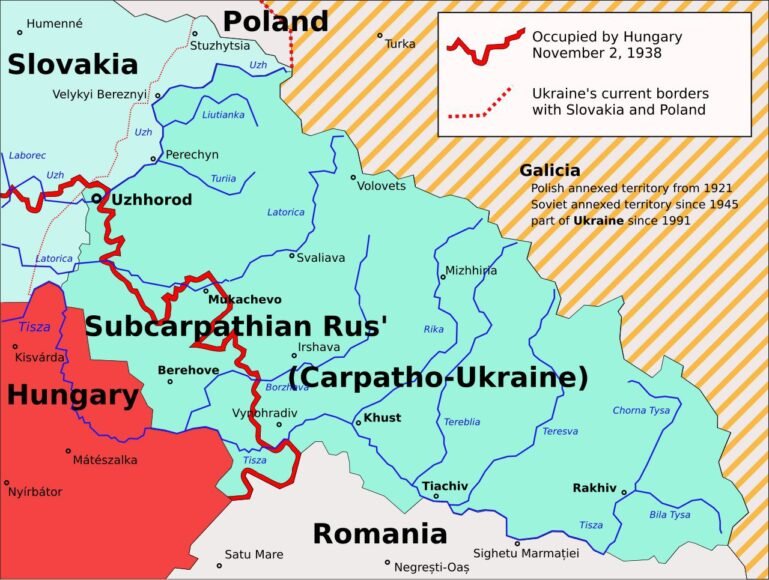
Carpatho-Ukraine, or Carpathian Ukraine, was an autonomous region within the Second Czechoslovak Republic and a short-lived state: it was proclaimed as Carpathian Ukraine on 30 December 1938, declared independence on 15 March 1939, and was abolished the same day.
The region was created in December 1938, renamed from Subcarpathian Rus’, whose autonomy was confirmed by constitutional law on 22 November 1938.
Twenty years earlier, the 1920 Treaty of Trianon had detached the region, historically belonging to Hungary, from the Kingdom of Hungary and attached it to the newly created Czechoslovakia. Hungary sought to revise the Treaty of Trianon and restore its historical borders.
The First Vienna Award on 2 November 1938 returned territories from Czechoslovakia, including southern Carpathian Rus’, mostly Hungarian-populated, to Hungary.
After the breakup of the Second Czechoslovak Republic, Carpatho-Ukraine proclaimed itself an independent republic on 15 March 1939, led by President Avgustyn Voloshyn. However, Nazi Germany supported Hungary against Ukrainian independence, and the state was invaded by the Kingdom of Hungary.
Intense Slovak and Ukrainian nationalism followed. On 10 March, the Hlinka Guard and Volksdeutsche demonstrated for independence from Czechoslovakia. Slovak leader Jozef Tiso met Adolf Hitler and others in Berlin on 13 March. Hitler demanded Slovakia declare independence or face a Hungarian takeover. On 14 March, the Slovak parliament declared independence, and on 15 March 1939, Hitler sent troops into Bohemia and Moravia.
Following these events, Carpatho-Ukraine declared independence as the Republic of Carpatho-Ukraine, headed by Avgustyn Voloshyn. The Constitutional Law of 15 March 1939 defined the new country as an independent republic, with Ukrainian as the state language and blue and yellow as the flag’s colors. The state emblem included a bear, blue and yellow stripes, and the trident of Saint Volodymyr the Great. The national anthem was “Ukraine has not perished.” The government was led by President Avgustyn Voloshyn, Prime Minister Julian Révaý, and others. The Slovak declaration of independence led to chaos, with Hungary poised to take over Carpatho-Ukraine.
Hungarian Chief of General Staff Henrik Werth asked for time to prepare for the invasion, but only 12 hours were given. Hungarian forces included infantry, cavalry, and irregular formations, supported by aircraft. On 14 March 1939, Hungarian Border Guard units advanced and took control of territories, facing little organized resistance.
On 15 March 1939, the Hungarian Army invaded Carpatho-Ukraine and quickly took control. A significant battle near Khust resulted in the death of about 230 Ukrainians. By 16 March, Hungary annexed the territory, and Czecho-Slovak troops retreated. The Hungarian Army reached the Polish border by 17 March, and captured members of the Carpathian Sich.
Contemporary research indicates that some captured members were killed by Polish soldiers, with estimated victims ranging from 43 to possibly more, though figures of 500 to 600 victims are under scrutiny.
The invasion demonstrated the Hungarian Army’s readiness issues due to the Trianon Treaty but showcased high morale and nationalist spirit.
Source: Wikipedia, the free encyclopedia.


Leave a Reply