


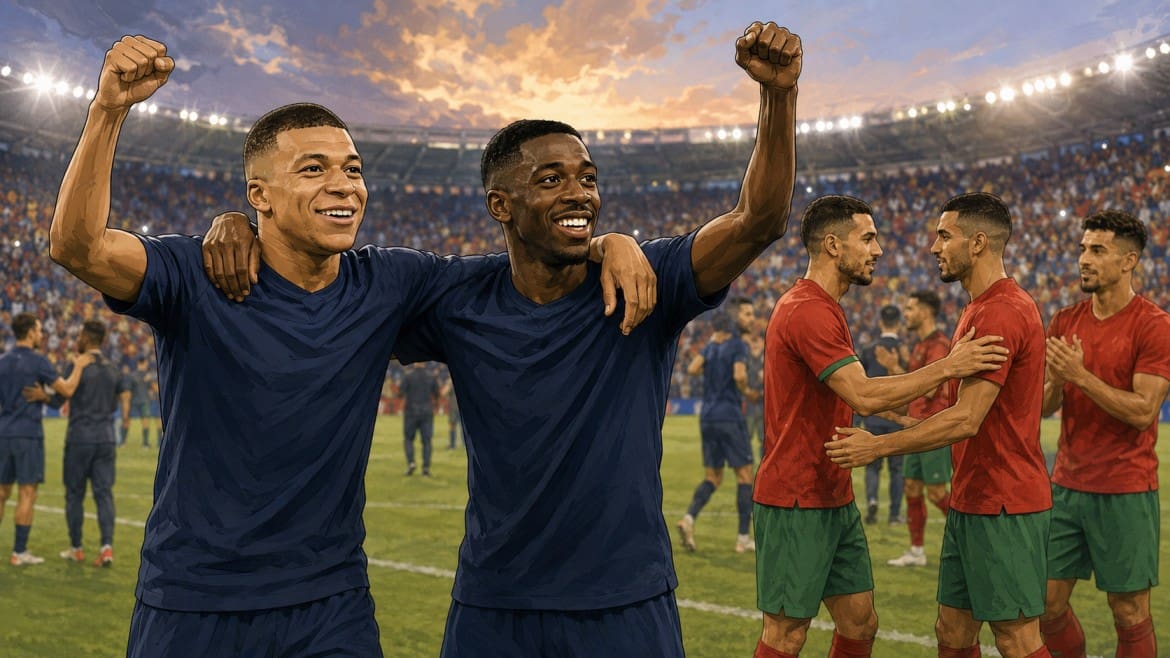
Mbappé and Dembélé overcame Morocco’s challenge in Boston, but the quarter-final highlighted the demands on Europe’s top teams in this expanded tournament
France advanced to the FIFA World Cup semi-finals with a composed 2-0 victory over Morocco in Boston, where second-half goals from Kylian Mbappé and Ousmane Dembélé transformed a tense quarter-final into a demonstration of French dominance. Morocco exits after a campaign that held significance beyond a single result, while France edges closer to a final, with European expectations mounting.
The match was resolved in a crucial six-minute period in the second half. FIFA’s report of France’s 2-0 win over Morocco highlighted Mbappé’s pivotal role in the breakthrough, with Dembélé scoring shortly after. Al Jazeera’s coverage recorded the goals at 60 and 66 minutes, altering the emotional tone of a contest Morocco had diligently kept alive.
A win founded on control
France didn’t need to make the evening spectacular. That’s perhaps more revealing. In knockout football, especially in a World Cup with an expanded field and longer schedule, authority often shows more through managing risks until the decisive moment than through constant brilliance.
Morocco’s resilience necessitated patience. They entered the quarter-final confident, having repeatedly forced established football nations to acknowledge them as equals instead of underdogs. Their organization, athletic discipline, and collective responsibility kept the game balanced for long stretches, even as France posed the greater attacking threat.
When Mbappé scored, the match swung sharply. When Dembélé followed, Morocco was left not only chasing two goals but also dealing with a French team adept at defending a lead, slowing the tempo, and using the clock as part of its strategy.
Morocco’s exit isn’t a step back
In elite sports, there’s a risk of equating elimination with disappearance. Morocco’s defeat shouldn’t be viewed that way. Their tournament run once again confirmed the wide scope of international football’s competitive landscape and the strength of a generation that has changed how opponents prepare against them.
For many Moroccan supporters in Europe, North Africa, and the wider diaspora, this campaign was not just about advancing through rounds. It was about visibility, inclusion, and a national team representing itself seriously on the world’s biggest stage.
That doesn’t lessen the disappointment of sport. Quarter-finals aren’t symbolic matches; they’re opportunities that may not come again in the same way. But Morocco’s place in this tournament has been earned through footballing substance, not sentiment, which impacts how the defeat should be understood.
Europe’s challenge intensifies
For France, the victory contributes to a larger European narrative. Earlier European Times coverage pointed out how Europe’s World Cup depth is being tested in a tournament where status alone no longer suffices. France has handled this challenge better than most.
Their semi-final berth also intensifies the question for Europe’s top football systems: whether technical skill, squad depth, and institutional continuity can still ensure control when the tournament becomes more physically demanding and geographically dispersed.
For now, France’s answer is affirmative. They have enough individual talent to swing matches quickly and enough collective experience to maintain those moments. Yet as a team nears the final, history matters less. What’s crucial is performance under pressure,



Leave a Reply