


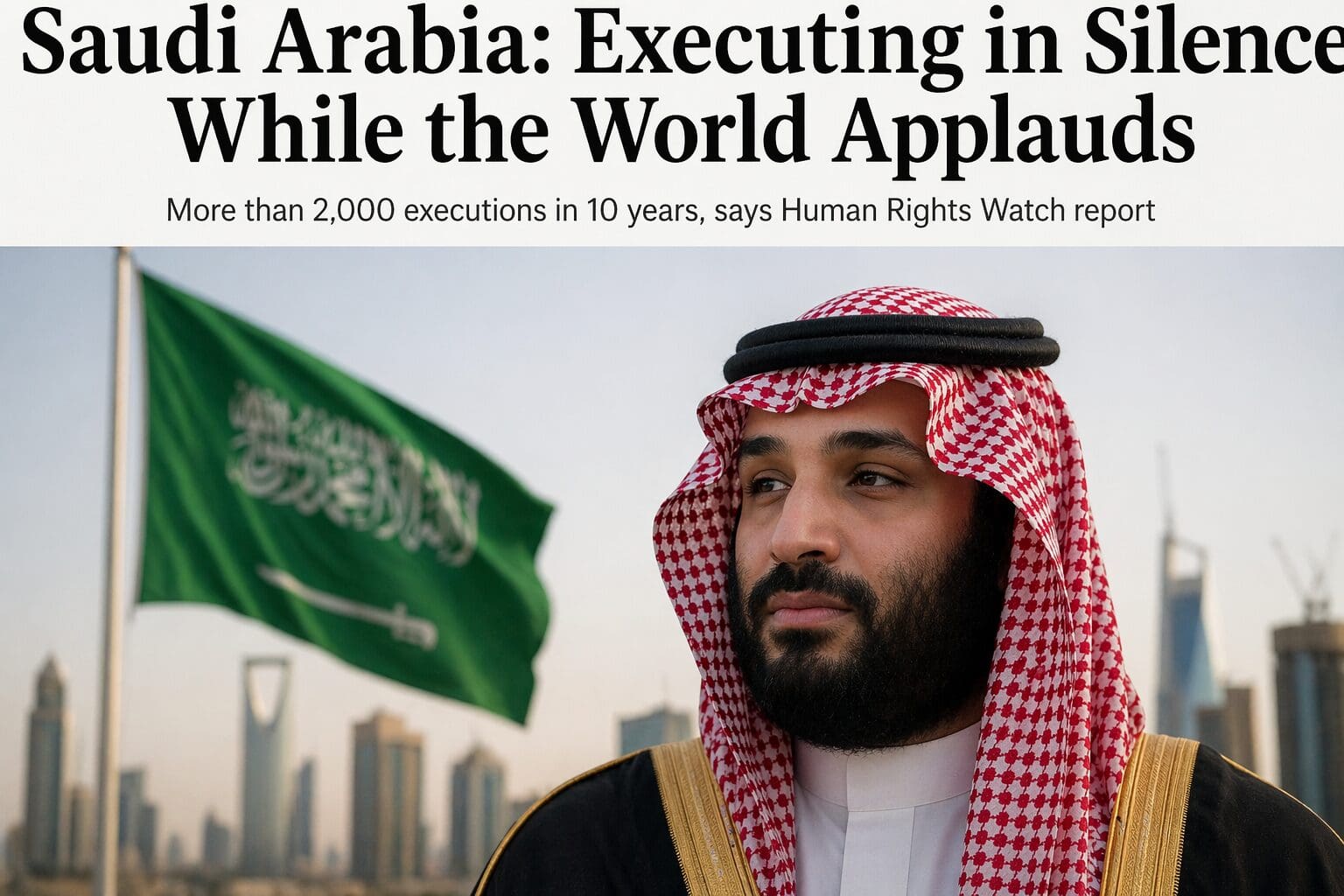
Behind the modern image of reform, the death penalty in Saudi Arabia has intensified.
Over 2,000 executions have occurred in 10 years, according to Human Rights Watch.
A man in a Saudi prison awaits execution without understanding the language of his judgment or having proper legal access. His name will vanish into statistics.
2,000+ Executions in 10 Years:
- 1,000 in 6 years
- Next 1,000 in 4 years
- ~50% are foreign nationals
The execution rate is accelerating. This punishment has become integrated into the governing system.
Saudi Arabia claims transformation with economic projects and cultural opening, yet the death penalty remains prevalent.
Most executions are for non-serious crimes or drug offenses. Some involve politically motivated accusations under ambiguous judicial frameworks, allowing discretionary sentencing.
Judges hold immense power without oversight, with opaque procedures and limited legal defense, fostering a perception of arbitrariness.
Nearly half of those executed are foreign nationals, often migrant workers with no translation, legal assistance, or support networks.
Despite promises to end executions for crimes committed by minors, cases persist, showing a gap between promises and reality.
Despite a suggested moratorium, executions for drug offenses resumed at record levels.
Europe, while condemning the death penalty, strengthens ties with Riyadh, illustrating a contradiction in values.
Saudi Arabia seeks global influence, but its adherence to norms is questioned.
The death penalty is a present instrument in Saudi Arabia. Communication strategies cannot hide this truth: an image may be modernized, but a justice system that kills remains exposed.
Source: Human Rights Watch Report | Analysis based on documented executions since 2015.




Leave a Reply