


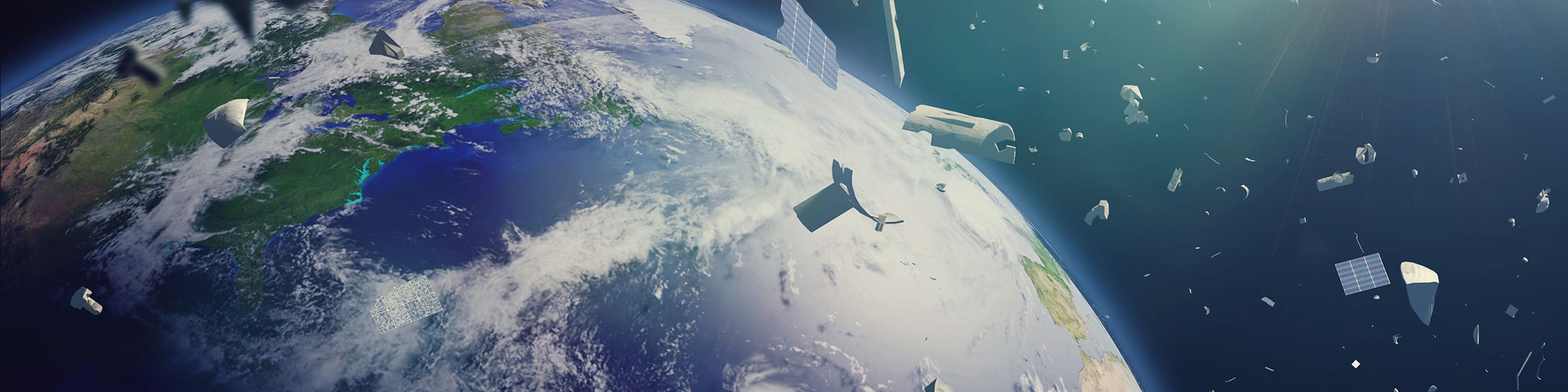
For years, space has been cluttered with decommissioned satellites and rocket parts orbiting our planet, creating a growing threat to the satellites and spacecraft we rely on. However, researchers see potential in this space debris as a valuable resource.
The European Space Agency reports that over 2,700 defunct satellites orbit Earth, alongside 54,000 objects larger than a golf ball and about 140 million pieces bigger than a speck of paint.
Although many solutions have been suggested, from new regulations to removal technologies, two EU-funded research initiatives are taking a novel approach as part of a European Innovation Council (EIC) effort to address space debris. Through high-risk research support, the EIC is enabling scientists to explore innovative methods, such as dismantling and recycling old satellites directly in space and “beaming” smaller debris back into Earth’s atmosphere to burn up.
A team of companies and universities from the UK, Spain, Estonia, and Sweden is investigating the possibility of dismantling and reusing old satellites in space. This work, named DEXTER, launched in 2025 and is led by Leonard Felicetti, an associate professor of space engineering at Cranfield University in the UK.
“We are cluttering space with new objects,” said Felicetti. “What we want to do is to try and reuse the material that is already there.”
Satellites are constructed from valuable materials like aluminium. While some may fall back to Earth and disintegrate, others remain in orbit for extended periods. The idea is to retrieve these materials before they pose a long-term risk.
The DEXTER team faces two main challenges: safely dismantling satellites in orbit and reusing their materials effectively. Options include repurposing metal to construct new space structures or, more ambitiously, turning it into fuel.
Researchers are developing tools to achieve this, such as robotic arms for debris collection and lasers for cutting metal in space-like conditions. Early laboratory tests are underway.
Converting scrap metal into fuel is complex. Magdrive, a project partner in the UK, is exploring the possibility of turning aluminium into plasma for use in an ion thruster, a spacecraft engine utilizing charged particles.
“It’s not a classical chemical fuel,” Felicetti said. “But it could offer a new way to power satellites using materials that are already in orbit.”
The storage or sharing of such fuel remains uncertain, with the option of creating refuelling depots in space being considered.
For now, the goal is to validate the concept, with plans to demonstrate key technologies in orbit soon.
While some focus on reusing debris, others aim to eliminate it, particularly smaller fragments that are hard to track and dangerous.
Companies have tested spacecraft capable of attaching to large debris to bring it back to Earth. However, this method is ineffective for tiny fragments, which are more numerous.
Led by the French start-up OSMOS X, researchers from France, Germany, Luxembourg, and Spain are collaborating on an EU-funded initiative called ALBATOR. The team is experimenting with using a stream of charged particles to beam smaller debris out of orbit.
OSMOS X CEO Matthieu Cavellier describes it as an “ion blower,” a spacecraft-mounted device that nudges debris into Earth’s atmosphere, where it burns up.
The goal is to target debris as small as a millimeter, such as fragments from a satellite collision, which can cause significant damage.
“Imagine two satellites collide,” Cavellier said. “You need to act quickly to clean up the debris before it spreads.” Swift action is crucial, as collisions can generate new debris, leading to further collisions, a cascade known as the Kessler syndrome.
The ALBATOR team envisions a fleet of spacecraft deployed as needed to clear debris clouds using ion beam bursts.
The technology is still being tested, with plans for experiments in a German vacuum chamber in 2027, followed by a space mission.
As space becomes a busier and crucial part of modern life, debris risks increase. These projects aim to keep Earth’s orbit usable for future generations.
For Felicetti, the goal extends beyond hazard removal; it involves rethinking space utilization.
“Space debris is a problem because it can collide with other satellites,” he said. “Our intention is to transform this liability into an opportunity.”
This research received funding from the EU’s Horizon Programme. The interviewees’ views do not necessarily reflect those of the European Commission. If you enjoyed this article, consider sharing it on social media.










Leave a Reply