


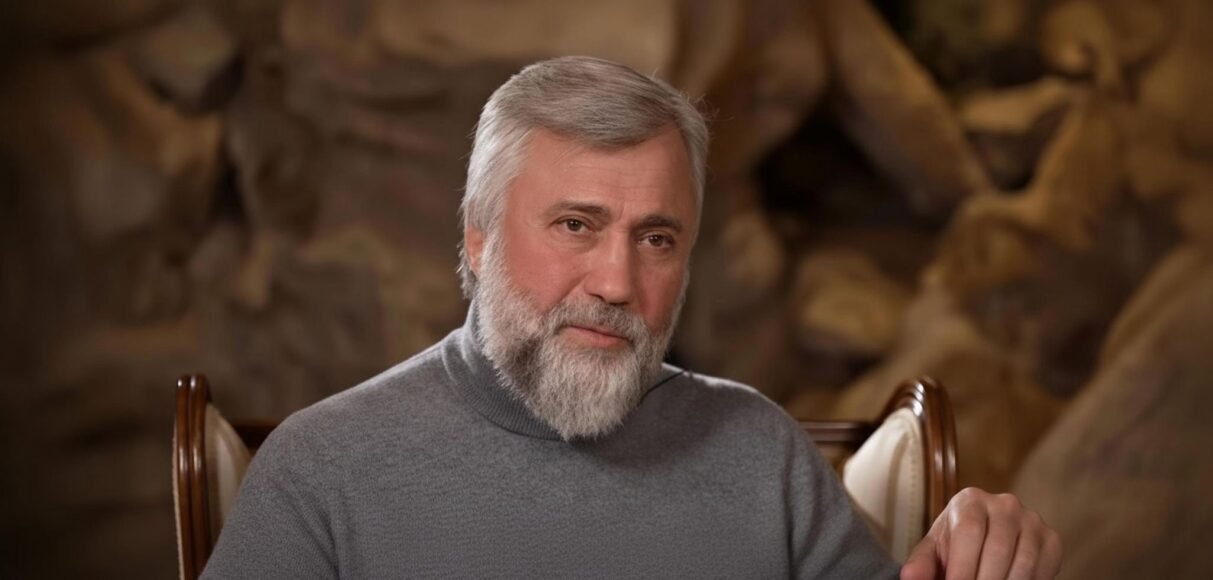
Former Ukrainian parliamentarian Vadym Novynskyi, who is currently living in one of the European countries after being forced to leave Ukraine, gave an interview to the conservative Spanish channel HerqlesTV. In the interview, he addressed key issues related to the current situation in Ukraine and placed particular emphasis on the condition of the Ukrainian Orthodox Church, which, according to him, is facing persecution by the authorities. Novynskyi himself — a well-known Ukrainian businessman, politician, and philanthropist — is an active member and supporter of the UOC.
The interview presents a systemic critique of Ukraine’s current leadership, while also offering an alternative interpretation of key developments in recent years — from the failure of the Minsk agreements to the breakdown of negotiations in the spring of 2022.
The Minsk Agreements as a “Missed Opportunity”
One of Novynskyi’s central arguments is that the full-scale war could have been avoided. As a key example, he points to the Minsk agreements, which, in his view, provided a clear and workable framework for conflict resolution.
He emphasizes that the sequence of steps was explicitly defined: local elections in the non-government-controlled territories, followed by the formation of local authorities, and only then the transfer of control over the state border. However, according to Novynskyi, the Ukrainian side effectively refused to implement these provisions, leading to a prolonged crisis and ultimately to war.
Expectations vs. Reality in 2022
A significant part of his assessment focuses on the period immediately preceding the full-scale invasion. Novynskyi claims that just one day before the invasion, Ukrainian authorities publicly denied the possibility of war.
At the same time, he says, certain members of the political elite warned of an imminent escalation and the need for urgent diplomatic action. The failure to heed these warnings, he argues, was a strategic miscalculation with catastrophic consequences.
The 2022 Negotiations: A “Window of Opportunity” That Closed
A substantial portion of the interview is devoted to the initial rounds of negotiations between Ukraine and Russia. Novynskyi states that he was involved in their organizational phase and maintained direct contact with representatives from both sides.
According to his account, by the spring of 2022, the parties had come close to a framework agreement, commonly referred to as the “Istanbul agreements.” Among the discussed provisions were Ukraine’s neutral status, a postponed decision on Crimea, and a special status for Donbas.
He describes these terms as a “compromise” and claims that the agreement was close to being finalized. However, in his view, the negotiation process was disrupted due to external political factors.
Power and the Concentration of Decision-Making
A key line of criticism is directed at the structure of decision-making in modern Ukraine. Novynskyi describes it as a highly centralized system in which significant authority is concentrated within a narrow circle.
He places particular emphasis on the role of the Presidential Office, arguing that it functions as a central hub of governance, including in matters of domestic policy, sanctions, and law enforcement practices.
In this context, he raises concerns about political competition and freedom of expression, pointing to the use of sanctions and criminal proceedings as instruments of pressure.
Corruption as a Systemic Factor
Novynskyi also addresses corruption, arguing that it is systemic and affects key sectors — from defense procurement to energy.
According to him, the scale of corruption undermines trust both within society and among military personnel, ultimately impacting mobilization efforts and national cohesion.
The Church as a Fault Line
A separate section of the interview focuses on the situation surrounding the Ukrainian Orthodox Church. Novynskyi frames it as part of a broader conflict that extends beyond religious policy.
He claims that the state is systematically increasing pressure on the UOC through legislative initiatives, criminal cases, and administrative measures. In his interpretation, this reflects an attempt to reshape the country’s religious landscape.
Novynskyi also highlights his involvement in international legal efforts to defend the Church, arguing that the issue is not only relevant to Ukraine but also to broader questions of human rights in Europe.
Power and Future Scenarios
In assessing the current political situation, Novynskyi takes a markedly critical stance. He argues that the current leadership has lost both political and moral legitimacy, and that the continuation of its current course will only deepen the crisis.
As an alternative, he proposes a political reset through parliament and the immediate launch of active peace negotiations.
“Peace as a Strategy for Survival”
The central conclusion of the interview is the urgent need to end the conflict. Novynskyi argues that prolonging the war will result in severe demographic and economic losses with long-term consequences for the country.
At the same time, he emphasizes that even after the end of hostilities, Ukraine will face deep internal divisions requiring a separate process of societal reconciliation.
Within this framework, peace is presented not as a concession, but as a fundamental condition for the country’s survival.



Leave a Reply