



Tom Fletcher will address the worsening humanitarian situation in the world’s youngest country and the increasing protection risks for civilians and aid workers.
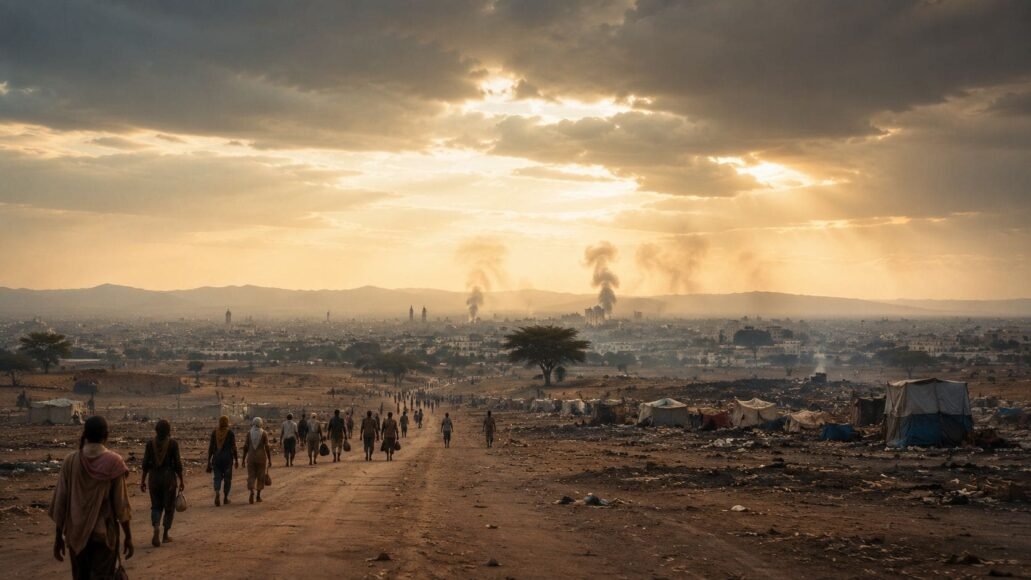
Upon arrival, he went to Malakal in Upper Nile state to meet local communities, leaders, and returnees. He learned about their needs and challenges amid the ongoing war in neighboring Sudan.
Raising awareness
Fletcher plans to visit Jonglei, where recent conflict has intensified humanitarian needs, displacing around 280,000 people, according to authorities.
He will use the five-day mission to South Sudan to highlight the worsening humanitarian situation globally.
“The humanitarian chief will meet with local responders on the frontline,” UN Spokesman Stéphane Dujarric said in New York.
“He will advocate for civilian and humanitarian worker protection, reiterate urgent calls for humanitarian response support, and urge coordinated efforts to address the crisis’s root causes.”
Gaza: Fire risks mount in shelters
Humanitarians stress the need for adequate housing in Gaza, where displaced Palestinian families live in overcrowded shelters posing severe fire and health risks.
“Families cook, sleep and store their belongings in small spaces where they also use open fire,” the UN aid coordination office OCHA said, noting partners recorded at least 12 fires in shelters since November.
Over a 10-day period this month, humanitarians provided shelters to 85 families in Deir al-Balah and Khan Younis whose shelters were damaged by a fire in Gaza City.
Aid missions blocked
Meanwhile, in Gaza, humanitarian movements still require coordination with Israeli authorities.
OCHA reported that out of 67 movements coordinated from February 12-19, 43 were approved, and nine were denied outright.
Eight missions were approved but faced impediments, although six were fully accomplished, while seven others were canceled for operational or security reasons.
Humanitarian partners coordinated the entry of fuel, medical supplies, animal fodder, and hygiene kits.
Teams also facilitated the medical evacuation of patients through two border crossings – the Rafah corridor with Egypt and Kerem Shalom/Karem Abu Salem with Israel.
West Bank: Guterres calls for probe into killing of Palestinian-American man
UN Secretary-General António Guterres condemned the killing of a Palestinian-American man in the West Bank.
Nasrallah Abu Siam, 19, was shot and beaten by Israeli settlers in Mukhmas village and died of his wounds the same day.
Three other Palestinians were shot and injured in the same attack.
“The Secretary-General extends condolences to the victim’s family and loved ones,” UN Spokesman Stéphane Dujarric said in New York.
He noted that the family includes journalist Abdelhamid Siam, a UN press corps member, and extended condolences to him and the entire family.
The Secretary-General called for a prompt, thorough, and transparent investigation into the incident, urging accountability for those responsible.
He also urged the Israeli Government to take concrete steps to stop and prevent all acts of violence by Israeli settlers against Palestinians, in line with its obligations as the occupying power.
Violence and attacks continue
Humanitarians warned of ongoing violence and coercive practices by Israeli forces and settlers in the West Bank, resulting in casualties, property destruction, and displacement.
Between February 3-16, Israeli forces killed three Palestinians, the UN aid coordination office OCHA reported. This brings the total for the year to nine, including two children.
Palestinian forces also killed a Palestinian boy in Tammoun while attempting to arrest his father.
“During the same period, at least 86 Israeli settler attacks were recorded, injuring over 60 Palestinians, and displacing 146 people,” OCHA said. People in 60 communities were affected by the attacks.
Since January 2023, approximately 880 Palestinian families – over 4,700 people – have been displaced across the West Bank due to settler attacks and access restrictions.









Leave a Reply