


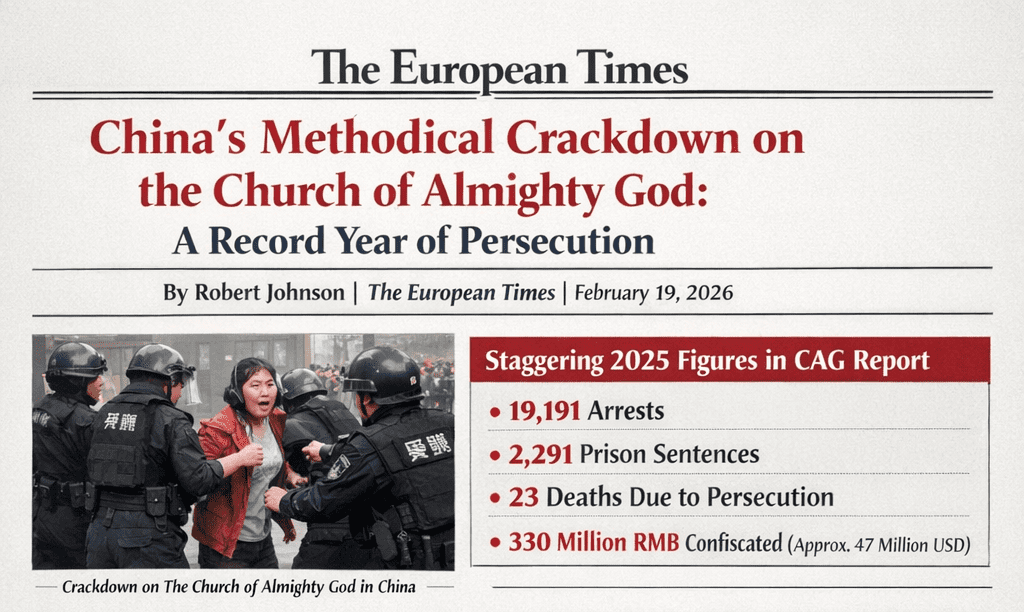
BRUSSELS — The Church of Almighty God (CAG) released its annual persecution report on February 13, 2026, highlighting 2025 as the most severe year of state repression since records began in 2017. Data showed 19,191 arrests, 2,291 prison sentences, 23 deaths linked to persecution, and over 330 million RMB (around USD 47 million) in seized assets, indicating a coordinated effort aimed at institutional elimination instead of isolated enforcement actions.
Available on the church’s documentation platform, the report spans all major provinces and municipalities in China, with conservative estimates due to the CCP’s information blockade. Entire regions, like Xinjiang, remain largely undocumented.
A “Three-Year Tough Battle” Against a Religious Community
2025 was shaped by policies from the CCP’s “Three-Year Tough Battle” (2024–2026), a nationwide campaign targeting the CAG, succeeding the “Three-Year General Battle” (2020–2023) that disturbed but did not stop the church’s global growth.
The 2025 institutional machinery was vast, with quotas tied to officials’ performance. Citizens were incentivized with cash to report CAG members. Coordinated police forces used tech surveillance like “Skynet” and “Sharp Eyes” to support operations. A Shandong officer stressed: “This year and next, we must ‘zero out’ The Church of Almighty God.”
Arrests at Record Levels: A Month-by-Month Escalation
The report shows a year-long escalation in arrests, from January’s 430 to June’s 2,387, culminating in 19,191 for the year, the highest recorded. Operations were coordinated across regions, utilizing extensive surveillance and directives from higher authorities. Elderly believers were specifically targeted, with thousands aged 60+ detained, including a 93-year-old.
Torture, Brainwashing, and the “Three Statements”
Detention often involved systemic torture, with 8,996 of 19,191 detainees subjected to methods like sleep deprivation and electric shocks. This aimed to secure signatures on “Three” or “Five Statements,” reflecting a centrally planned coercion protocol. Testimonies describe severe abuse, with 23 deaths resulting from persecution, including Yu Xiaomei’s from neglect.
International Condemnation: A Growing but Incomplete Record
The CAG report aligns with assessments from bodies like USCIRF, which identified the church among groups targeted as “cults” by China. Despite CPC status recommendations, access for independent oversight remains restricted, highlighted during China’s 2024 UN review. The legal framework against CAG violates international protections like ICCPR Article 18 and the Convention Against Torture.
A Campaign Defined by Its Own Officials
The CAG report features corroborating statements from officials, evidencing the structured persecution. Surveillance methods and performance pressures on local officials demonstrate the campaign’s bureaucratic integration, reflecting its systemic nature.
Implications and the Path Forward
This report emerges amid sustained scrutiny of China’s religious freedom record, but with limited operational impact. The international community’s engagement with CAG remains insufficient given the documented scale of persecution. With the “Three-Year Tough Battle” ongoing, the outcome depends on potential internal or external pressures.
Sources: CAG Annual Persecution Report 2025 (godfootsteps.org); USCIRF Annual Report 2025 – China Chapter; U.S. State Department International Religious Freedom Reports; UN Human Rights Council Universal Periodic Review of China, 2024; UN press briefing, August 2024; ICCPR Article 18; Convention Against Torture, Article 1; Universal Declaration of Human Rights, Article 18.










Leave a Reply