



Approximately 40% of the EU’s population resides within 50 kilometres of the coast, with significant parts of the economy, climate resilience, and wellbeing linked to healthy oceans and seas. Despite this proximity, there remains a limited understanding of ocean functions and human impacts on it.
“People live by the sea and depend on it but lack knowledge about it,” said Melita Mokos, a marine biologist at the University of Zadar in Croatia.
Her work centers on ocean literacy, educating people about ocean functions, its importance, and the impact of everyday choices on ocean health.
Although awareness campaigns have risen, many underestimate the pressure human activities place on the ocean and the benefits of healthy marine ecosystems.
A survey of 3,500 young individuals highlights the issue. Three-quarters acknowledged the importance of a healthy ocean, yet nearly half believed the ocean remains in good condition.
Mokos is part of a European research group involved in BlueLightS, an EU-funded initiative launched in 2024 aimed at enhancing blue education to improve ocean literacy by teaching learners of all ages about their connection to the ocean and their role in its protection.
BlueLightS is among several EU-funded initiatives addressing ocean literacy. Sister projects like ProBleu and SHORE explore new methods to connect people with the ocean, from education and community engagement to hands-on learning. While each focuses on different aspects, they share the goal of illustrating the strong link between human lives and ocean health.
Connecting the blue dots
Despite increased awareness, a fundamental gap persists between knowledge and action relating to ocean issues.
“There’s a gap between ocean knowledge and understanding the effects of personal actions on the ocean,” said Pierre Strosser, a consultant at ACTeon, an environmental consultancy specialising in the sustainable management of oceans, coasts, and natural resources based in Colmar, France.
With a PhD in water management and economics, Strosser brings nearly a decade of experience in ocean literacy initiatives across Europe. He coordinates the BlueLightS team, focusing primarily on blue education.
“
People live by the sea and depend on it but lack knowledge about it.
Their approach integrates the ocean into a broader human–nature ecosystem, including seas, rivers, and lakes.
“The ocean begins in every city, even in Strasbourg, through rivers, consumption, and the air we breathe,” Strosser stated.
Their goal is to highlight the mutual influence between people and the ocean. For instance, plastic litter on a beach can enter the sea, degrade into microplastics, and ingested by marine life, eventually returning to humans through seafood consumption.
Making education bluer
The BlueLightS team is implementing practical measures by developing learning resources, training teachers, and suggesting school curriculum adaptations. They have established a multilingual knowledge hub where anyone can access and upload resources, facilitating educators across Europe to find and utilize materials.
One contributor, Team Malizia, an international offshore sailing team, produces marine learning materials in various languages.
The My Ocean Challenge program uses the excitement of round-the-world racing to engage children with ocean science and climate solutions.
School curricula and teacher training pose a greater challenge. Strosser and Mokos recognize this but believe it could have the most significant long-term impact.
“A systemic approach is needed,” Strosser said. “Education systems need more blue topics, not just individual school efforts.”
The BlueLightS approach is being tested in France
Comments
18 responses to “Ocean Learning: Bringing the Sea into Every Classroom”
-
Ocean Learning? Brilliant! Because clearly, the coastal folks have been too busy sunbathing to notice the whole ‘ocean’ thing right next to them. 🌊😂
-
Ocean Learning? Right, because if there’s one thing kids need, it’s another excuse to skip class while pretending to be eco-warriors. 🌊📚
-
Honestly, who knew that living a stone’s throw from the ocean wouldn’t automatically make everyone a marine biologist? 🐟 Maybe next they’ll teach us how to properly recycle a fish and chips wrapper! 😂
-
Ocean Learning? Brilliant idea, mate! Nothing like teaching kids about the sea while they’re stuck in a classroom, right? 🌊📚 Who needs hands-on experience when you’ve got textbooks! 😂
-
Ocean Learning? Oh, brilliant! Because who doesn’t want to spend their school days submerged in the science of saltwater, while the fish are out there living their best lives? 🌊😂
-
Ocean Learning? Brilliant idea! Just what we need—more lessons for the folks who think the ocean’s a swimming pool. 🌊💼
-
Aye, so we’re finally bringing the ocean into classrooms, eh? Just what every kid dreams of – a salty breeze and a chance to ponder how many plastic straws are ruining their beach holiday! 🌊📚
-
Seems like the EU’s found a way to get kids to see the ocean without ever getting their feet wet—genius! 🏖️ Who knew all it took was a bit of classroom magic and a sprinkle of “blue literacy”? 😂
-
Ocean Learning, eh? Just what every classroom needs—a splash of saltwater to go with the homework. 🍋 Who knew we could surf on ignorance while living next to the waves? 🏄♂️
-
Incredible! Who knew that living by the sea could be such a mystery? 🤔 Maybe we should just give everyone a snorkel and call it a day! 🌊
-
Ocean Learning? Brilliant idea! Because who wouldn’t want to drag the salty sea into the classroom, right? 🌊📚 I mean, just what every student dreams of – a lesson on microplastics instead of a proper lunch break! 😂
-
Ocean Learning? Brilliant! Because who wouldn’t want their kids to learn about the sea while they’re busy trying to figure out if they can still afford a pint after rent? 🌊🍻
-
Ocean Learning, eh? Just what we need—more reasons to look out the window at the sea while pretending we understand it. I suppose next they’ll be teaching us how to chat with dolphins! 🐬💼
-
Oh sure, because all we needed was a fancy program to tell us that fish don’t grow on trees. 🌊🤦♂️
-
Oh, brilliant! Just what we needed—more education about the ocean for those who thought ‘seafood’ was a type of fishing gear. 🌊 Who knew living by the coast didn’t come with a complimentary marine biology degree? 😂
-
Looks like they’ve finally figured out how to turn the ocean into a classroom – because nothing says “curriculum upgrade” like marine biology while you’re still trying to grasp the basics of algebra, right? 🌊📚
-
Ocean Learning? Brilliant idea! Because clearly, what we need is more classroom time for kids to learn about the sea when they could just stick their heads out the window and see it for themselves. 🌊😏
-
Ocean Learning? Brilliant! Because who doesn’t need a refresher on the fact that the sea is more than just a pretty backdrop for their beach selfies? 🌊😏

Last News
Latvia’s New Prime Minister Commits to Strengthening Air Defense Systems
“The economy is closely linked with security. Without security, there’s no economy, and wi
Albania Advances Further in EU Accession Process
The eighth meeting of the Accession Conference with Albania confirmed that Albania has, overall, met the interim benchmarks on the so-called cluster (fundamentals).
This cluster covers notably the functioning of democratic institutions, public administration reform, the rule of law chapters and economic criteria.
Comment came from Marilena Raouna, Deputy Minister for European affairs of the Repu

Inequalities – The Hidden Norm of Our Economic System?

L’UE inflige une amende de 200 millions d’euros à Temu

US Keeps Kyiv Embassy Open as Ukraine’s Security Situation Remains Tense
Eurotoday is a daily online newspaper based in Belgium. BM publishes unique and independent coverage on international and European affairs. With a Europe-wide perspective, BM covers policies and politics of the EU, significant Member State developments, and looks at the international agenda with a European perspective.
Europe’s Far Right Faces Ban Threat
On the show, Zoya Sheftalovich and Sarah Wheaton examine how the far-right Europe of Sovereign Nations party — associated with Germany’s AfD — is at risk of losing EU funding and its political party status. A 300-page letter from the Authority for European Political Par
European Citizen Rights Guide

Blair’s Speech Sparks New Debate on Labour’s Identity, With or Without Starmer
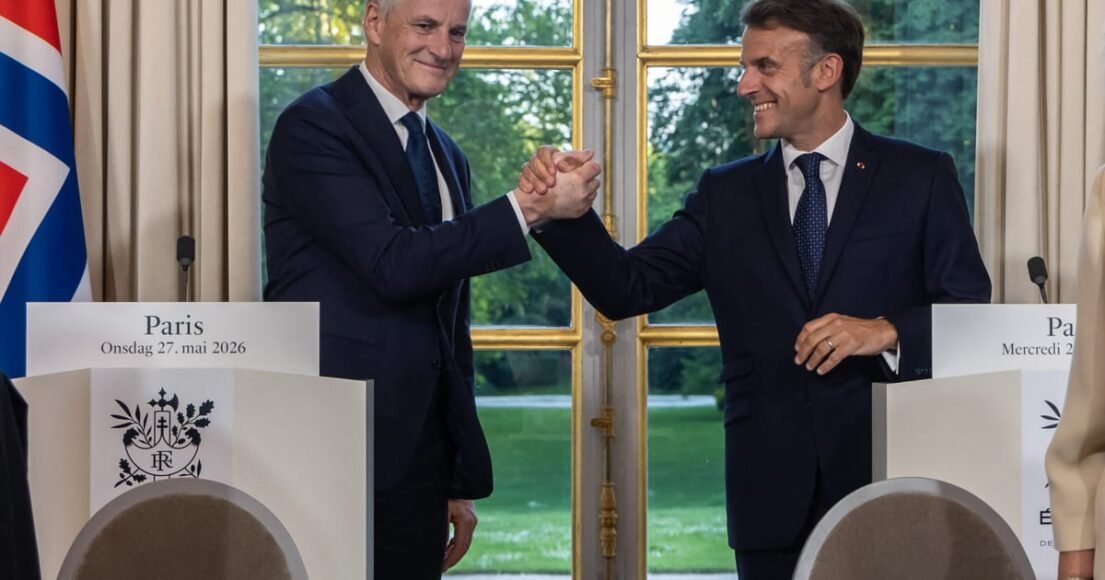
Norway Aligns with France’s Nuclear Deterrence Policy
On March 2, the French president announced that Germany, Poland, Greece, the Netherlands, Belgium, Denmark, and Sweden agreed to discuss nuclear cooperation with Paris. This may include joint nuclear drills, information shari

Debate on European Nuclear Deterrence Intensifies Following Norway’s Support for France’s Security Role in Oslo 2026
The statement comes during a period of heightened geopolitical uncertainty, increasing Arcti
Leave a Reply