


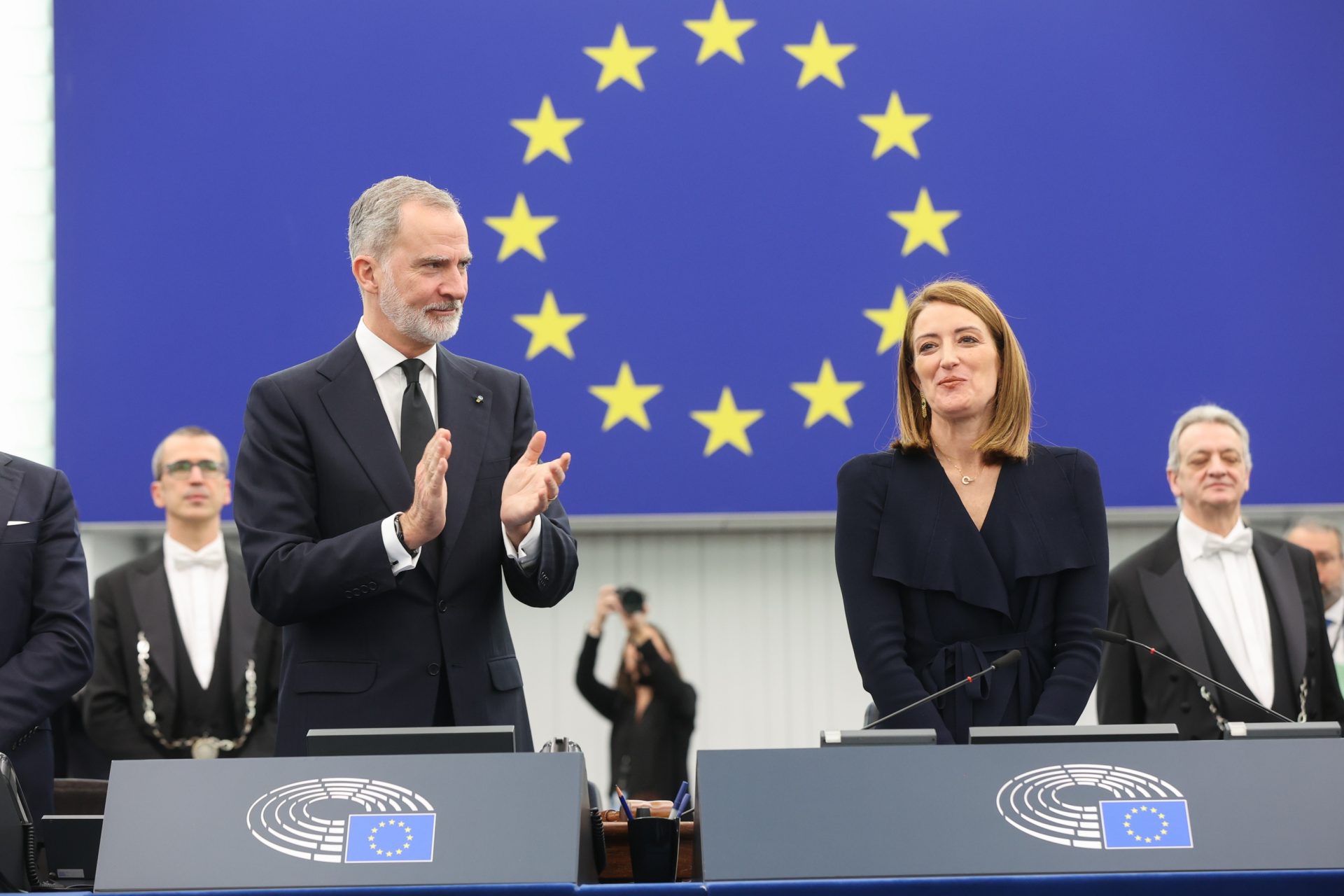
STRASBOURG – In his address to the European Parliament on Wednesday, King Felipe VI urged against accepting “geopolitical approaches from another era” and emphasized that “any issue affecting one part of this space impacts us all.” He highlighted the EU’s “strength” as stemming from its “unity” and stressed the importance of defending solutions grounded in “rules and dialogue,” as well as preserving the transatlantic relationship, warning that neglecting it could lead to “a more uncertain, more unstable and more dangerous world.”
This address took place in Strasbourg, commemorating the fortieth anniversary of Spain and Portugal’s formal accession to the European Communities.
The King pointed out that “there is no citizenship without full awareness of our shared political space, and any issue affecting one part affects us all.” Although he did not mention U.S. President Donald Trump or his Greenland intentions, the American leader’s influence was felt throughout his speech.
Europe “cannot be taken for granted”
“Our strength is our unity: it is crucial to remember this in our times,” Felipe VI noted, asserting that the current situation in Europe requires everyone’s commitment and that the European Union must not be “taken for granted.”
He reaffirmed that in foreign policy, Europe stands for “rule-based and dialogue-driven solutions to conflicts, promoting peace, stability, and cooperation,” and stressed that it cannot accept or endorse outdated geopolitical perspectives.
Power without principles is equivalent to barbarism
“Ladies and gentlemen, our current times frequently remind us that power devoid of principles amounts to barbarism, while principles without action lead to disillusionment,” the King cautioned.
In this light, he called for ongoing efforts towards Europe’s defense and strategic autonomy, as well as “strengthening the European pillar within the Atlantic Alliance,” perceiving this as an “urgent necessity” and the best means to maintain a transatlantic bond based on respect and loyalty, which has been beneficial for all. “Without that bond, we risk a more uncertain, unstable, and dangerous world,” he warned.
He urged for “boldness” in domestic policies to combat “bureaucracy and regulatory excess” and to meet challenges in productivity, innovation, and AI. “The pandemic demonstrated our capabilities when we collaborate and leverage each member state’s strengths. A few months ago, at the College of Europe’s academic year closing, I remarked, ‘Let no one underestimate Europeans’ ability to address their challenges,’” he concluded.
The “threat” of “forgetfulness”
Felipe VI acknowledged that European citizens are often “very critical” of EU institutions, frequently expressing concerns about “the weakness of a united Europe, its outdated idealism,” and “its disconnection from reality.” While he views such criticism as a sign of a functioning democracy, he warned that some perspectives are detrimental to the EU.
“Certain criticisms undermine our principles and values, which are essential; without them, Europe could revert to being merely a geographical concept. This forgetfulness regarding what European construction represents poses our greatest threat,” he cautioned, highlighting existing dangers within the Union.
During his speech, the head of state reflected on Spain’s transformation since its accession to the European Communities alongside Portugal in 1986, noting the presence of Portuguese President Marcelo Rebelo de Sousa. “Together, we took a historic step, a further step in our long-shared history,” he stated in Portuguese.
Preserving the European legacy
He characterized the accession as “a reunion” following the abrupt separation from Europe brought on by the Civil War and subsequent Franco dictatorship. He recalled that on the day the accession treaty was signed, ETA committed a violent act, allowing him to honor all victims of “terrorism, hatred, and violence.”
Pointing out that Europe’s membership has been a “decisive factor” in Spain’s modernization, he emphasized that




Leave a Reply