


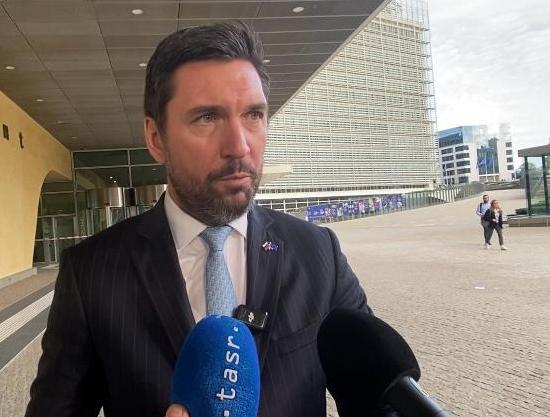
Brussels – The EU’s new common agricultural policy remains contentious and unsatisfactory. This was highlighted on Wednesday evening by Slovak Minister of Agriculture Richard Takáč (Smer-SD) following a meeting of agriculture ministers from EU member states with three European Commissioners. The discussions centered on the future of agriculture in Europe and food security, according to a TASR correspondent.
Richard Takáč characterized the meeting as a platform for political dialogue regarding the common agricultural policy and its agreements with third countries. He noted that the hastily arranged meeting at the European Commission (EC) was prompted by protests from European farmers over the trade deal with Mercosur, allowing agriculture ministers to voice their concerns about financing the common agricultural policy in the upcoming multiannual financial framework.
“There is still no agreement or satisfaction with the new common agricultural policy. There are also unresolved issues regarding agreements with third countries, prompting us to continue seeking action and solutions from the European Commission,” he stated.
He emphasized that the conversation extended beyond Mercosur, as the agreement with Ukraine and the high quotas imposed on certain commodities pose a greater concern for Slovakia.
Before the meeting, EC President Ursula von der Leyenová suggested that member states could access part of the EU’s long-term agricultural budget (2028-2034) early, amounting to 45 billion euros. However, Takáč remarked that the ministers “did not gain new insights” from her letter and that no additional support is offered to the agricultural sector.
“The President merely indicates that we can access the funds allocated for us earlier. The flexibility she proposes does not equate to increased funding, nor does she clarify that the common agricultural policy will be separate with distinct pillars. This is a hurried obfuscation that gives the impression of action while effectively doing nothing,” he asserted.
Nonetheless, he acknowledged the significance of the meeting, as ministers articulated their positions and established “red lines” for their countries. He noted that many advocated for a separate and dual-pillar structure for the common agricultural policy.
Slovakia’s three red lines: a dual-pillar structure, improved CAP financing, and the reintegration of the food industry into the common agricultural policy
He highlighted three critical issues for Slovakia. First is the capping of direct payments, as Slovakia cannot be disadvantaged by its historical reliance on larger farms. The second concern is the distribution of financial resources; after two decades of EU membership, Slovakia is receiving only 82% of direct payments relative to older member states, with external convergence fading. Considering inflation, Takáč pointed out that Slovakia will face 20% fewer resources for agriculture, a situation the Slovak government finds troubling as the EU plans to increase military spending by one trillion euros.
“Today, several ministers reiterated that we must achieve competitiveness and food self-sufficiency, which can only be accomplished with adequate funding for agriculture and reduced bureaucracy,” he conveyed.
The third vital aspect for Slovakia is the exclusion of the food and wine sectors from agricultural financing, having been reassigned to industry. It is crucial for Slovakia that the food industry is incorporated back into the common agricultural policy.
Referring to trade agreements, Takáč insisted on the need for protective mechanisms for farmers in the EU. Regarding Ukraine, Slovakia is advocating for a special fund to compensate the agricultural sector for any detrimental effects stemming from Ukrainian imports.
“We collectively demanded that the EU’s standards must be upheld, including limits on pesticides, fertilizers, and other substances banned within the Union. The standards required of European farmers and food producers must also apply to potential importers from third countries. We do not want delays of two, three, or four years; we require immediate adherence to these conditions when the agreements take effect,” Takáč explained. (7 January)





Leave a Reply