


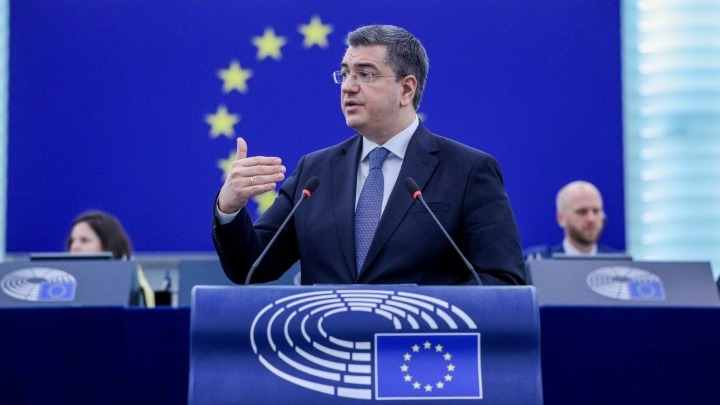
The European Union’s strategy for military mobility was unveiled by Commissioner for Sustainable Transport and Tourism, Apostolos Tzitzikostas, during a meeting of the North Atlantic Council of NATO held in Brussels.
In his address, Commissioner Tzitzikostas highlighted the significant geopolitical and geostrategic challenges confronting Europe and the Alliance, asserting that “we are at a pivotal moment in European history.”
“Those who seek to undermine us underestimate our political resolve to deliver a substantial and long-term response. They are mistaken,” he stated, adding that “European security has greatly benefited from our ongoing cooperation with NATO, which we have strengthened in recent years to effectively tackle emerging threats. Nonetheless, the security landscape is evolving rapidly, necessitating that Europe enhance its efforts to establish credible deterrence and ensure the security vital for our prosperity. This requires unity among member states and investment in our collective defense.”
The Commissioner reiterated the EU’s stance on the war in Ukraine, emphasizing the desire for a “just and lasting peace in the region,” while referencing the White Paper on the Future of European Defense.
On the topic of military mobility, Tzitzikostas underscored its significance within his portfolio, noting that the EU has been proactive in this area since 2017, with the approval of an initial action plan in 2018 aimed at identifying dual-use transport infrastructures (both civilian and military), in collaboration with NATO.
“These dual-use infrastructures were established using existing non-military infrastructures, particularly the trans-European transport networks, which are crucial connections between member states, their capitals, and major economic centers. This is important because the military movement infrastructure is 97% identical to the civilian network. The partnership between the European Commission and NATO on dual-use infrastructures stands out as one of our most successful collaborations to date,” he emphasized.
Tzitzikostas recalled the launch of the first budget for dual-use military mobility infrastructures in 2019, pointing out that at that time, the importance of these infrastructures was not considered a priority for the EU. However, he noted, “this changed in 2022 with the onset of the war in Ukraine.”
He revealed that the available funding of 1.7 billion euros was fully utilized within just two years for 95 dual-use projects across 21 EU member states, remarking that the budget was insufficient for the task at hand.
“While it was a small amount, the geopolitical context is vastly different now. Consequently, we still lack a well-connected and resilient dual-use transport network,” he said. “Future investments must be more substantial and strategically focused. In collaboration with NATO, we have pinpointed four key military mobility corridors within the EU that require urgent enhancements to satisfy military needs. We have also identified 600 specific dual-use infrastructure projects. By July 1, we aim to finalize the mapping of these projects to present to the transport and defense ministers of EU member states,” the Commissioner indicated.
He mentioned that these initiatives will encompass improvements to roads, railways, ports, and airports, as well as provisions for refueling, tailored to the needs of both the EU and NATO.
As for future funding for military mobility, Tzitzikostas stressed the necessity of increasing resources in the upcoming Multiannual Financial Framework of the EU, set to commence in 2028.
Beyond financing, he also stressed the importance of reducing bureaucratic hurdles, particularly regarding military movements, with the goal of ensuring that troops and equipment traveling within the EU will no longer require cross-border traffic permits. He proposed that those arriving from non-EU countries should only need a single permit at the external borders for entry and transit through EU territory.
Following his presentation, Tzitzikostas engaged with members of the North Atlantic Council of NATO, addressing their questions and participating in a discussion. (16/4/2025)








Leave a Reply