


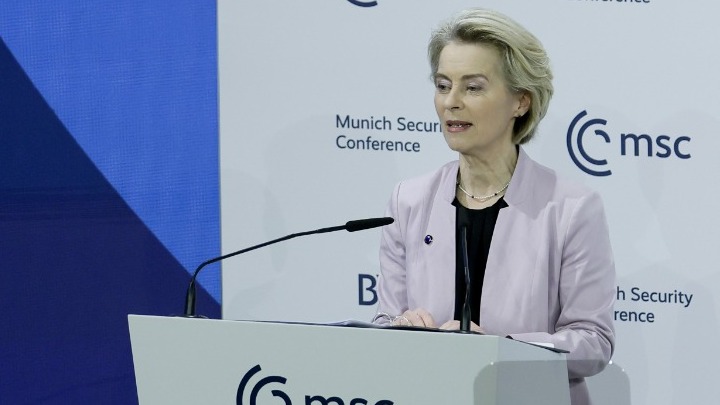
BRUSSELS – Ursula von der Leyen, the President of the European Commission, revealed on Friday that member states’ defense expenditures will be exempt from budget deficit limitations.
This announcement was made during her address at the International Security Conference in Munich, aimed at creating more fiscal flexibility for increased defense budgets across member states.
The Commission has invoked a waiver from the Stability and Growth Pact, which typically restricts the budget deficit to no more than 3 percent of GDP and public debt to 60 percent of GDP. This waiver was previously utilized during the COVID-19 pandemic to allow member states to allocate larger budget deficits to support businesses and citizens.
“In times of previous extraordinary challenges, we granted member states additional fiscal leeway by activating the derogation clause. Essentially, we permitted them to substantially boost public investments needed to address the crisis,” von der Leyen stated.
“Now, as we face another crisis, similar measures are necessary. Therefore, I am announcing my intention to propose the activation of the derogation clause specifically for defense investments. This will enable member states to significantly enhance their defense spending,” she added.
Von der Leyen noted that this exemption will come with oversight and specific conditions.
An assessment of each member state’s circumstances will be conducted, taking into account their defense expenditure levels and fiscal health, leading to tailored support solutions for their unique situations.
Plans are also in place for joint investments in essential common defense projects of European significance. Von der Leyen emphasized the need for increased EU defense spending, which currently stands at about two percent of GDP. Prior to the conflict in Ukraine, member states allocated just over 200 billion euros to defense, a figure that has now risen to more than 320 billion euros.
“We will need to further escalate that investment,” von der Leyen asserted, noting that raising spending from just below two percent of GDP to above three percent could entail hundreds of billions of euros in additional investments annually. (February 14, 2025)








Leave a Reply