


Historic Agreement Between Italy and the Romanian Orthodox Diocese: A Milestone for Religious Freedom
Formal Recognition of the Romanian Orthodox Diocese in Italy
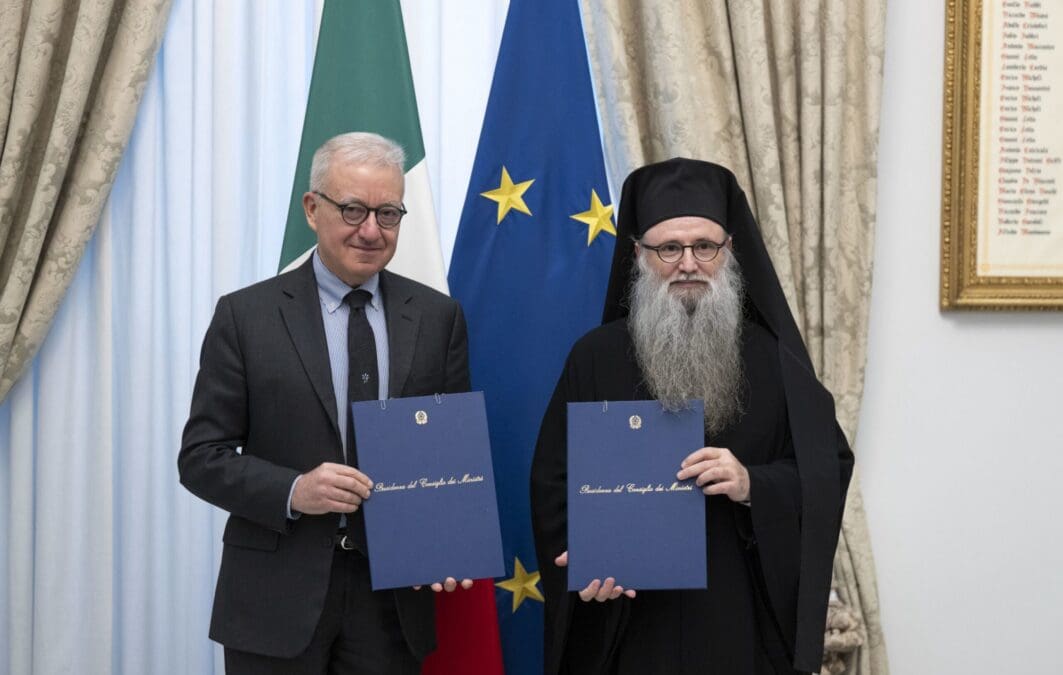
On January 27, 2025, in Rome, a significant step was taken toward religious pluralism with the signing of an agreement (Intesa) between the Italian Republic and the Romanian Orthodox Diocese of Italy (DOR). The signing ceremony, held at Palazzo Chigi, was attended by Undersecretary to the Presidency of the Council, Alfredo Mantovano, and His Excellency Siluan (Span Ciprian Nicolae), the legal representative of the DOR. This agreement provides official legal and institutional recognition to one of Italy’s largest and most deeply rooted religious communities.
A Framework for Official Recognition and Protection
The agreement formalizes a series of key provisions that structure the religious and administrative activities of the Romanian Orthodox community in Italy. These include:
– Autonomy and Independence: The Italian state acknowledges the DOR’s full autonomy in managing its religious affairs, including appointing religious ministers and organizing community activities, without external interference.
– Ministerial Confidentiality: Clergy members are protected from legal obligations requiring them to disclose information obtained through pastoral duties.
– Religious Education: Orthodox religious instruction can be provided outside regular school hours at the request of students and families, with costs covered by the DOR.
– Recognition of Religious Marriages: Marriages performed by DOR ministers will be legally recognized as long as they are recorded in the civil registry.
– Legal Status of Religious Institutions: Organizations affiliated with the DOR, focused on worship, education, charity, and social assistance, are officially recognized by the Italian state.
– Access to Public Funding: The DOR will now be eligible to receive funds through Italy’s “eight per thousand” tax system, which allocates a portion of individual income taxes to religious denominations.
A Long-Awaited Recognition
The Romanian Orthodox Church, with nearly 20 million followers in Romania and its diaspora, is one of the largest Orthodox communities in Europe. The DOR has had a presence in Italy since the 1960s, with the first parish established in Milan in 1974. By 2023, the community had grown to include 285 registered parishes, reflecting the increasing number of Romanians in Italy, now one of the country’s largest immigrant populations.
With this agreement, the DOR gains an institutional status similar to other religious communities that have previously formalized agreements with the Italian state, such as the Waldensian Church, the Italian Buddhist Union, and the Church of Jesus Christ of Latter-day Saints.
Strengthening Religious Freedom in Italy
This agreement aligns with Article 8 of the Italian Constitution, which guarantees religious denominations the right to self-governance within the national legal framework. It also arrives at a critical moment when European countries are focusing more on religious integration policies, ensuring fundamental rights while fostering intercultural dialogue.
At the ceremony, Professor Geraldina Boni, President of the Commission for Agreements with Religious Denominations, emphasized the importance of ensuring equal recognition for all faiths present in Italy.
Reactions from the Romanian Orthodox Community
Leaders of the DOR expressed their gratitude and satisfaction with the agreement, seeing it as a recognition of their cultural and social contributions to Italy. Bishop Siluan stated:
“This agreement highlights the Italian State’s respect and attention toward our community, which has lived in and contributed to the development of this country for decades.”
The Ongoing Challenge of Religious Equality
Despite this achievement, many other religious communities in Italy continue to face legal and bureaucratic barriers that hinder their formal recognition. Some groups struggle to register religious ministers or obtain higher institutional acknowledgment, creating inequality in legal status and available rights.
This agreement with the DOR could serve as a model for expanding religious freedom in Italy, ensuring all faiths are granted the same rights under a fair and inclusive system. The challenge now is to make recognition processes more accessible and equitable for all religious communities.
Moving Toward a European Model of Religious Integration
The partnership between Italy and the DOR contributes to the broader effort to recognize and integrate diverse religious communities within the state framework. It sets a precedent for other European nations hosting large Orthodox populations, demonstrating a commitment to positive secularism, in which religious diversity is not just tolerated but embraced and protected.
Through









Leave a Reply