


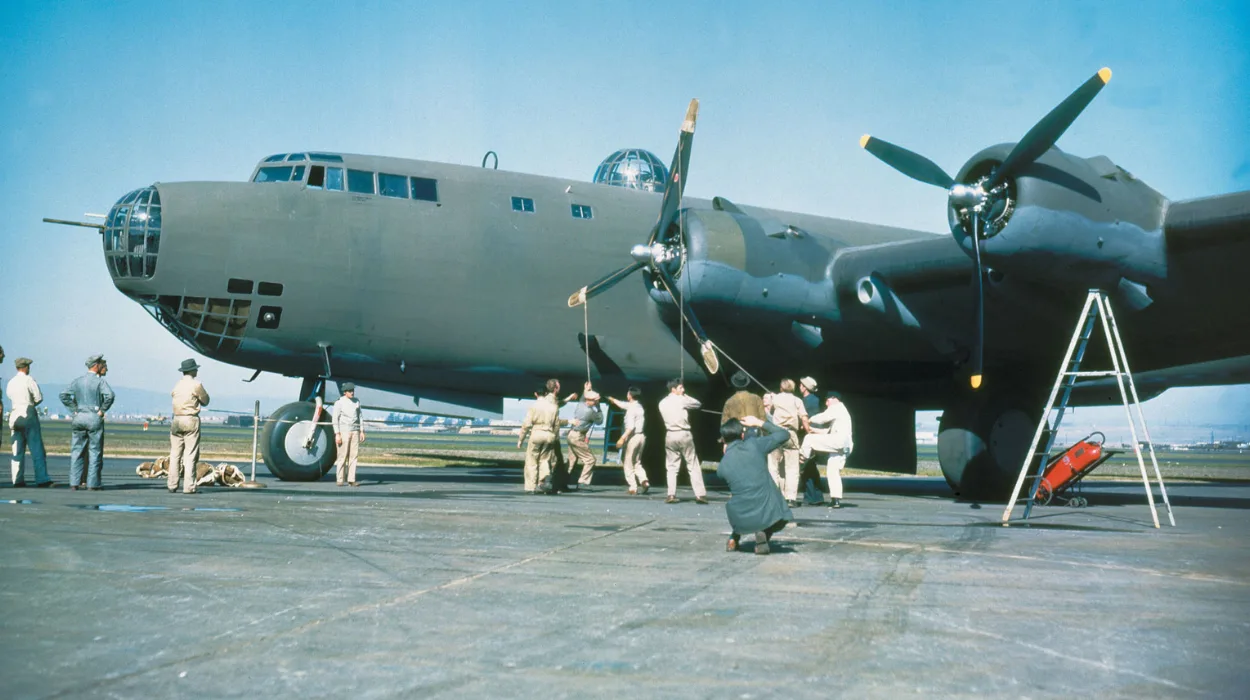
The Douglas XB–19 is a technical bomber capable of long distances. Its design was completed in the late 1930s. When it was first flown in 1942, the XB-19 ranked as the heaviest bomber. The XB-19 served as a valuable testbed for the technologies and strategies used in bombers during World War II. This article examines its development and operational history, which significantly accelerated due to ambitions of advancing aviation capabilities and military strategies in the lead-up to the war.
Origins and Development
The XB-19’s origins date back to 1935. That year, the United States Army Air Corps requested a long-range bomber capable of flying continents with a flight range of up to 8,000 miles. The specifications emphasized range and payload, aiming to develop a plane that could target locations at extreme distances. The XB-19’s fuselage was semi-monocoque and primarily crafted from aluminum, with steel used in high-stress areas. Its massive wings were equipped with Fowler flaps to assist in takeoff and landing. Initially designated XBLR-2, the project wasn’t intended to produce a bomber immediately but to test and demonstrate emerging aviation technologies.
The designs took considerable time to complete due to their complexity and innovative nature. By 1940, the project’s official designation of XB-19 was achieved, and development timelines accelerated. This was due to the project’s ambitious goals of integrating advanced materials, engine technologies, and aerodynamics into an unprecedentedly large American airframe.
Design
The XB-19 was remarkable for its size, weighing over 160,000 lbs., which was unprecedented and posed significant structural challenges for its designers.
Airframes and Structures
The XB-19 featured a semi-monocoque fuselage primarily crafted from aluminum, with steel used in high-stress regions. Its massive wings, equipped with Fowler flaps, allowed takeoff and landing for a plane of such weight. The aircraft featured a horizontal fin and a high-mounted stabilizer. Initially, it was powered by four Wright R-3350 Duplex-Cyclone radial engines, each generating 2,000 horsepower. These engines were mounted in nacelles on the wings, providing the necessary thrust for the enormous plane.
In 1944, the engines were upgraded to Allison V-3420 liquid-cooled engines, which improved both reliability and overall power.
Crew and Armament
The XB-19 was designed to house a crew of up to 18, including pilots, navigators, bombardiers, and gunners. The defensive armament consisted of machine guns mounted on powered rotating turrets or movable positions. Additionally, the bomber could carry an impressive 18,700-pound payload of explosives, significantly exceeding what most bombers of its time could transport.
Performance
Despite its advanced design, the XB-19’s performance was hindered by its engine limitations. The bomber could reach a maximum speed of 224 mph and had a cruising speed of around 135 mph. While these figures were respectable for its era, the trade-offs inherent in building such an immense aircraft were evident.
Operational History
The XB-19 had its maiden flight on June 27, 1941, piloted by Stanley M. Umstead and Eddie Allen. Although not intended for combat, the bomber served extensively in testing. Its size and features provided valuable data on large-bay bomb configurations, long-range navigation systems, and other operational challenges. These insights directly contributed to the design of subsequent heavy bombers.
The XB-19 was also showcased in demonstrations for foreign officials and military leaders. By the time it became operational, however, technological advancements had rendered it obsolete. The next generation of bombers, such as the B-29 Superfortress, had already been designed and produced, offering superior performance and versatility.
<
Comments
Last News

Death Toll in Venezuela Earthquake Climbs to 4,490 Amid Ongoing Recovery Efforts
Caracas, July 12, Eurotoday Newspaper – The death toll from the devastating earthquakes in Venezuela has risen to 4,490, according to the latest official figures released by authorities. Thousands of people remain displaced, while emergency teams continue recovery efforts across the country’s hardest-hit regions. Rescue crews have worked around the clock since the powerful twin earthquakes struc

What does Starmer’s last week look like?
Sam Coates and Anne McElvoy provide updates on the police investigation, Nigel Farage’s response, and the broader political implications. This coincides with an intensifying debate over political party donations, with Reform contending that existing

Bangkok Pub Fire Claims at Least 27 Lives; Thailand Begins Investigation
Bangkok, July 12, Eurotoday Newspaper – Bangkok pub fire has left at least 27 people dead after flames swept through a crowded nightlife venue in Thailand’s capital, according to local officials. Dozens of people were also injured as firefighters battled the blaze and rescue teams searched the building. Authorities have launched a formal investigation to determine what caused one of the country’

EU Confronts Trade Settlement Decision on Gaza
EU foreign ministers are set to meet in Brussels on Monday under growing pressure to decide if the bloc’s long-standing opposition to Israeli settlements should be accompanied by concrete trade actions. The debate, expected on July 13, highlights the humanitarian and legal cha

Why Europe Still Can’t Agree on Israel

DOJ Reviews Allegations Against UAW President Shawn Fain
Sarhan Basem is Eurotoday’s Senior Correspondent to the European Parliament. With a Bachelor’s degree in English Literature, Sarhan brings a unique blend of linguistic finesse and analytical prowess to his reporting. Specializing in foreign affairs, human rights, civil liberties, and security issues, he delves deep into the intricacies of global politics to provide insightful comment

Bulgaria’s Deficit Highlights Euro Discipline
Bulgaria has been subjected to the EU’s excessive deficit procedure, increasing the scrutiny of its public finances during its first year using the euro. The Council of the EU requires Sofia to submit corrective measures by 15

Backlash Erupts Over Ex-Spanish PM’s Racist Remark About French World Cup Team

The Impact of Positive Media Coverage on Enhancing Your Online Reputation
Sarhan Basem is Eurotoday’s Senior Correspondent to the European Parliament. With a Bachelor’s degree in English Literature, Sarhan brings a unique blend of linguistic finesse and analytical prowess to his reporting. Specializing in foreign affairs, human rights, civil liberties, and security issues, he delves deep into the intricacies of global politics to provide insightful comment

Brussels Transforms Meta Design Into a DSA Case
The Commission’s preliminary finding against Facebook and Instagram intensifies Europe’s effort to regulate platform architecture, not just online content
The European Commission has advanced one of its most politically sensitive Digital Services Act investigations, initially finding that Meta violated EU regulations through the addictive design of Instagram and Facebook. While not a final decis
Leave a Reply