


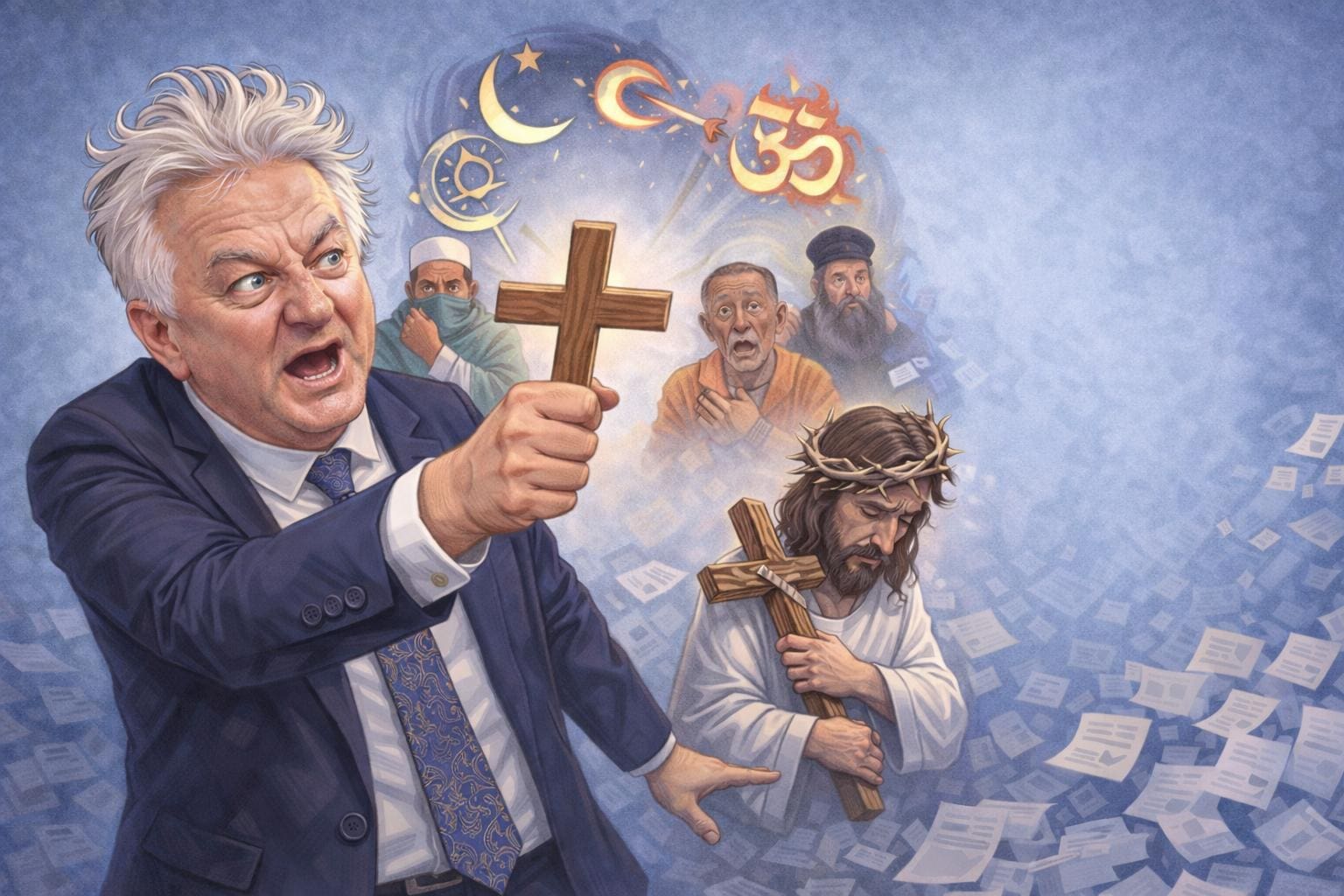
As Hungary approaches the parliamentary election on 12 April 2026, Viktor Orbán is once again portraying himself as the protector of Christian Hungary. However, a deeper analysis indicates that the primary force behind the country’s exclusionary church policy is Deputy Prime Minister Zsolt Semjén. Critics suggest that the model he contributed to has politicized rather than protected Christianity, initially harming minority faiths but eventually undermining the freedom, independence, and moral credibility of all religious communities.
Though Orbán is usually depicted as the face of Hungary’s Christian nationalism in campaign messaging, the architecture of these politics often points to Zsolt Semjén, leader of the Christian Democratic People’s Party (KDNP) and deputy prime minister responsible for church policy and diplomacy. Orbán delivers the message, but Semjén has been instrumental in designing the system.
This distinction is significant as the election approaches. The 12 April vote is considered a challenging electoral test for Orbán, with Reuters describing it as a pivotal contest for Hungary’s direction, and the OSCE’s Office for Democratic Institutions and Human Rights deploying an observation mission. But the stakes extend beyond politics to constitutional, civic, and religious issues: the public role of faith in Hungary and who decides which believers are legitimate.
Semjén’s approach to religion has been explicitly selective. On his official CV, he emphasizes a proposal made while still in opposition: that state recognition as a church requires at least 100 years of presence in Hungary or 10,000 members. This was not a technical adjustment but a governing philosophy that religion should be filtered through history, scale, and state approval.
This approach, presented as a defense of Christian values, replaces freedom with hierarchy, favoring large, historically embedded institutions and disadvantaging smaller, newer, or less politically useful communities. In practice, it transforms religion from a right into a status conferred more generously on some than others.
After Orbán returned to power in 2010, Semjén was positioned to turn this philosophy into law. The Venice Commission noted Semjén’s responsibility for church-related issues during its review of Hungary’s 2011 church law, which stripped many religious communities of their status and shifted recognition to a parliamentary process susceptible to political discretion.
The Venice Commission warned that parliamentary recognition politicized the issue, contradicting European standards. The European Court of Human Rights later ruled in Magyar Keresztény Mennonita Egyház and Others v. Hungary that the system violated the applicants’ rights, as communities needed parliamentary approval to regain church status.
This election-year rhetoric about protecting Christianity appears less like spiritual conviction and more like state engineering. Semjén has not merely defended Christian identity in abstract terms but helped create a model where the state categorizes religions into preferred and less-preferred.
A prominent example is pastor Gábor Iványi, a Methodist minister who once officiated Orbán’s wedding and baptized his children. Now an opponent of Orbán’s Christian nationalism, Iványi faces prosecution in what critics describe as a politically motivated case.
Iványi’s Hungarian Evangelical Fellowship was notably impacted by the post-2011 recognition regime, resulting in reduced resources, legal vulnerability, and pressure on its social services. Human Rights Watch states that the prosecution and interference with Iványi’s church reflects a broader pattern targeting those supporting marginalized groups, suggesting the issue involves more than administrative control. It involves legal and financial pressure against religious humanitarian work that diverges from the government’s ideological frame.
Exclusionary church policies primarily affect smaller communities, with the UN Special Rapporteur noting in 2024 that the 2011 law stripped almost 350 religious groups of legal status, with amendments failing to resolve discrimination.
The impact extends beyond minority communities. A state that selectively supports compliant churches alters religion’s meaning for majority denominations, risking their moral independence when closely aligned with state power.
This paradox, central to Semjén’s project, risks reducing Christianity to a political identity marker rather than a faith challenging and cooperating with society. While strengthening state control over religion, it may weaken religion’s spiritual authority.
Even for communities benefiting from state recognition, the cost is significant. Publicly framing religion through exclusivity and state preference narrows Christianity’s message to boundary-drawing rather than universal dignity.
This situation reflects not just a dispute between the government and minority faiths but an internal debate within Christianity, as exemplified by Iványi’s break from Orbán, suggesting that under the guise of defending Christian values, the government may be advancing an exclusivist ideology that instrumentalizes religion.
Thus, the 2026 election is also a verdict on Semjén’s church policy. While Orbán remains the dominant figure selling the nationalist-Christian message, Semjén has been the specialist converting it into legal order.
If the governing alliance wins again, it can claim legitimacy for both Orbán’s electoral machine and Semjén’s church-state model. If it loses, an important question is whether a new government will dismantle this hierarchy




Leave a Reply