


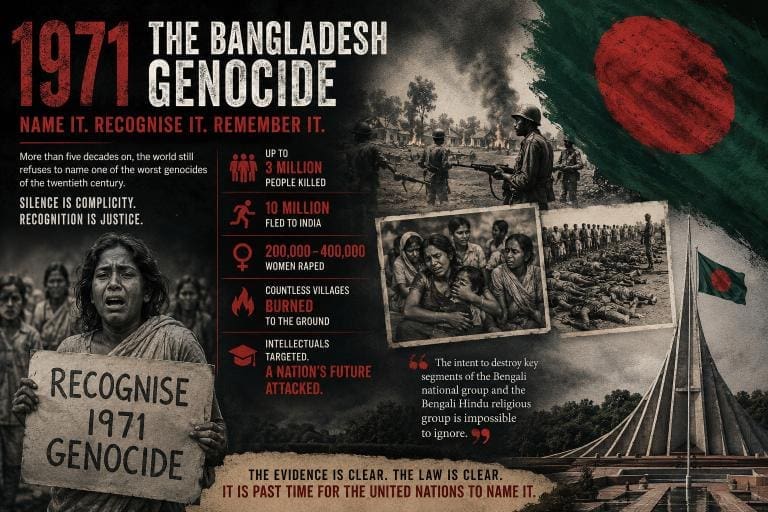
The 1971 genocide in Bangladesh stands as a brutal yet largely unrecognized atrocity of the twentieth century. Over five decades later, the global community, particularly the United Nations, has not mustered the political will to acknowledge it as genocide. This silence weakens international law, undermines the promise of “never again,” and denies justice and dignity to victims and survivors.
Between March and December 1971, the Pakistani military launched an extermination campaign in East Pakistan to suppress Bengali autonomy and independence movements. This began with Operation Searchlight on March 25th in Dhaka, targeting students, professors, and neighborhoods with coordinated attacks. It was a calculated assault on a national community asserting self-determination.
Throughout the months following, widespread atrocities occurred across the region, with death estimates ranging from hundreds of thousands to up to three million. Approximately 10 million people fled to India, while millions more were internally displaced. Mass graves in cities like Dhaka and Chittagong highlight the scale of the killings. University campuses became execution grounds, and rural areas perceived as supportive of independence faced scorched-earth tactics, with villages and crops destroyed.
A particularly harrowing aspect of 1971 was the systematic use of sexual violence; between 200,000 and 400,000 women were raped by Pakistani forces and allied militias. These acts were strategic, meant to terrorize communities, stigmatize women for life, and symbolize the humiliation of the emerging Bengali nation.
Religious minorities, particularly Hindus, faced targeted aggression. The terms “Bengali,” “Hindu,” and “Indian” were often used interchangeably, with Hindus labeled as “Indian agents.” Many were killed, and large numbers fled to India, revealing the targeted nature of the persecution. Sacred sites like the Ramna Kali temple in Dhaka were destroyed, worshippers massacred, while Hindu women faced compounded vulnerabilities of gender and faith, experiencing rape, abduction, forced conversion, and marriage. Other non-Muslim communities, including Buddhists and Christians, were also attacked, albeit to a lesser degree.
The targeting of intellectuals and professionals added a chilling element to the genocide. As the war neared its conclusion, death squads eliminated journalists, teachers, doctors, artists, and other prominent figures, aiming to dismantle future leadership in an independent Bangladesh.
These crimes undeniably meet the legal definition of genocide as per the UN Genocide Convention. The organized mass killings and rapes, along with the disproportionate targeting of Bengali Hindus and explicit orders for destruction, demonstrate a clear intent to annihilate key segments of the Bengali national and Hindu religious groups.
Bangladesh has actively sought recognition, with successive governments, especially under Prime Minister Sheikh Hasina, demanding a formal apology from Pakistan and addressing reparations. Civil society and survivor groups have campaigned for international acknowledgment, with genocide-focused organizations urging states and international bodies to recognize the events of 1971 as genocide. Some national parliaments, including the U.S. House of Representatives, have condemned the atrocities explicitly as genocide.
Despite these efforts, the United Nations has not formally recognized the 1971 atrocities as genocide. Bangladeshi diplomats and international NGOs have presented evidence and survivor testimonies, arguing that these crimes are among the worst since World War II and meet the legal genocide threshold. Yet, official UN records remain noncommittal.
The reluctance stems from political considerations rather than legal ones, as acknowledging 1971 would mean confronting Pakistan’s involvement, revisiting Cold War alliances, and recognizing systemic failures. Some countries find it easier to ignore these issues.
However, ignoring these events carries a high cost. The lack of recognition deepens the trauma for survivors, allowing denial and distortion to thrive, and sending a message that even clear cases of genocide can be dismissed.
Recognition of the 1971 genocide would not fully deliver justice or restore the lives lost but would validate the experiences of victims, strengthen global norms against mass atrocities, and combat denial and distortion, ensuring the events of 1971 are remembered and taught.
For an entity that values the lessons of the Holocaust and champions “never again,” the UN’s failure to recognize the Bangladesh genocide presents a significant moral and institutional contradiction. Resolving this contradiction is imperative. The evidence and legal criteria are clear, and the victims have waited long enough.
Unaddressed atrocities resonate across generations and borders. The 1971 genocide in Bangladesh is not just a concern for Dhaka and Islamabad, but a crucial test for the international human rights and humanitarian law system. Failure to acknowledge this genocide is a failure to both past and future generations.








Leave a Reply