



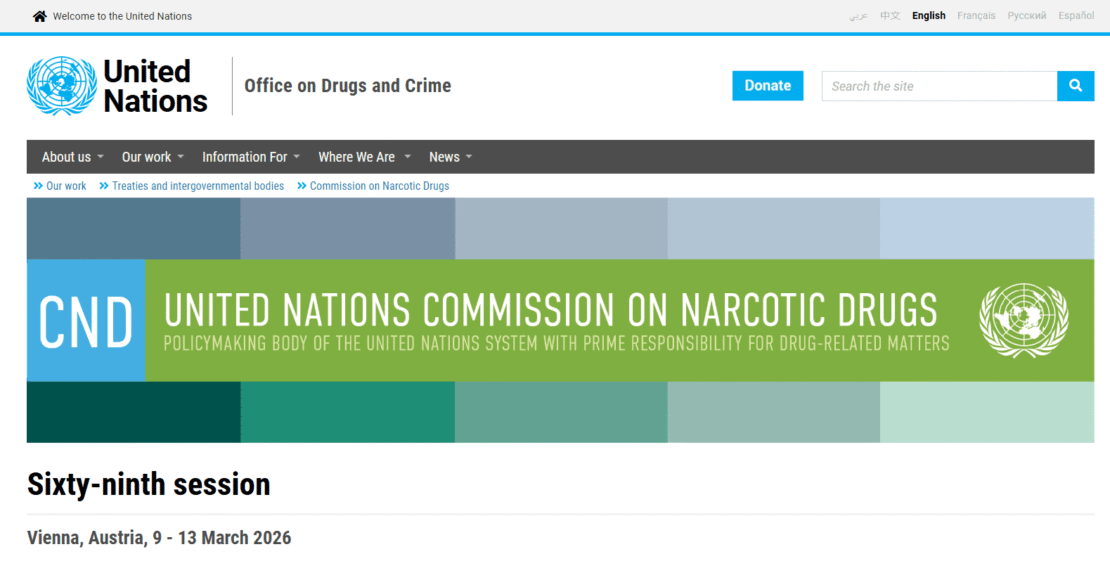
Vienna has become a diplomatic hub as the 69th session of the United Nations Commission on Narcotic Drugs begins at UNODC headquarters, gathering governments, researchers, and civil-society organizations for a week of discussions on prevention, synthetic drugs, treatment, and future global drug policy directions.
VIENNA — The 69th session of the Commission on Narcotic Drugs has placed Vienna at the center of significant international policy debates. From March 9 to 13, delegates are meeting at the Vienna International Centre, the home of the United Nations Office on Drugs and Crime, to review drug-market trends, assess international commitments, and negotiate state responses to trafficking, addiction, prevention, and public-health pressures.
The Commission, described as the United Nations’ central drug policy-making forum, has opened under the chairmanship of Armenia’s ambassador to the United Nations in Vienna, Andranik Hovhannisyan, with acting UNODC Executive Director John Brandolino among the senior figures leading the week.
An official UNODC media advisory highlighted the broad program, including 169 side events and 23 exhibitions. Much of the real policy debate now occurs in smaller rooms, where various stakeholders compete to shape the global drug policy language and priorities.
Where the sharper debates often happen
Side events provide more revealing conversations than plenary sessions, showcasing actors pressing for different approaches: tougher criminal-justice responses, evidence-based prevention, stronger treatment systems, or framing drug policy through public health or human rights.
The Vienna NGO Committee on Drugs has organized informal dialogues with key figures, reflecting the reality that the Vienna week involves civil society, health institutions, and international agencies trying to influence the global agenda.
A broader overview from the World Federation Against Drugs illustrates the varied side-event calendar, with sessions on women, youth, mental health, synthetic drugs, and human-rights-centered drug strategies. The program suggests that CND69 is a crowded debate with multiple messages.
Prevention takes a visible place
This year’s side events emphasize prevention’s policy weight, arguing that governments must invest in programs to stop drug use before it escalates. “The Hidden Costs of Ineffective Drug Prevention” examines the consequences of poorly designed prevention policies. Another session, “From Implementation to Impact: Outcome-Based Capacity Building in Drug Education,” focuses on measuring education programs by practical results.
A wider struggle over what drug policy should be
Drug policy is debated as a contested field where public health, criminal enforcement, education, rights language, and political credibility collide. Some sessions focus on resilience and early intervention, others on synthetic substances and digital environments, and some on human dignity and community support.
The coexistence of themes shows why the Commission remains politically sensitive. States agree on balanced, evidence-based responses but disagree on the balance’s practical meaning.
Why Vienna still matters
Vienna remains a hub where legal, security, and health conversations converge. For CND69, it means multiple stakeholders try to influence the effective response to drugs in 2026. Side events are crucial, revealing policy mood, advancing narratives, forming coalitions, and gaining traction.
For European readers, the Vienna session echoes ongoing debates in Brussels, Strasbourg, and national capitals, offering insight into the next phase of the argument.







Leave a Reply