The Impact of a Legal Error: How a Jurisdictional Mistake Influenced Decades of War

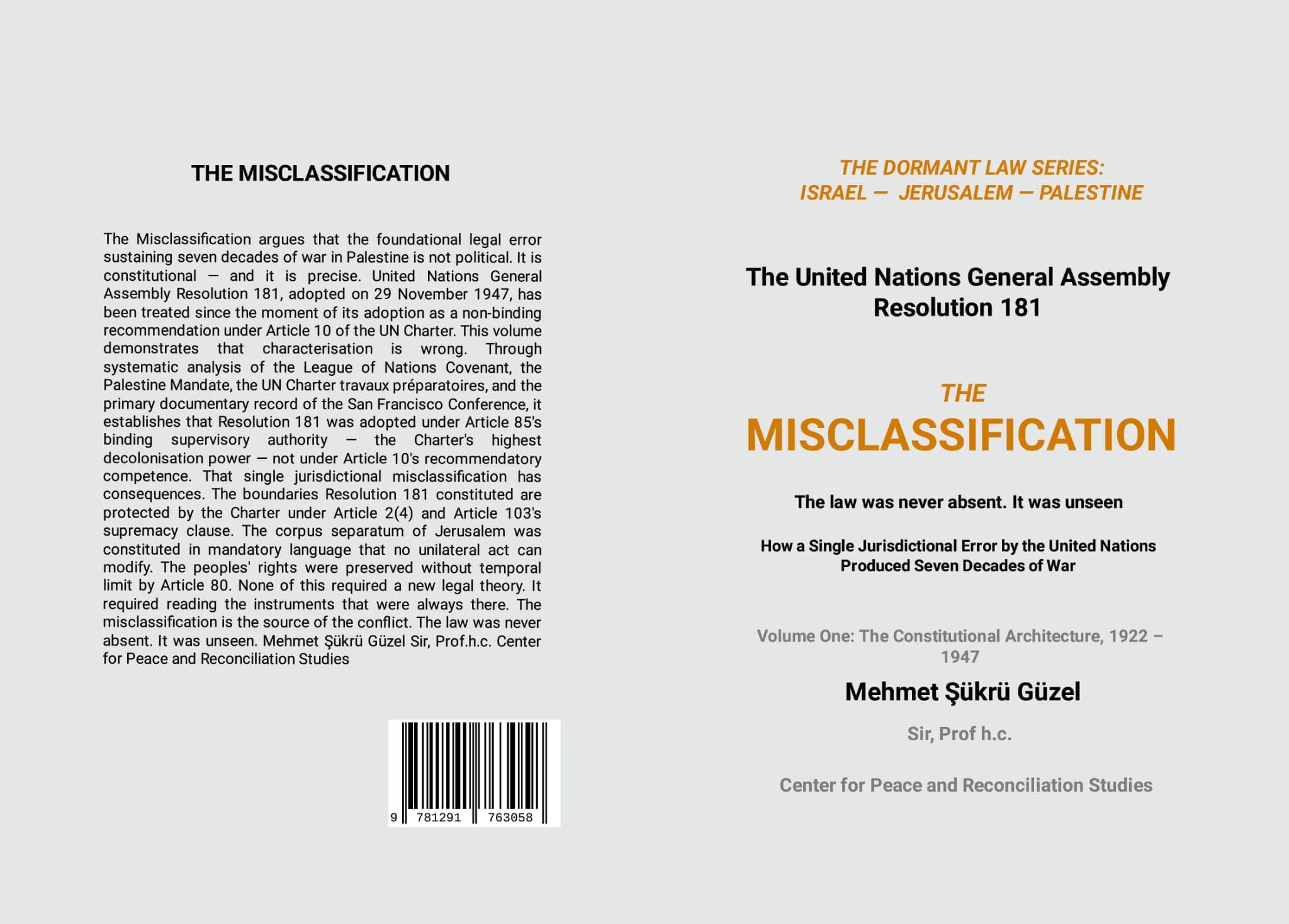
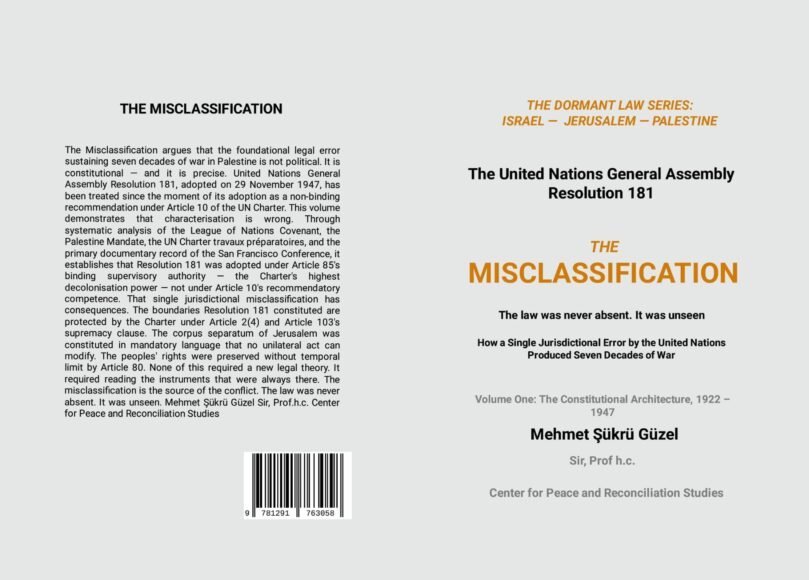
In the quiet realm of international law, where treaties and resolutions lie undisturbed, there’s been a longstanding silence regarding the origins of one of today’s most persistent conflicts. Typically, the Middle East’s strife is perceived through political failures, diplomatic impasses, or age-old hatreds. However, Mehmet Şükrü Güzel’s new book, “The Misclassification,” proposes that the conflict’s root might be more technical and bureaucratic than previously thought.

Güzel’s book isn’t a political manifesto but a forensic look at the legal frameworks that ended the British Mandate for Palestine. His central thesis is straightforward: for almost eight decades, the international community has misunderstood the legal nature of United Nations General Assembly Resolution 181. According to him, a single jurisdictional error—treating a binding constitutional order as a non-binding recommendation—created an authority vacuum that decades of conflict haven’t resolved.

The book encourages readers to examine the UN Charter’s text beyond the conflict’s reality. Güzel argues that Resolution 181, adopted on November 29, 1947, wasn’t an exercise of the General Assembly’s typical recommendatory powers (Article 10). Instead, he claims it was enacted under the Assembly’s “terminal disposition” authority (Article 85), acting as the Successor Trustee for the “Sacred Trust of Civilization” from the League of Nations.

This isn’t a mere semantic issue. If Resolution 181 was a recommendation, parties could accept, reject, or negotiate its terms, implying that the territory became terra nullius—a land without sovereign, open to force acquisition. If Güzel’s legal analysis is correct, the Resolution was a binding fiduciary determination. The boundaries and Jerusalem’s international regime were protected obligations under the Charter’s supremacy clause (Article 103).

This argument has an “Arendtian” quality. Hannah Arendt noted that great evils often arise from functionaries following flawed logic within bureaucracies. Güzel views international law similarly, not accusing the 1947 actors of malice, but of a collective cognitive slip categorizing a complex constitutional act as a mere diplomatic suggestion.

Güzel outlines the consequences of this misclassification with precision. He tracks how not recognizing the binding nature of the UN’s fiduciary duty allowed the mandatory power to withdraw without ensuring lawful transition. This abandonment, he argues, left a legal void, replacing legal authority with military capacity. “Peace processes” like Oslo are presented as efforts to negotiate already legally determined rights or trade territories under a specific international regime.

The book’s treatment of Jerusalem is particularly interesting. Güzel asserts the international status (corpus separatum) wasn’t a proposal but a legal reality upon adoption. Decades of recognizing exclusive sovereignty over the city by any party are seen as a continuous breach of an obligation owed to the international community.

“The Misclassification” is dense, rooted in the Covenant of the League of Nations, the UN Charter, and the Vienna Convention on the Law of Treaties. Yet, it’s accessible in its logic. It removes political rhetoric to reveal a structural failure in applying international law.

For those looking to understand why the conflict endures, Güzel offers a provocative answer: we’ve tried solving a political problem instead of enforcing a legal trust. The book reminds us that, in nations’ realm, the absence of law isn’t freedom; it precedes chaos. Whether one agrees or not, Güzel insists we view the 1947 documents not as historical artifacts but as the active, unseen constitution of a region that has forgotten its rules.

Comments

2 responses to “The Impact of a Legal Error: How a Jurisdictional Mistake Influenced Decades of War”

  1. Red Woman Avatar
    Red Woman

    Brilliant! Who knew decades of conflict could boil down to a bureaucratic blooper? Next time, maybe we should just let the lawyers handle the peace talks instead of the politicians! 😏📜

  2. Insane SweepKick Avatar
    Insane SweepKick

    So, turns out we’ve been fighting for decades over a legal mix-up—who knew international relations were just a big bureaucratic game of “whoops”? 🤷‍♂️ Just what the world needed, more paperwork! 😂

  3. fireberry Avatar
    fireberry

    Oh, brilliant! Who knew a legal mix-up could be the true mastermind behind decades of turmoil? Sounds like the ultimate bureaucratic blunder—next time I misplace my keys, I’ll just blame it on a binding fiduciary duty! 😏

Leave a Reply

Your email address will not be published. Required fields are marked *

Last News

Tehran Targets Near Israeli Nuclear Facility Amid Trump’s Threats to Attack Iranian Power Plants

Tehran Targets Near Israeli Nuclear Facility Amid Trump’s Threats to Attack Iranian Power Plants

Iranian state TV reported that Saturday’s strikes by Tehran were in response to an earlier attack on Iran’s Natanz nuclear facility, according to the BBC. Mohammad Bagher Ghalibaf, the speaker of Iran’s parliament, stated that ballistic missiles bypassing Israeli defenses near the nuclear research site suggests “a new phase” in the conflict. He posted on social media

Read More

The Impact of a Legal Error: How a Jurisdictional Mistake Influenced Decades of War

The Impact of a Legal Error: How a Jurisdictional Mistake Influenced Decades of War

In the quiet realm of international law, where treaties and resolutions lie undisturbed, there’s been a longstanding silence regarding the origins of one of today’s most persistent conflicts. Typically, the Middle East’s strife is perceived through political failures, diplomatic impasses, or age-old hatreds. However, Mehmet Şükrü Güzel’s new book, “The Misclassification,” propos

Read More

Trump Issues Ultimatum to Iran Regarding Strait of Hormuz

Trump Issues Ultimatum to Iran Regarding Strait of Hormuz

Danish prime minister praised the health care systems of Denmark and Greenland after Trump sent a vessel to assist those who are ill and lack sufficient care.

Read More

Did Orbán Lure EU into a Trap?

Did Orbán Lure EU into a Trap?

According to Michael Ignatieff, a former Canadian politician and history professor at the Central European University, Orbán’s tactics in Hungary resemble previous election strategies. The Central European University, initially based in Budapest, was relocated to Vienna after being pushed out by Orbán. Ignatieff noted the risk of being ensnared by Orbán, who is fighting for his political career, a

Read More

Trump Affirms ‘Total Endorsement’ of Orbán Ahead of Hungary Election

Trump Affirms ‘Total Endorsement’ of Orbán Ahead of Hungary Election

An incident at Diego Garcia took place prior to the U.K.’s affirmation that U.S. utilization of its bases entails defensive measures against “missile sites and capabilities being used to attack vessels in the Strait of Hormuz.”

Read More

Safeguarding Civil Society: Addressing the Erosion of Conscience in a Diminishing UN System

Safeguarding Civil Society: Addressing the Erosion of Conscience in a Diminishing UN System

GENEVA, March — On a Tuesday morning in the pristine halls of the Palais des Nations, a side event was held parallel to the 61st session of the Human Rights Council. The gathering, marked by a serious atmosphere, included diplomatic delegations, international organizations’ representatives, and human rights experts. The focus wasn’t a new conflict but the gradual administrative underm

Read More

Iran unsuccessfully targeted Diego Garcia base, confirms UK

Iran unsuccessfully targeted Diego Garcia base, confirms UK

The Royal Air Force of the United Kingdom and other British military resources continue to protect personnel and citizens in the region. The U.K. has allowed the U.S. to use its bases for specific and limited defensive actions. Iran targeted Diego Garcia prior to the U.K.’s confirmation that the U.S. could conduct defensive operations from its bases against missile threats in the Strait of H

Read More

eFM Enhances Experience as a Service Leadership in Europe by Integrating PROCOS Group into Its Ecosystem

eFM Enhances Experience as a Service Leadership in Europe by Integrating PROCOS Group into Its Ecosystem

Daniele Di Fausto, CEO eFM Global

BELGIUM, March 11, 2026 /EINPresswire.com/ — eFM, a global platform company in digital real estate and workplace services, announces the addition of PROCOS Group, operating in Belgium, Luxembourg, the Netherlands, and Portugal, strengthening its European presence.
This venture marks a strategic milestone in eFM’s international growth, placing the company amo

Read More

Switzerland Stops Weapons Exports to US Amid Iran Conflict

Switzerland Stops Weapons Exports to US Amid Iran Conflict

Switzerland announced it will not permit weapons exports to the U.S. while Washington is engaged in its current military operations against Iran.
The Swiss government stated on Friday it won’t approve new licenses for exporting war materials to nations involved in the conflict, emphasizing Switzerland’s adherence to neutrality.
Switzerland has refrained from issuing new export licenses

Read More

Zelenskyy Highlights Values and Technology in UK Parliament Address

Zelenskyy Highlights Values and Technology in UK Parliament Address

In a significant address to the UK Parliament, Ukrainian President Volodymyr Zelenskyy highlighted the importance of values like freedom and peace in Ukraine’s ongoing battle against aggression. Speaking to MPs and peers, Zelenskyy outlined a vision where deeply held values are vital for safeguarding nations.
Zelenskyy’s speech emphasized Ukraine’s belief in people, their rights, and freedom. He

Read More