The Environment-Economy Nexus – Realities

Whether we view the natural environment as a separate realm or a part of a larger one, it is clear that ongoing economic growth depends on the subjugation of the natural environment to sustain the economic system. This economic system has altered the nature of environmentally related human and economic activity. However, the concern is clear: while economic activity fosters development across various areas and exploits both humans and the environment, it is often seen as beneficial. To echo British economist Joan Robinson, ‘the only thing worse than being exploited by the capitalist system is not being exploited at all.’ This suggests that exploitation, which upholds the economic system, is perceived as positive. Proponents of the neoclassical economic school argue that sustaining the economic system leads to prosperity for all. Yet, the problems arising from this exploitation demand our attention.

The most pressing issue resulting from this exploitation is environmental degradation due to relentless economic activity. This activity, driven solely by the aim of maintaining and expanding the system, often ignores adverse effects on the natural environment and focuses on its own gains. In summary, free market economies necessitate continuous economic growth, mainly through capital multiplication. This capital is then reinvested into supposedly profitable activities, generating even more capital. However, questions arise about when this reinvestment will no longer yield returns. How much can companies invest in new product development, and how much can people consume? When returns diminish, capital is shifted to previously untouched, uncommodified areas.

Commodification, simply put, involves turning anything material or non-material into something that can be bought, sold, and used. Consider a book as an example; it can be purchased with money and read for pleasure. This book was likely created for these purposes. The complexity arises when non-economically produced items become commodities. Since the term commodity originates from economic theory, it is expected to apply to economically produced goods that can be bought, sold, and used. Can a tree from a nearby forest be a commodity? Two answers: yes and no. Yes, because it can be bought, sold, and used (such as being turned into wood). No, because it doesn’t belong to the economy in terms of production. Another example is care (child or elderly); can it be a commodity? Yes, because it can be bought, sold, and used. No, because care, while essential to the economy, is not inherently an economic activity (to be discussed further in a later article).

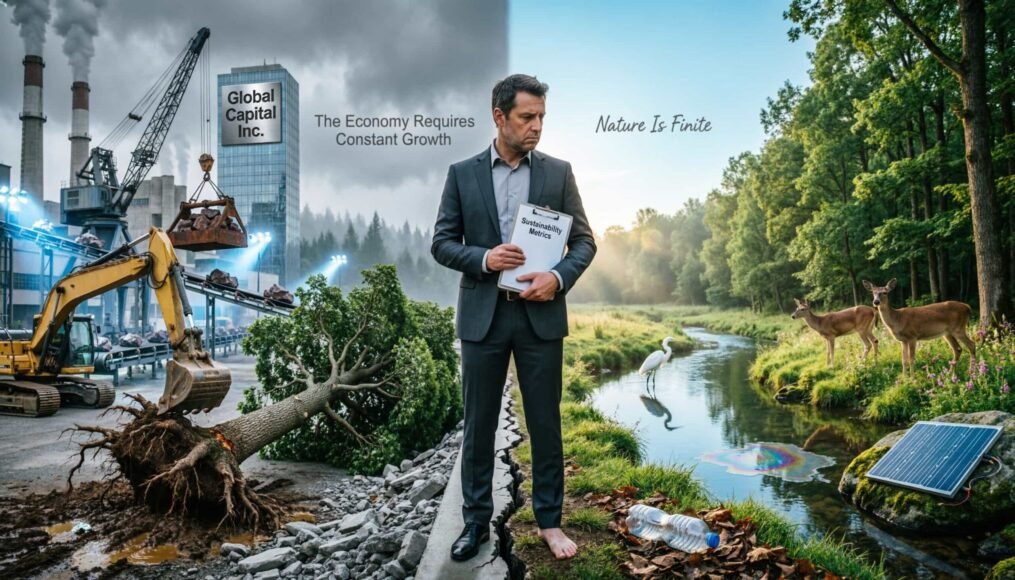
The commodification of nature is the first step in subjecting the environment to the economy. This process assumes the environment is an external realm, brimming with resources for endless exploitation. Two contradictions underpin this assumption: firstly, the environment is not an external realm independent of the economy, and conversely, the economy relies on the environment as they mutually shape and define each other; secondly, the natural environment is finite, and eventually, the resources that the economy eagerly exploits will be depleted. This subjugation has enabled the economy to elevate itself above other realms, neglecting mutual benefit and necessity relationships, and allowed the rampant exploitation of the natural environment through deforestation, pollution, and waste-dumping.

These issues, which stem from a distorted inter-realm relationship where the economy assumes a dominant position and exploits other realms like the natural environment for its continuation, form the environment-economy nexus. They are central to the current global environmental crisis. However, there is hope. Most global decision-makers acknowledge the environmental damage caused, prompting an active response. The principle of constant expansion is to be retained but modified to occur sustainably, minimizing further harm to the natural environment. This heralded the emergence of sustainability, emphasizing reuse, reduction, recycling, and zero-carbon emissions, aiming for a greener economic approach mindful of the natural environment. Yet, is it enough and is it genuine? These questions will be explored in the next article.

Comments

3 responses to “The Environment-Economy Nexus – Realities”

  1. If only the economy could recycle its own contradictions as well as it does our rubbish, we’d all be sipping organic lattes in a utopia by now. But alas, here we are, still debating whether a tree is just a fancy commodity or, you know, something that actually grows in nature. 🍃💸

  2. Pepper Prada Avatar
    Pepper Prada

    Talk about a real page-turner! Who knew that turning trees into profit would be the new bestseller in the economic thriller section? 📈🌳

  3. Just another day in paradise, where we cleverly turn forests into commodities and call it progress. 🍃💸 Can’t wait for the next shiny report on how we can sustainably exploit what’s left of our planet!

  4. New York Mood Avatar
    New York Mood

    Seems like the only thing greener than our economy these days is the guacamole at last week’s tapas night. Who knew exploiting nature could be so chic? 🍃💸

Leave a Reply

Your email address will not be published. Required fields are marked *

Last News

The Environment-Economy Nexus – Realities

The Environment-Economy Nexus – Realities

Whether we view the natural environment as a separate realm or a part of a larger one, it is clear that ongoing economic growth depends on the subjugation of the natural environment to sustain the economic system. This economic system has altered the nature of environmentally related human and economic activity. However, the concern is clear: while economic activity fosters development across va

Read More

SONDAGE. Trautmann favorite pour les municipales à Strasbourg, malgré un premier tour incertain

SONDAGE. Trautmann favorite pour les municipales à Strasbourg, malgré un premier tour incertain

En vacances, que ce soit à la plage ou en montagne, vous vous demandez peut-être ce qui vous attend à la rentrée. Ne vous inquiétez pas, POLITICO vous propose un guide des événements politiques de la fin de l’été.

Read More

Brussels to Host Launch of Freedom of Thought Report 2025

Brussels to Host Launch of Freedom of Thought Report 2025

Humanists International is set to release the newest edition of its worldwide benchmark on the treatment of humanists, atheists, and the non-religious during a hybrid event in the EU district.
On Wednesday, 25 February 2026, Humanists International will hold the launch of its 2025 Freedom of Thought Report at Press Club Brussels Europe. The event will gather EU policymakers, human-rights officia

Read More

UK Must Accelerate Defense Spending: Starmer

UK Must Accelerate Defense Spending: Starmer

In response to the BBC report, Starmer informed journalists: “During the weekend, I was advocating at the Munich Security Conference that the U.K. and Europe must enhance their efforts in defense and security.”
He further stated: “This means we need to accelerate defense spending.”
Two defense insiders, one current and one former official, revealed to POLITICO that the shi

Read More

Morocco 2025: Tackling International Credibility and Corruption Challenges

Morocco 2025: Tackling International Credibility and Corruption Challenges

Transparency International’s Corruption Perceptions Index (CPI) is an essential global governance indicator, scrutinized by investors, credit rating agencies, multilateral lenders, European institutions, and policymakers. The 2025 CPI highlights a global trend where institutional credibility is a form of power.
The index ranks 182 countries on a scale from 0 to 100, where 0 indicates extrem

Read More

Europe Moves Toward a Multi-Speed Future

Europe Moves Toward a Multi-Speed Future

At the Munich Security Conference, the U.S. adopted a gentler approach, though Europe still feels cautious.
In Brussels, during a Eurogroup meeting of finance ministers, the informal E6 grouping, consisting of Germany, France, Italy, Spain, the Netherlands, and Poland, is gaining attention. These leading European economies are collaborating closely, sparking discussions about the EU possibly headi

Read More

PACE Unanimously Rejects New Protocol on Involuntary Mental Health Measures

PACE Unanimously Rejects New Protocol on Involuntary Mental Health Measures

The Parliamentary Assembly of the Council of Europe (PACE) unanimously reaffirmed its opposition to a new protocol on involuntary placement and treatment in mental healthcare, emphasizing it would hinder the elimination of coercive practices in these settings.
Assembly Stands Firm on Human Rights
PACEs was asked by the Council’s executive body, the Committee of Ministers, for its opinion on a dra

Read More

UK Police Request Government to Withhold Key Mandelson-Epstein Email Exchange

UK Police Request Government to Withhold Key Mandelson-Epstein Email Exchange

Starmer accused Mandelson of “repeatedly lying” to No. 10 about his ties with Epstein, while the police and government remain at odds over revealing Downing Street’s knowledge through documentation. The prime minister has faced scrutiny for appointing Mandelson despite his ongoing connection with Epstein post-conviction and has vowed transparency—a promise complicated by the with

Read More

EU Leaders Support ‘Game Changer’ Economic Reform to Compete with US, China, and Russia

EU Leaders Support ‘Game Changer’ Economic Reform to Compete with US, China, and Russia

BRUSSELS—European Union leaders have agreed to a comprehensive restructuring of the bloc’s economy to address a significant triple threat from Washington, Beijing, and Moscow, supporting urgent reforms aimed at creating “European champions” capable of competing in a challenging global landscape.
Meeting Thursday at a 16th-century castle in eastern Belgium, the 27 heads of state endorsed what Euro

Read More

A Strained Partnership: Europe and America Need Each Other, But Trust is Lost

A Strained Partnership: Europe and America Need Each Other, But Trust is Lost

He appealed to supporters with themes familiar to Make America Great Again supporters, focusing on shared (often economic) interests rather than the democratic values and rule of law that have historically united the alliance.
“We are connected by the deepest bonds nations could share, shaped by centuries of shared history, Christian faith, culture, heritage, language, ancestry, and the sacrifices

Read More